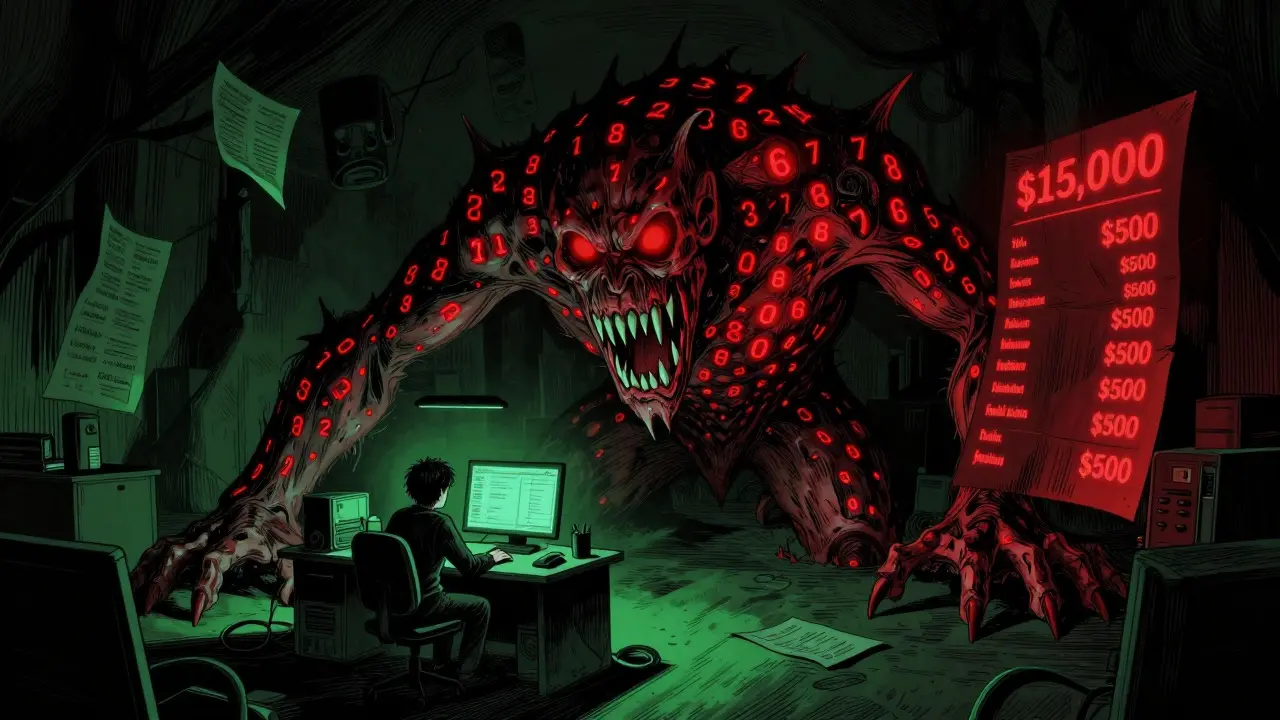
Imagine your engineering team deploys a new customer support bot on a Tuesday morning. By Friday, the finance department is staring at an invoice for $15,000 in API fees, up from the projected $500. This isn't a hypothetical scenario; it's a recurring nightmare for teams adopting Large Language Models is advanced AI systems that process text based on token-based pricing structures. The core problem is simple: unlike traditional software where costs are fixed per user or server, LLM costs scale with usage, specifically with the number of tokens processed. Without strict controls, a single misconfigured agent or a viral feature can drain your budget in hours.
Token budgets is a systematic approach to controlling LLM operational expenses by setting precise limits on input and output token consumption. These mechanisms act as guardrails, automatically throttling, downgrading, or blocking requests when predefined thresholds are reached. As of 2026, this is no longer optional for enterprise-scale deployments. With 83% of enterprises now using some form of token budgeting, the question has shifted from "should we do this?" to "how do we implement it without slowing down development?"
Why Token-Based Billing Breaks Traditional Budgeting
Traditional cloud costs are often predictable. You spin up a server, pay a monthly fee, and done. LLMs work differently. Pricing is granular, charged per million tokens, and varies significantly between input (prompt) and output (completion). For example, Alibaba Cloud’s Qwen-Flash model charges $0.05 per million input tokens but $0.40 per million output tokens for standard usage. That’s an 8x difference. If you don’t track these separately, you’re flying blind.
The complexity deepens because context windows matter. A long conversation history means more input tokens every time the model responds. Marcus Chen, a Senior Analyst at Cloud Geometry, notes that many organizations ignore context window costs, leading to 30-40% higher expenses than necessary. If you keep feeding the model entire chat histories without summarization, your input costs will skyrocket even if the actual responses are short.
Furthermore, different models have different price tags. Using a high-end reasoning model like GPT-4o or Claude Opus for simple tasks like sentiment analysis is like using a sledgehammer to crack a nut. It works, but it’s expensive and inefficient. Smart budgeting requires matching the model’s capability to the task’s complexity.
The Core Mechanics: How Quotas Actually Work
Implementing a quota system isn't just about setting a dollar limit. It involves technical patterns that control flow in real-time. There are four primary patterns used in modern API gateways:
- Prompt Token Limits: Caps the maximum number of input tokens per minute. This protects prefill resources and prevents users from pasting massive documents into a prompt field.
- Output Token Limits: Restricts the length of the model's response. This safeguards decode throughput and prevents infinite loops where the model keeps generating text.
- Total Token Limits: Sets a cap on combined input and output tokens over a defined period (hourly, daily, or weekly). This is your primary financial guardrail.
- Concurrency Caps: Limits the number of simultaneous requests per authentication key. This prevents a single buggy script from saturating your API connection.
Under the hood, these limits are enforced using algorithms like the token bucket or sliding window. A token bucket maintains a balance that refills at a steady rate (e.g., 60,000 tokens per minute). As requests come in, tokens are deducted. If the bucket is empty, the request is throttled or rejected. Sliding windows, on the other hand, track usage over a rolling period without sharp resets, providing a smoother enforcement experience.
| Strategy | Best For | Risk if Misconfigured | Implementation Complexity |
|---|---|---|---|
| Prompt Token Cap | Preventing large document uploads | Blocking legitimate long-context queries | Low |
| Output Token Cap | Standardizing response lengths | Truncating complex answers mid-sentence | Low |
| Daily Total Budget | Financial forecasting and chargebacks | Sudden service outage at midnight | Medium |
| Dynamic Model Routing | Cost optimization under load | Inconsistent answer quality across tiers | High |
Setting Thresholds: The Graduated Response System
A binary switch (on/off) is rarely useful in production. Instead, effective systems use graduated thresholds that trigger different actions as you approach your limit. OneUptime’s implementation offers a clear blueprint for this approach:
- 50% Consumption: Trigger email alerts to the engineering team. This is a heads-up, not a crisis.
- 80% Consumption: Send notifications to Slack or Teams. Begin monitoring closely. Consider pausing non-critical batch jobs.
- 95% Consumption: Initiate request throttling. Slow down incoming traffic to extend the remaining budget.
- 100% Consumption: Block all new requests or downgrade to a cheaper model tier.
Dr. Elena Rodriguez, Director of AI Strategy at Tonic3, recommends setting your hard quota at 90% of the agreed-upon project budget, with a low threshold alert at 75%. This creates an "emergency brake" mechanism that gives humans time to react before the money runs out completely.

Implementation Roadmap: From Prototype to Production
Getting started doesn't require a six-month overhaul. Most teams can implement basic tracking within two to four weeks. Here is a practical progression:
Step 1: Instrument Your API Gateway (Weeks 1-2) Integrate a token counter at the gateway level. Tools like KrakenD Enterprise or custom Nginx/Kong configurations can count tokens in and out of your LLM calls. Ensure you track input and output tokens separately. This data is the foundation of everything else.
Step 2: Establish Baselines (Days 3-5 after Step 1) Run your application in a prototype environment for a week. Measure average tokens per user, per session, and per feature. Don't guess. Use real data. If a typical customer support query uses 500 input tokens and 200 output tokens, that’s your baseline unit cost.
Step 3: Configure Graduated Thresholds (Days 2-3) Based on your baselines, set the 50%, 80%, and 95% triggers. Connect these alerts to your existing communication channels (Slack, Email, PagerDuty).
Step 4: Define Cost Allocation (Week 4) Decide how to attribute costs. Are you charging back to specific business units? Are you allocating costs per feature? Implement tagging in your API requests so that every token consumed is linked to a specific dimension (user ID, feature flag, department code). Traceloop’s case study showed that a fintech company reduced costs by 63% simply by implementing per-user token attribution.
Advanced Tactics: Dynamic Routing and Context Optimization
Once you have basic controls, you can optimize further. The biggest trend in 2026 is dynamic model switching. 68% of new implementations now incorporate logic that automatically routes requests to cheaper models as budgets approach limits. For instance, if you’re at 90% of your monthly budget, route simple classification tasks to a lightweight model like Qwen-Flash, reserving the expensive GPT-4o for complex reasoning only when absolutely necessary.
Another critical area is context management. As mentioned earlier, long contexts eat up input tokens. Implement aggressive summarization of conversation history. If a user has been chatting for 50 turns, summarize the first 40 turns into a concise summary before sending it to the model. This can reduce input token counts by 40-60% without sacrificing answer quality.
Finally, consider the "Build vs. Run" distinction. Tonic3 categorizes costs into Build (one-time setup/integration), Run (recurring token/API fees), and People (expertise). Many teams overspend on "Run" costs because they didn't invest enough in "Build" phase optimizations. Spending two extra weeks optimizing your prompt structure during development can save thousands in monthly token fees.

Common Pitfalls to Avoid
Even with the best tools, teams make mistakes. Here are the most common ones:
- Ignoring Free Tier Quotas: Some providers share free quotas between main accounts and sub-users. If you don’t track this, you might think you’re paying for usage when you’re actually consuming free credits, or vice versa.
- One-Size-Fits-All Limits: Applying the same token limit to a casual user and a power user leads to frustration. Use tiered limits based on subscription plans or user roles.
- Lack of Visibility: If only the engineering team sees the token usage dashboard, finance won’t understand the cost drivers. Share dashboards across departments.
- Static Budgets: Usage grows. Review your budgets quarterly. What was a generous limit in Q1 might be too tight in Q3 as your user base expands.
Remember, the goal isn’t to minimize costs at all costs. It’s to align spend with value. If a feature generates significant revenue, a higher token budget is justified. If it’s an experimental side-project, keep the quota tight.
Frequently Asked Questions
What is the average cost overrun for unmanaged LLM projects?
According to Gartner’s February 2026 report, unmanaged implementations see average cost overruns of 227%. This highlights why token budgeting is becoming a standard feature in enterprise AI deployments.
How do I calculate my token budget accurately?
Use the formula: Fee = (Actual tokens consumed ÷ 1,000,000) × Unit price. Track input and output tokens separately because their unit prices differ. Multiply your expected volume by the specific model's rates for both inputs and outputs.
Should I throttle requests or block them when hitting the limit?
Throttling is generally better for user experience. It slows down the service rather than stopping it entirely. Blocking should be reserved for critical failures or when the budget is completely exhausted. Use a graduated approach: warn at 50%, throttle at 95%, block at 100%.
Does dynamic model routing affect answer quality?
It can, if not implemented carefully. Route simple tasks (classification, extraction) to cheaper models. Reserve expensive models for complex reasoning, creative writing, or multi-step logic. Monitor quality metrics post-routing to ensure consistency.
How long does it take to implement a token budgeting system?
Basic implementation typically takes 2-4 weeks. This includes integrating token counters at the API gateway, setting baseline budgets, configuring thresholds, and establishing cost allocation processes. Complex multi-provider environments may take longer.