
Imagine your support team handling thousands of emails a day without losing their minds. No more copy-pasting generic replies. No more drowning in repetitive questions about billing or shipping. This isn't a fantasy for the distant future. It’s happening right now through Email and CRM automation powered by Large Language Models (LLMs). Companies are using these tools to turn chaotic inboxes into organized, actionable data streams while keeping every interaction feeling personal.
The shift started gaining serious momentum between 2023 and 2024. Organizations realized that traditional rule-based bots couldn’t handle nuance. They needed something that could understand context, sentiment, and intent. Enter LLMs. These aren’t just chatbots; they are engines that process unstructured text and convert it into structured insights. The result? A massive drop in manual work and a huge jump in customer satisfaction. If you’re still relying on static templates, you’re leaving money on the table and frustrating your best customers.
How LLM-Powered Email Automation Works
To get personalization at scale, you need more than a simple keyword matcher. You need a system that thinks. Modern implementations use multi-layered architectures. Let’s look at how a sophisticated pipeline, like the one developed by Xebia in mid-2024, processes an incoming email.
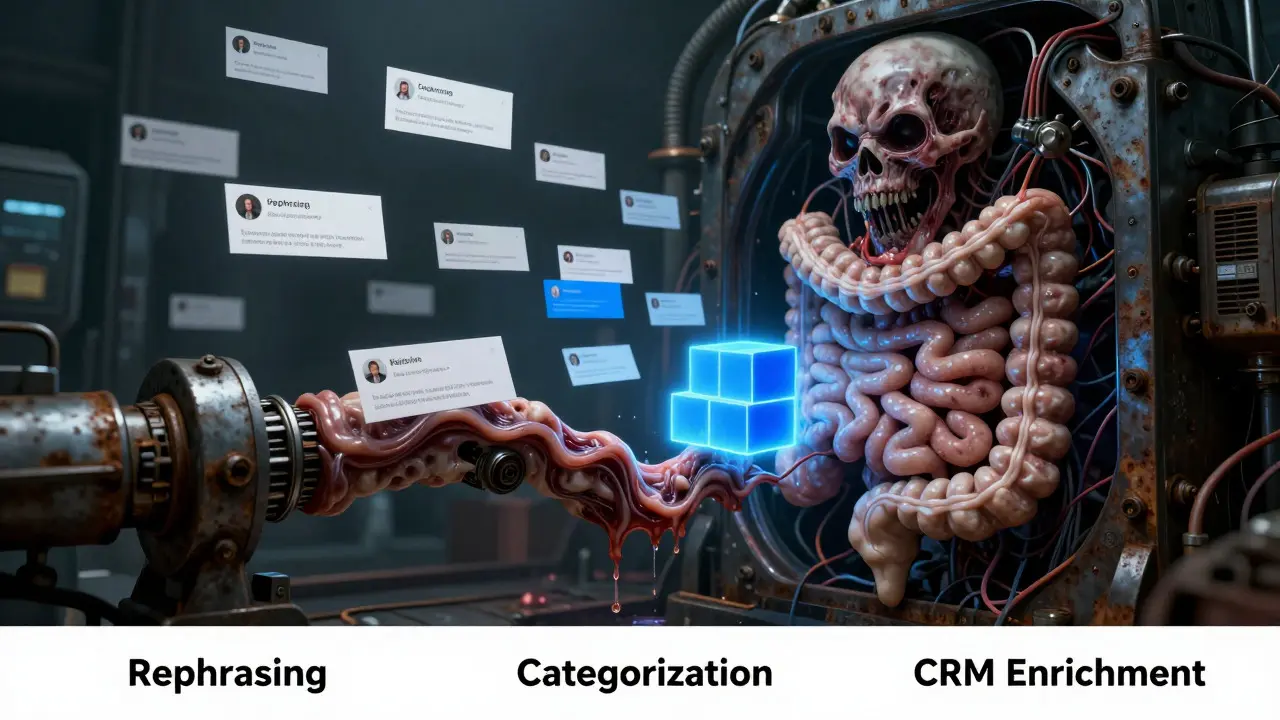
- Rephrasing: The LLM first cleans up the raw query. Customers often write in fragmented sentences or use slang. The model rephrases this into clear, standard language.
- Categorization: It identifies the intent (e.g., "refund request") and urgency (e.g., "high priority"). This uses semantic understanding, not just keywords.
- Routing: The system maps the issue to the correct business unit, whether that’s sales, technical support, or billing.
- Action Inference: Based on sentiment analysis, it suggests the next best action. Is the customer angry? Do they need empathy before a solution?
- CRM Enrichment: Here is where the magic happens. The system pulls data from your CRM-like past purchases or previous tickets-to add context.
- Response Generation: The LLM drafts a personalized reply that matches your brand voice and addresses the specific issue.
- Confidence Scoring: The system assigns a confidence score. If it’s low, a human agent reviews it. If it’s high, it sends automatically.
This approach transforms unstructured communication into structured data. According to Salesforce’s definition from May 2024, LLMs act as the engine powering generative AI, capable of understanding natural language queries. When integrated correctly, this reduces ticket volume by up to 80% and cuts processing costs by 64%. That’s not a marginal improvement; it’s a fundamental change in how you operate.
Choosing the Right Tool: Yellow.ai vs. AWS vs. Custom Solutions
Not all automation solutions are created equal. Your choice depends on your technical resources, industry needs, and budget. Let’s break down the major players in the market as of mid-2025.
| Feature | Yellow.ai | AWS Generative AI Framework | Custom Research-Based (e.g., IJIRST Model) |
|---|---|---|---|
| Primary Focus | Customer Service & Support | Financial Workflows & Document Processing | Recruitment & Specific Verticals |
| Hallucination Rate | <1% (Proprietary YellowG LLM) | Variable (Depends on Prompt Engineering) | Low in Controlled Environments |
| Integration Complexity | Moderate (Pre-built CRM connectors) | High (Requires Python & Cloud Expertise) | Very High (Custom Development) |
| Key Metric | 80% Ticket Volume Reduction | 64% Cost Reduction per Form | 98.7% Retrieval Accuracy |
| Best For | Enterprises seeking quick ROI | Technical teams building custom workflows | Niche applications requiring deep customization |
Yellow.ai stands out for its ease of use and reliability. Launched in October 2024, its proprietary YellowG LLM boasts a hallucination rate of less than one percent. Gartner identified it as a "Representative Vendor" in their May 2025 Market Guide. Users report an 80% reduction in ticket volume and a 20% improvement in first-contact resolution. It’s ideal if you want a plug-and-play solution that integrates smoothly with Salesforce or Zendesk.
AWS, on the other hand, offers a framework rather than a boxed product. Their March 2025 blog post details using Amazon Textract and LangChain for intelligent document processing. This is powerful for financial services where extracting data from invoices is critical. However, it requires significant technical expertise. If your team doesn’t have strong Python skills, this path will be painful.
Custom research-based systems, like those detailed in IJIRST research from July 2025, offer extreme precision for specific tasks. Using LLaMA 3.1 and ChromaDB, they achieved 98.7% retrieval accuracy. But they lack broad CRM integration out of the box. You build what you need, but you also maintain everything.
Implementation Challenges and Real-World Pitfalls
Don’t let the success stories fool you. Implementing LLM automation is hard. Many projects fail because companies underestimate the preparation required. Here are the biggest hurdles based on user feedback from G2, Capterra, and Reddit discussions in mid-2025.
- Dirty Data Kills Performance: Quiq’s implementation guide cites clean CRM data as the single biggest predictor of success. If your customer records are incomplete or outdated, the LLM will generate irrelevant responses. Spend time cleaning your database before you start coding.
- Legacy System Integration: 42% of negative reviews mention struggles with integrating new AI tools into old CRM systems. APIs might be deprecated, or data structures might be incompatible. Plan for middleware development.
- The Hallucination Risk: Even with low rates, LLMs can make things up. Forrester warns about this in complex scenarios. Always implement a "human-in-the-loop" validation step. Set confidence thresholds-for example, require human review for any response below 85% confidence.
- Brand Voice Consistency: Maintaining your unique tone across thousands of automated emails is tricky. You’ll need 20-40 hours of prompt engineering and fine-tuning to ensure the AI sounds like your team, not a robot.
User statistics from TrustRadius show an average adoption rate of 63%, but successful deployments take 8-12 weeks. Don’t expect overnight results. Start small. Pilot the system with narrow use cases like billing inquiries or appointment scheduling. Measure the results, tweak the prompts, and then expand.
The Role of RAG and Fine-Tuning
Two technical concepts are crucial for getting high-quality results: Retrieval Augmented Generation (RAG) and Fine-Tuning. Understanding the difference helps you choose the right strategy.
RAG connects the LLM to your live data sources. Instead of relying solely on the model’s training data (which might be outdated), RAG pulls real-time information from your CRM, knowledge base, or product catalog. Quiq emphasizes this in their April 2025 updates. Gartner reports that organizations using RAG see 37% higher customer satisfaction scores compared to basic template automation. It ensures the AI answers with current, accurate facts.
Fine-Tuning involves training the model on your specific historical data. By exposing the LLM to thousands of past agent-customer interactions, you teach it your company’s style, jargon, and preferred solutions. This improves response quality significantly. However, fine-tuning is resource-intensive and requires ongoing maintenance as your business evolves.
Most successful enterprise setups use both. RAG provides the factual backbone, while fine-tuning ensures the personality and tone match your brand.

Future Trends: Beyond Simple Responses
We are moving past the era of simple auto-replies. The future of email and CRM automation is predictive and proactive. Here’s what’s coming in late 2025 and beyond.
Predictive Engagement: American Express piloted a system that anticipates customer needs before they contact support. By analyzing email patterns, the AI predicts issues and reaches out first. Early pilots showed a 63% success rate in resolving issues proactively. Imagine fixing a billing error before the customer even notices.
Emotion-Aware Responses: Salesforce is testing emotion-aware models that analyze voice and text sentiment with 78% accuracy. The AI won’t just answer the question; it will adjust its tone based on whether the customer is frustrated, happy, or confused.
Relationship Intelligence: McKinsey predicts that LLMs will transform CRMs from record-keeping tools into proactive advisors. Tools like Attio are already showing a 29% increase in customer retention by suggesting relationship-building opportunities based on email history. The AI becomes a strategic partner for your sales and support teams.
Gartner predicts that 80% of customer service organizations will implement some form of LLM-powered email automation by 2027. The window to adopt this technology is closing. Those who wait risk falling behind competitors who are already delivering hyper-personalized experiences at scale.
Getting Started: A Practical Checklist
If you’re ready to move forward, here is a concise checklist to ensure a smooth implementation.
- Audit Your Data: Clean up your CRM. Ensure customer profiles are complete and accurate.
- Define Use Cases: Start with high-volume, low-complexity tasks like password resets or order status checks.
- Choose Your Stack: Decide between a managed service like Yellow.ai for speed or a custom AWS/LangChain build for flexibility.
- Set Up Human Oversight: Configure confidence scoring. Define clear rules for when a human must intervene.
- Train the Model: Feed it historical successful interactions. Refine prompts until the tone matches your brand.
- Monitor and Iterate: Track metrics like first-contact resolution and customer satisfaction. Adjust continuously.
The technology is mature enough to deliver real value today. The key is balancing automation with the human touch. Use LLMs to handle the noise, so your team can focus on the relationships that truly matter.
What is the cost of implementing LLM email automation?
For mid-sized organizations, implementation costs typically range from $150,000 to $500,000. This includes software licensing, integration work, and initial training. However, the ROI is often realized within 3-6 months due to reduced operational costs and improved efficiency.
Is LLM email automation secure for sensitive data?
Security depends on the provider and implementation. Enterprise solutions like Yellow.ai and AWS offer robust security features, including data encryption and compliance with GDPR and HIPAA. However, you must configure access controls carefully and avoid sending highly sensitive PII directly to public LLM endpoints without proper safeguards.
How do I prevent the AI from hallucinating incorrect information?
Use Retrieval Augmented Generation (RAG) to ground responses in your verified knowledge base. Additionally, implement confidence scoring and set a threshold (e.g., 85%) below which responses require human review. Regularly audit AI outputs and retrain the model with corrected examples.
Can LLMs handle multilingual customer support?
Yes, most modern LLMs support multiple languages out of the box. However, performance varies by language pair. You may need additional fine-tuning for niche languages or dialects to ensure cultural nuance and accuracy are maintained.
What are the best industries for LLM email automation?
Financial services, healthcare, and retail are currently the largest adopters. Financial services benefit from document processing capabilities, healthcare from patient inquiry management, and retail from high-volume customer service automation.



Mark Harvey
July 30, 2026 AT 20:41finally someone talking about the human side of this stuff. we always forget that tech is just a tool to help people do their jobs better not replace them entirely. i think the part about confidence scoring is huge because it keeps the safety net in place. my team has been struggling with generic replies and seeing customers get frustrated so this approach makes total sense. if you can keep the brand voice consistent while scaling up that is a game changer for sure. dont be afraid to start small and iterate as you go along.
Art HND
July 31, 2026 AT 01:57another day another AI hype cycle. most companies cant even clean their basic excel sheets let alone integrate complex LLM pipelines. the data quality issue mentioned is real but nobody talks about how expensive it actually is to maintain that level of hygiene. save your money and hire more support staff instead.
Brandon Olvera
August 1, 2026 AT 05:46we need to stop relying on foreign cloud providers for our critical business infrastructure. aws and these other big tech giants are spying on us all. build local solutions keep the data here where we can control it. national security starts with data sovereignty. stop outsourcing our customer relationships to servers who knows where.
Elizabeth Brooks
August 2, 2026 AT 09:04i totally agree with mark about starting small. we tried to boil the ocean last year and failed miserably. focusing on high volume low complexity tasks like password resets was a lifesaver. also did u know that rag setups can drastically reduce hallucinations if done right? its not magic its just good engineering. hope this helps anyone thinking about jumping in. dont forget to check your api limits tho they bite hard sometimes.
Deb Kortyna, MBA
August 3, 2026 AT 10:01The assertion that traditional rule-based bots are obsolete is an oversimplification that ignores the nuanced reality of enterprise IT landscapes. While Large Language Models offer promising capabilities, the integration challenges cited-particularly regarding legacy system compatibility-are often underestimated by vendors eager to sell subscriptions. Furthermore, the reliance on proprietary frameworks such as Yellow.ai introduces vendor lock-in risks that savvy CTOs should scrutinize heavily before committing significant capital expenditures. One must question whether the touted 80% reduction in ticket volume accounts for the increased overhead of managing false positives and required human oversight protocols.