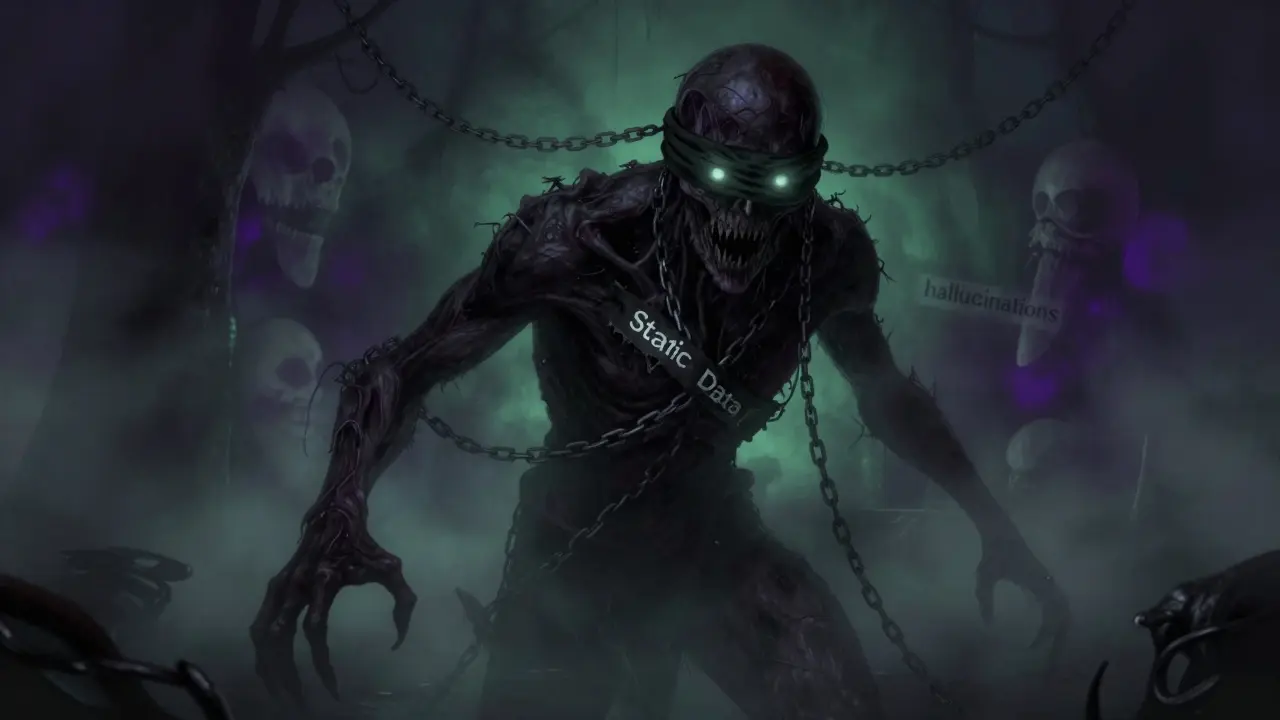
Large Language Models are incredibly smart, but they have a major blind spot: they don't know what happened yesterday. If you ask an LLM about last week's stock market crash or your company's internal policy updated this morning, it will either guess-or worse, confidently make up an answer. This is where Retrieval-Augmented Generation steps in. It’s not just a buzzword; it’s the architectural bridge that connects static AI models with dynamic, real-world data.
RAG allows you to build AI applications that are accurate, up-to-date, and trustworthy without the astronomical cost of retraining massive models. In this guide, we’ll walk through exactly how RAG works, why it beats fine-tuning for most use cases, and how to build an end-to-end system from scratch.
What Is Retrieval-Augmented Generation?
At its core, Retrieval-Augmented Generation is an architectural pattern that enhances Large Language Models by retrieving relevant external information before generating a response. Think of it like taking an open-book exam. The student (the LLM) has general knowledge, but for specific questions, they look up the exact page in their textbook (your data) before answering.
Without RAG, an LLM relies solely on its pre-training data. If that data is outdated or lacks niche details, the model hallucinates-creating plausible-sounding but false information. With RAG, the system intercepts your query, searches a designated knowledge base, finds the relevant documents, and feeds those snippets back into the LLM as context. The LLM then generates an answer based on both its internal logic and the retrieved facts.
This approach solves two critical problems:
- Hallucination Reduction: By grounding responses in actual source documents, you drastically reduce made-up answers.
- Data Freshness: You can update your knowledge base instantly without touching the model itself.
The Core Components of a RAG Pipeline
A functional RAG system isn’t magic; it’s a pipeline with four distinct stages. Understanding these components is crucial because bottlenecks usually happen here, not in the generation step.
- Document Ingestion & Chunking: Your raw data (PDFs, websites, databases) needs to be broken down into smaller, manageable pieces called "chunks." If chunks are too large, the LLM gets confused by irrelevant noise. If they’re too small, you lose context. A common starting point is 500-1000 tokens per chunk, often with some overlap to preserve continuity.
- Embedding Creation: Text doesn’t mean much to computers until it’s converted into numbers. An Embedding Model transforms each text chunk into a high-dimensional vector-a list of numbers that represents the semantic meaning of the text. Similar concepts result in similar vectors.
- Vector Storage: These vectors are stored in a Vector Database designed for fast similarity search. Unlike traditional SQL databases that match exact keywords, vector databases find items that are "semantically close" to your query.
- Retrieval & Augmentation: When a user asks a question, the system converts that question into a vector, searches the database for the most similar chunks, and appends them to the prompt sent to the LLM.
RAG vs. Fine-Tuning: Which Should You Choose?
Many developers assume that if they want better performance, they need to fine-tune their model. But for most enterprise use cases, RAG is the superior choice. Here’s why.
| Feature | Retrieval-Augmented Generation (RAG) | Fine-Tuning |
|---|---|---|
| Data Updates | Instant (update the database) | Slow (requires retraining) |
| Cost | Low (API calls + storage) | High ($50k-$500k+ per iteration) |
| Hallucination Control | High (grounded in sources) | Medium (model still guesses) |
| Best For | Factual queries, knowledge bases | Style transfer, specialized tasks |
| Latency | Higher (+200-400ms overhead) | Lower (direct inference) |
Fine-tuning changes the model’s weights to learn new patterns. It’s great for teaching a model to speak in a specific tone or format. However, it doesn’t reliably memorize facts. If you fine-tune a model on your Q3 financial report, it might still struggle to recall specific numbers accurately months later. RAG, on the other hand, always looks up the current document. As Dr. Andrew Ng noted, RAG is the "most practical path for enterprises to deploy trustworthy LLM applications without exposing proprietary data."
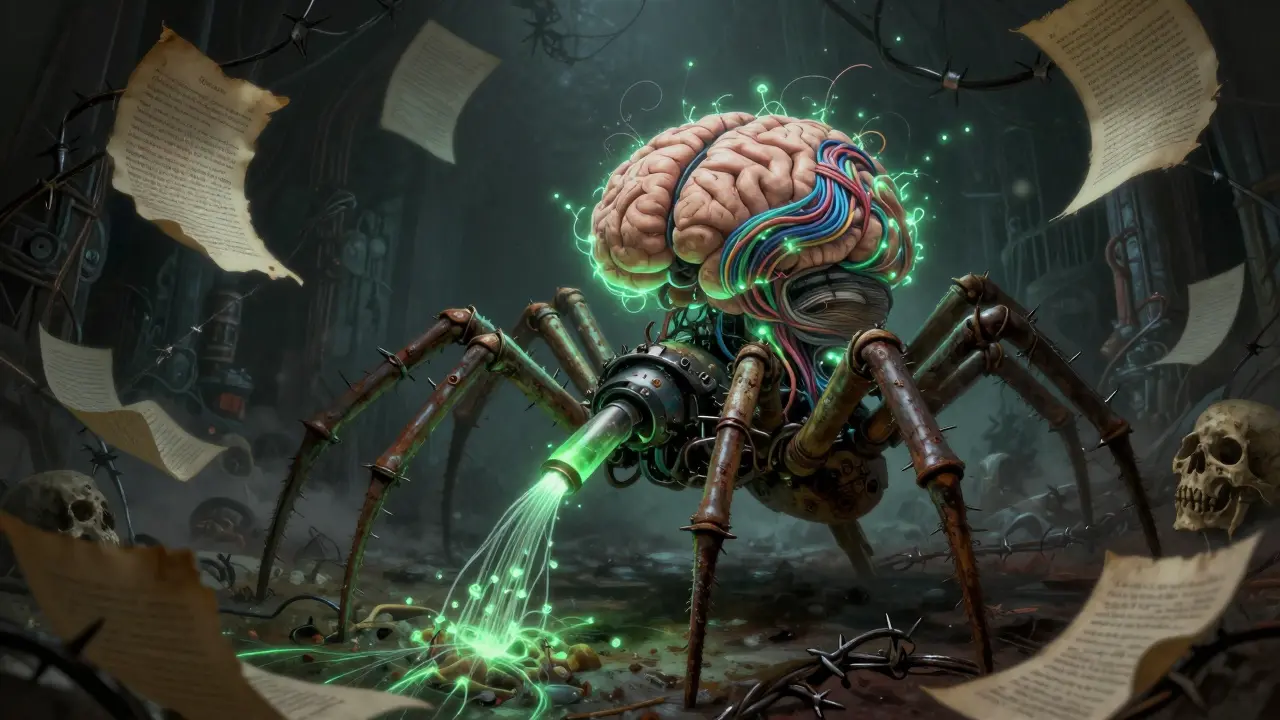
Building Your First RAG System: Step-by-Step
Ready to build? Here’s a simplified roadmap for creating an end-to-end RAG application using modern tools like LangChain, Pinecone, and OpenAI.
1. Prepare Your Data
Start with clean data. If your PDFs have messy headers or footers, strip them out. Use a library like PyPDF2 or LlamaParse to extract text. Then, chunk your text. Don’t just split by character count; try "semantic chunking," which breaks text at natural boundaries like paragraphs or sections. This preserves context and improves retrieval accuracy.
2. Generate Embeddings
Choose an embedding model. text-embedding-ada-002 from OpenAI is a solid default used in 73% of commercial deployments. Pass your chunks through this model to get vector representations. Store these vectors along with the original text snippet.
3. Set Up a Vector Database
You need a place to store and search these vectors. Popular choices include:
- Pinecone: Fully managed, easy to set up, great for beginners.
- Weaviate: Open-source, flexible, good for self-hosting.
- Milvus: High-performance, scalable for large datasets.
Index your vectors in the database. Ensure you configure the index for cosine similarity or dot product, depending on your embedding model’s output.
4. Implement Retrieval Logic
When a user submits a query:
- Convert the query to an embedding using the same model as your documents.
- Search the vector database for the top-k most similar vectors (usually k=3 to k=5).
- Retrieve the corresponding text chunks.
5. Augment the Prompt
Construct a prompt that includes:
- System Instruction: "You are a helpful assistant. Answer only using the provided context."
- Context: The retrieved text chunks.
- User Query: The original question.
Send this combined prompt to your LLM (e.g., GPT-4o or Llama 3). The model will generate a response grounded in the retrieved facts.
Common Pitfalls and How to Avoid Them
Even with a solid plan, RAG implementations can fail. Here are the most common issues developers face and how to fix them.
Chunking Too Small or Too Large
If chunks are too small, the LLM misses context. If they’re too large, the retrieval becomes noisy. Test different chunk sizes (256, 512, 1024 tokens) and evaluate retrieval precision. Use overlap (e.g., 10-20%) to ensure sentences aren’t cut off awkwardly.
Poor Retrieval Quality
If the wrong documents are retrieved, the LLM will give bad answers. Improve retrieval by:
- Hybrid Search: Combine semantic search (vectors) with keyword search (BM25). This catches exact matches that embeddings might miss.
- Query Expansion: Rewrite the user’s query to be more descriptive before searching. NVIDIA’s RAG Refinery framework shows a 28% improvement in accuracy using this technique.
Ignoring Latency
RAG adds steps, which means slower responses. Optimize by caching frequent queries, using faster embedding models, or parallelizing retrieval tasks. If sub-200ms latency is critical, consider whether RAG is the right fit or if a simpler lookup table suffices.
Evaluating Your RAG System
You can’t improve what you don’t measure. Use metrics like:
- Recall@K: Did the correct document appear in the top K results?
- Answer Relevance: Does the final answer directly address the user’s question?
- Factuality: Can you trace every claim in the answer back to a source document?
Tools like RAGAS or TruLens automate this evaluation. Run tests on a held-out dataset of questions and answers to benchmark your system before deploying to production.
Future Trends in RAG
RAG is evolving rapidly. Look out for:
- Self-Correcting RAG: Systems that verify their own answers against multiple sources and flag uncertainties.
- Adaptive RAG: Dynamically adjusting retrieval parameters based on query complexity.
- Multi-Hop Reasoning: Chaining multiple retrievals to answer complex questions that require synthesizing information from several documents.
As Gartner predicts, "self-correcting RAG" systems will become mainstream by 2026. Staying ahead means building modular architectures that can easily integrate these advanced features.
Is RAG better than fine-tuning?
For most factual and knowledge-intensive applications, yes. RAG provides up-to-date information, reduces hallucinations, and is significantly cheaper than fine-tuning. Fine-tuning is better suited for changing the model's style, tone, or behavior rather than injecting new facts.
How do I choose the right chunk size?
Start with 500-1000 tokens and experiment. Smaller chunks offer precise retrieval but may lack context; larger chunks provide more context but increase noise. Use semantic chunking to break text at logical boundaries like paragraphs.
What is a vector database?
A vector database stores data as high-dimensional vectors (embeddings) and enables fast similarity searches. Unlike traditional databases that match exact keywords, vector databases find semantically similar content, making them essential for RAG systems.
Can RAG eliminate hallucinations completely?
No, but it significantly reduces them. RAG grounds responses in retrieved facts, but the LLM can still misinterpret the context or generate errors. Combining RAG with strict system prompts and verification steps further minimizes risks.
Which embedding model should I use?
OpenAI's text-embedding-ada-002 is a popular, reliable choice for English-language applications. For multilingual support, consider models like BGE-M3 or E5-large-v2. Always test multiple models to see which performs best with your specific data.

Michael Richards
June 19, 2026 AT 12:49Laura Davis
June 19, 2026 AT 21:07Lisa Nally
June 21, 2026 AT 18:58Edward Gilbreath
June 23, 2026 AT 17:50kimberly de Bruin
June 23, 2026 AT 22:50Edward Nigma
June 25, 2026 AT 11:07Francis Laquerre
June 25, 2026 AT 21:11michael rome
June 26, 2026 AT 12:18Andrea Alonzo
June 28, 2026 AT 02:25Saranya M.L.
June 28, 2026 AT 13:18