You type a prompt. The AI writes the code. You launch the app. It works. But who actually owns it? That is the question keeping developers, founders, and lawyers up at night in 2026. "Vibe coding"-a term popularized by Andrej Karpathy in early 2025-has shifted from a niche experiment to a mainstream development methodology. It allows non-technical creators and seasoned engineers alike to build applications by describing functionality in natural language rather than writing syntax manually.
While the technology democratizes software creation, it creates a legal gray zone that did not exist five years ago. If you are building a startup, a side project, or an enterprise tool using vibe coding, you cannot ignore the underlying legal architecture. Ignorance is not a defense when a competitor claims your code infringes on their intellectual property or when an open-source license violation forces you to shut down your business. This guide breaks down the critical legal basics of copyright, licensing, and IP ownership for vibe-coded apps, helping you navigate these risks with confidence.
Who Owns AI-Generated Code?
The most pressing question in vibe coding is authorship. Traditional copyright law requires a human author. In the United States, the Copyright Office has consistently ruled that purely AI-generated content lacks the necessary human authorship to be copyrighted. However, vibe coding is rarely "purely" AI. You provide prompts, select outputs, refactor code, and integrate modules. This human input changes the legal landscape significantly.
Current legal consensus suggests that while you may not own the copyright to the raw lines of code generated by the AI, you likely own the copyright to the specific arrangement, structure, and compilation of that code into a functional application. Think of it like photography. You don't own the camera, and you might not own the scene you're photographing, but you own the specific photo you took because of your creative choices in framing, lighting, and timing. Similarly, your "vibe"-your unique sequence of prompts, edits, and architectural decisions-creates a protectable derivative work.
Can I copyright my vibe-coded app?
You can copyright the original elements you contributed, such as the overall structure, unique user interface designs, and any manual code you wrote. Purely AI-generated snippets may not be copyrightable, but the final compiled application usually qualifies for protection if there is sufficient human creative control.
Understanding Platform Terms of Service
Before worrying about federal copyright law, look at the contract you signed with the AI provider. Most major platforms, including OpenAI, Anthropic, and GitHub, have updated their terms of service (ToS) to address IP ownership. As of 2026, most commercial AI coding assistants grant users full ownership rights to the output they generate. For example, OpenAI’s ToS states that users own the content they generate, subject to applicable laws. This means you can use, sell, and distribute the code without owing royalties to the AI company.
However, this ownership comes with conditions. Some free tiers or specific enterprise agreements may restrict commercial use or require attribution. Always read the fine print. If you are using a tool like Cursor, Windsurf, or Replit, check their latest ToS updates. A change in policy could retroactively affect how you monetize your app. Document which tools you used and under what terms. This paper trail is crucial if you ever face a dispute.
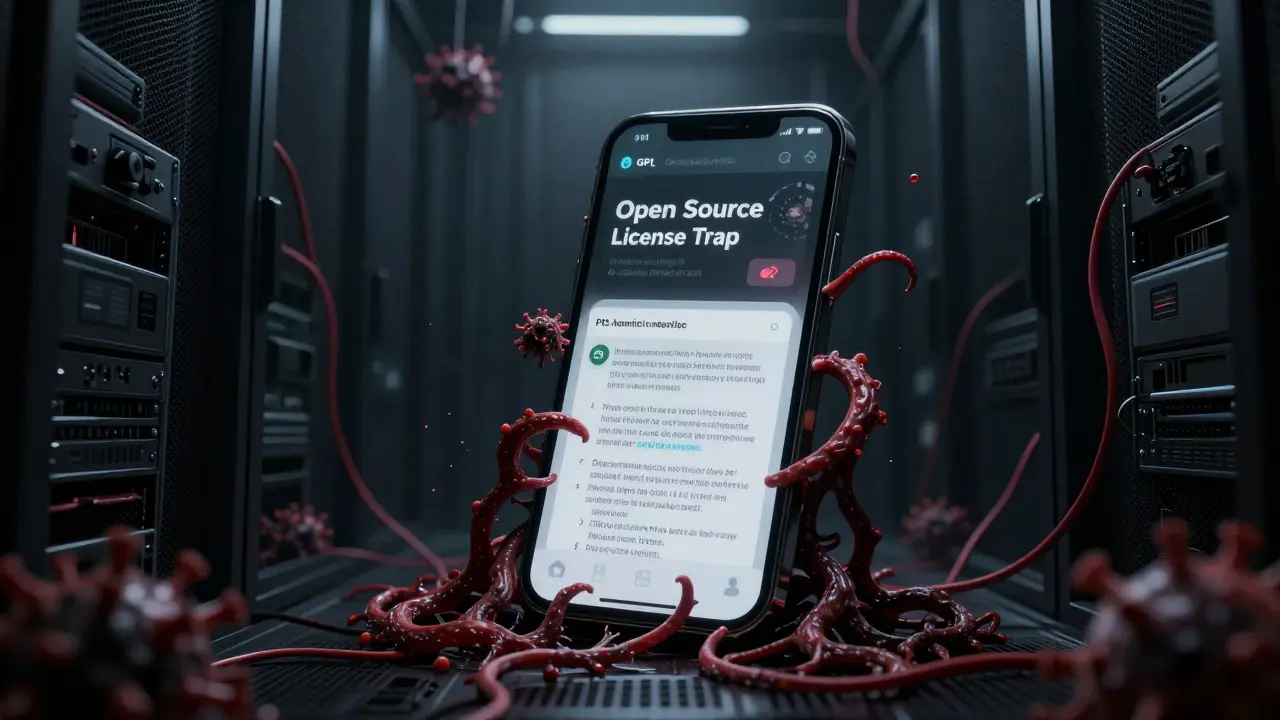
The Open Source License Trap
This is where most vibe-coders get burned. Large Language Models (LLMs) are trained on vast datasets that include millions of lines of open-source code. When you ask an AI to "write a Python function to scrape websites," it might reproduce code from a library licensed under the GNU General Public License (GPL). The GPL is "viral." If you incorporate GPL-licensed code into your proprietary app, you must release your entire source code under the same license. This can destroy your business model overnight.
AI models do not inherently know or respect license boundaries. They predict text based on probability, not legal compliance. Just because the AI didn't flag a license issue doesn't mean one isn't present. You need to implement rigorous code scanning practices. Tools like FOSSA or Black Duck can scan your repository for known open-source components and their associated licenses. Treat every block of AI-generated code as potentially tainted until proven otherwise.
| License Type | Key Restrictions | Risk Level for Proprietary Apps |
|---|---|---|
| MIT / Apache 2.0 | Require attribution; allow commercial use | Low |
| GPL v3 | Require releasing all derived source code | High |
| BSD | Minimal restrictions; no warranty | Low |
| AGPL | Requires source disclosure even for network services | Critical |
Intellectual Property and Training Data Risks
Beyond open-source licenses, there is the risk of reproducing proprietary code. Several lawsuits filed in 2024 and 2025 alleged that AI companies trained their models on copyrighted code without permission. While these cases are still unfolding, they highlight a significant liability gap. If your vibe-coded app contains substantial similarities to a competitor's proprietary algorithm, you could face infringement claims. Courts may look at whether the AI reproduced "substantial similarity" in expression, not just ideas.
To mitigate this, avoid asking the AI to replicate specific existing products or libraries. Instead, focus on high-level functionality descriptions. Use abstract prompts like "create a data visualization dashboard" rather than "clone the analytics UI of Product X." Additionally, consider using AI models trained exclusively on public domain or permissively licensed data. Some providers now offer "clean room" training sets designed to minimize IP risks.
Practical Steps for Legal Compliance
Navigating the legal landscape of vibe coding requires proactive measures. Here is a checklist to protect your intellectual property:
- Document Your Process: Keep records of your prompts, iterations, and manual edits. This demonstrates human authorship and creative control.
- Scan for Licenses: Integrate automated license scanning tools into your CI/CD pipeline to detect open-source dependencies.
- Review ToS Regularly: Subscribe to updates from your AI provider to stay informed about changes in ownership rights.
- Avoid Direct Replication: Do not use AI to copy-paste protected works. Focus on original functionality.
- Consult a Lawyer: For commercial projects, invest in a legal review of your codebase and IP strategy.
Future Outlook and Regulatory Changes
The legal framework for AI-generated content is evolving rapidly. In 2026, several jurisdictions are considering new legislation to clarify AI authorship and liability. The European Union’s AI Act, for instance, imposes transparency requirements on AI-generated content. While primarily focused on consumer protection, these regulations may influence how IP is handled globally. Stay tuned to regulatory developments in your target markets. What is legal today might require disclosure tomorrow.
Vibe coding offers unprecedented speed and accessibility, but it does not absolve you of legal responsibility. By understanding copyright nuances, respecting open-source licenses, and documenting your creative process, you can build robust, defensible applications. The goal is not to fear the technology, but to harness it wisely within the bounds of the law.
What happens if my AI code violates a license?
You may be required to release your source code, pay damages, or cease distribution. Immediate remediation involves removing the offending code and replacing it with compliant alternatives.
Do I need to disclose that I used AI?
Currently, there is no universal requirement to disclose AI usage in software. However, some platforms and clients may request transparency. Check specific contractual obligations.
Can I sue someone for stealing my vibe-coded app?
Yes, if you can prove substantial similarity in the expressive elements you created. Trade secret protection may also apply if you kept your code confidential.
Is vibe coding safe for enterprise use?
It can be, provided you implement strict governance, use enterprise-grade AI tools with clear IP guarantees, and conduct regular security and compliance audits.
How do I ensure my prompts are legally safe?
Avoid referencing copyrighted works directly. Use generic, functional descriptions. Do not input confidential or proprietary data into public AI models.
Kevin Hagerty
May 29, 2026 AT 18:16lol another article telling us to read the fine print like we actually do that
Eric Etienne
May 31, 2026 AT 15:11You guys are missing the point entirely. The whole vibe coding thing is just a glorified copy-paste job with extra steps. You think you're being creative when you're just curating garbage output from a black box that doesn't even know what it's doing. It's lazy engineering disguised as innovation. I've seen too many startups fail because they thought 'vibe' was a strategy instead of a skill.
The legal stuff here is secondary to the fact that most of these devs can't debug their own code if the AI hallucinates a variable name. It's pathetic. We used to write syntax for a reason, to understand the logic. Now everyone wants to be a director without learning how to hold a camera.
And don't get me started on the IP ownership debate. If you didn't write it, you don't own it. Period. The courts will eventually figure out that prompting isn't authorship. Until then, enjoy your fragile sense of security while the lawyers pick apart your 'original' compilation.
Dylan Rodriquez
May 31, 2026 AT 23:30I find this perspective quite reductive, Eric. While the risks are real, dismissing the entire methodology ignores the democratization aspect. Not everyone has ten years of CS degrees, but many have brilliant ideas that deserve execution. The legal framework is indeed murky, but that's true for any new technology paradigm. Think about photography in the 19th century; people argued it wasn't art because the machine did the work. Now look at it.
We should focus on education rather than judgment. Understanding the GPL trap is crucial, yes, but so is understanding that human intent and curation matter. The prompt engineer is the architect, even if the AI lays the bricks. It's a collaborative process, not a replacement. We need to foster an environment where creators feel safe to experiment while staying informed. Ignoring the legalities is dangerous, but fearing them paralyzes progress. Let's bridge that gap with knowledge, not cynicism.
Amanda Ablan
June 1, 2026 AT 05:59I appreciate the nuance here Dylan. It is easy to be cynical but the reality is that tools evolve. The key is really about documentation as mentioned in the post. Keeping a trail of your prompts and edits is such a simple step that makes a huge difference in proving human authorship.
I also agree that the GPL issue is the biggest immediate threat. So many people just paste code without checking licenses. It’s not about judging the method but about being responsible with it. If you treat the AI as a junior dev who needs supervision, you avoid most of these pitfalls. It’s a mindset shift rather than a technical one.
Meredith Howard
June 2, 2026 AT 08:05i think we are all getting a bit ahead of ourselves with the moral judgments here. the law is what it is right now and until there is a supreme court ruling or new legislation we have to operate within the current gray area. it is not black and white.
the comparison to photography is actually quite strong legally speaking. the selection and arrangement doctrine has been around for decades. if you spend hours refining the output changing the structure and integrating modules that is human creativity. ignoring that seems disingenuous. we should perhaps focus more on the practical compliance aspects like license scanning which is something every team regardless of method should be doing anyway
Yashwanth Gouravajjula
June 2, 2026 AT 23:42In India, we see rapid adoption of AI tools in startups. The speed is undeniable. However, the IP laws here are still catching up. Many founders assume ownership by default. This is risky. We must verify terms of service carefully. Open source violations are common due to lack of awareness. Education is key for sustainable growth in tech sector.
Janiss McCamish
June 4, 2026 AT 06:49The table in the post is super helpful. AGPL is a nightmare for SaaS businesses. I always tell my team to scan everything. Don't trust the AI to know what is public domain. It often confuses permissive licenses with proprietary ones. Just run a scanner. It takes five minutes and saves millions in potential lawsuits. Simple as that.
Richard H
June 5, 2026 AT 06:07This is exactly why American innovation is being stifled by over-regulation and fear. In the US, we value individual creation and ownership. If I pay for the tool and I direct the outcome, it is mine. That is the spirit of entrepreneurship. We shouldn't let European bureaucracy or overly cautious lawyers dictate how we build software here. The EU AI Act is already a headache. We need to protect our developers, not handcuff them with red tape. Vibe coding is a powerful tool for American founders to compete globally. Let them build. If someone sues, we fight back in court. That is how property rights are established. Through use and defense. Not through preemptive surrender.
Kendall Storey
June 5, 2026 AT 11:14Yo Richard, chill with the nationalism. The code doesn't care where you live. The GPL virus doesn't discriminate based on passport.
But seriously, the workflow optimization is where it's at. Integrate FOSSA into your CI/CD pipeline. Automate the compliance. Don't rely on manual checks. It's scalable. If you're building a startup, you need velocity. Vibe coding gives you that velocity. Just add the guardrails. Scan, document, iterate. It's not rocket science. It's just good engineering hygiene. Stop arguing about philosophy and start shipping secure products. The market rewards execution, not debates.