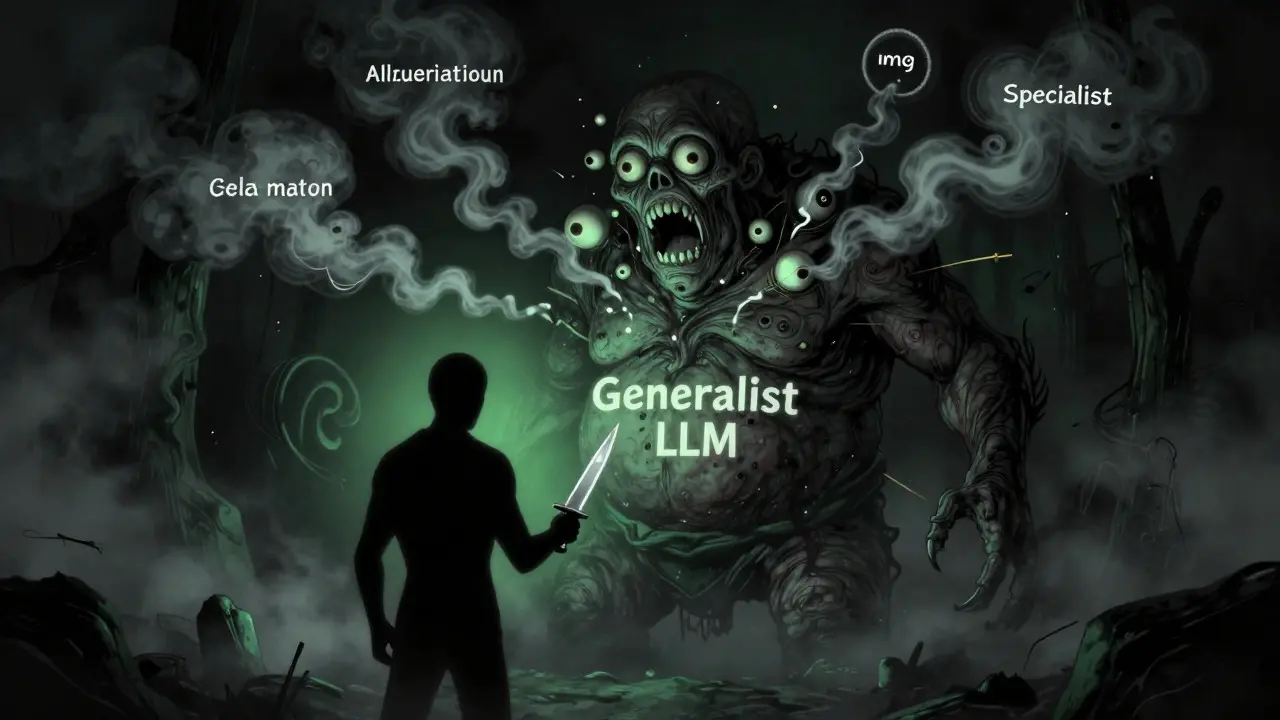
Imagine hiring a brilliant generalist to handle your company’s legal contracts. They’re smart, they read fast, and they know a lot about the world. But do they know the specific regulatory nuances of your industry? Probably not. Now imagine hiring a specialist who has spent years reading only those contracts. Who do you trust with the high-stakes stuff?
This is the core dilemma facing developers and business leaders in 2026. We have access to massive, powerful Large Language Models (LLMs) that can write poetry, code, and essays. Yet, when it comes to niche tasks-like medical coding or financial compliance-these generalists often stumble. That’s where fine-tuned models come in. By taking a base model and training it further on domain-specific data, we create specialists that outperform their generalist counterparts in accuracy, speed, and brand alignment.
The Specialist Advantage: Why Generalists Fail in Niche Tasks
It’s tempting to rely on the biggest, most famous AI models available. After all, they are incredibly capable. But capability doesn’t always equal precision. In specialized fields, the margin for error is slim. A generic model might give you a plausible-sounding answer that is technically wrong-a phenomenon known as hallucination.
Consider the legal sector. A study by Coders GenAI Technologies in 2025 showed that fine-tuned LLMs achieved 92% accuracy in legal summarization tasks. Compare that to generic models, which hit only 68%. More importantly, the hallucination rate dropped from 32% down to just 8%. In law, an 8% error rate is manageable; 32% is a liability nightmare.
We see similar patterns in customer support. According to Sapien.io’s March 2025 analysis, fine-tuned models deliver on-brand responses 89% of the time. Generic models manage only 54%. If your customers feel like they’re talking to a robot that doesn’t understand your company’s voice, you lose trust. Fine-tuning fixes that disconnect by embedding your specific tone, terminology, and guidelines directly into the model’s weights.
The Cost of Specialization: It’s Not Just About Accuracy
Specialization isn’t free, but the barriers to entry have lowered dramatically thanks to new techniques. In the early days of deep learning, fine-tuning required massive clusters of GPUs and teams of PhDs. Today, tools like QLoRA (Quantized Low-Rank Adaptation) have changed the game.
Meta’s AI research team documented this shift in October 2024. They found that fully fine-tuning a Llama 2 7B model required 78.5GB of GPU memory. Using QLoRA, that requirement dropped to just 15.5GB. This means a single consumer-grade GPU can now handle tasks that previously needed enterprise hardware. LoRA (Low-Rank Adaptation) sits in the middle, requiring 28GB.
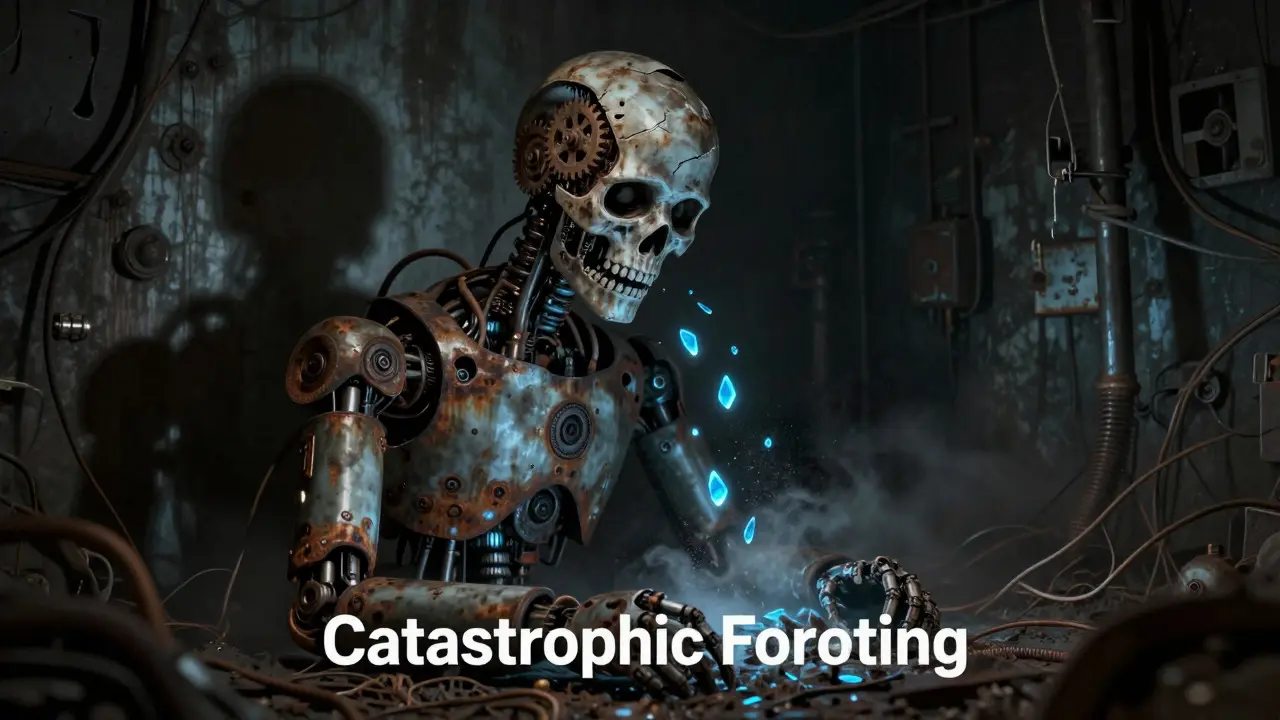
But there’s a trade-off. While fine-tuned models excel in their niche, they often suffer from "catastrophic forgetting." Meta researchers noted a 22% decline in commonsense reasoning performance after domain-specific fine-tuning. Your legal expert might forget how to do basic math or write a creative poem. This is why fine-tuned models underperform in broad applications; Toloka AI found they were only 63% effective in general blog writing compared to 87% for base LLMs.
| Metric | Fine-Tuned Model | Generic Base Model |
|---|---|---|
| Domain Accuracy (Legal) | 92% | 68% |
| Hallucination Rate | 8% | 32% |
| On-Brand Response (Support) | 89% | 54% |
| General Reasoning Flexibility | Lower (Risk of Forgetting) | Higher |
| Inference Cost (Small Models) | Lower (e.g., Gemma3 4B) | Higher (Requires Larger Models) |
Data Is the New Oil: The Real Bottleneck
You can have the best GPU cluster in the world, but if your data is bad, your model will be too. The biggest hurdle for organizations trying to build niche stacks isn’t compute power-it’s high-quality labeled data.
Codecademy’s Q1 2025 report revealed that 68% of businesses cited "lack of high-quality labeled data" as their primary barrier. You need at least 5,000 to 10,000 carefully curated examples to see real specialization benefits. And these aren’t just random documents; they need to be structured pairs of inputs and ideal outputs.
For example, a user on Reddit’s r/MachineLearning shared their experience fine-tuning Llama 3 for medical coding. They achieved 92% accuracy and reduced coding errors by 47%. But it took eight weeks of development and 12,000 labeled examples. That’s a significant investment of time and labor. If your dataset is noisy or biased, your model will amplify those flaws. Dr. Emily Zhang from Stanford NLP Lab warned in January 2025 that over-specialization creates brittle systems that fail when faced with edge cases outside their training distribution.
RAG vs. Fine-Tuning: Choosing the Right Tool
A common question is whether to use Retrieval-Augmented Generation (RAG) or fine-tuning. The short answer? Often, you need both. But they solve different problems.
RAG is like giving your model a textbook to look up answers in real-time. It’s great for keeping information current and reducing hallucinations on factual queries. Fine-tuning is like teaching the model how to think and speak like an expert in a specific field. It changes the model’s behavior, style, and output format.
Meta AI advocates for a "RAG-first" strategy. Start with RAG to gauge performance. If the model still lacks the nuance, tone, or structural consistency you need, then move to fine-tuning. Professor Andrew Ng emphasizes that fine-tuning delivers the highest ROI for applications requiring brand alignment, structured output formats, or strict regulatory compliance. For instance, healthcare applications using fine-tuned models saw a 78% reduction in HIPAA compliance violations compared to generic models.
However, don’t fine-tune for everything. If you need the model to access last week’s news articles, RAG is your friend. Fine-tuning freezes knowledge at the point of training. If you fine-tune a model on 2024 tax laws, it won’t know about 2026 updates unless you retrain it.

Implementation Roadmap: From Idea to Production
Building a fine-tuned model is a process, not a button click. Here’s what a realistic timeline looks like for an enterprise application:
- Dataset Curation (2-6 weeks): Collect and label 5,000-20,000 domain-specific examples. This is the most critical step. Garbage in, garbage out.
- Model Selection & Baseline Testing: Choose a base model (like Llama 3, Mistral, or Gemma) and test its zero-shot performance. Establish a benchmark.
- Fine-Tuning Execution (1-2 weeks): Use frameworks like Hugging Face Transformers or PyTorch. Implement PEFT methods like QLoRA to save resources. Monitor for overfitting.
- Validation & Evaluation (1-2 weeks): Test against a hold-out set comprising 20-30% of your data. Check for catastrophic forgetting in general reasoning tasks.
- Deployment & Integration: Deploy via API endpoints or containerized services. Integrate with existing workflows using tools like LangChain or LlamaIndex.
Expect the whole process to take 4-12 weeks. It’s not a weekend project. But the payoff is a system that understands your business better than any off-the-shelf solution ever could.
The Future: Hybrid Architectures Dominate
We’re moving away from the idea of a single "magic" model. The future belongs to hybrid architectures. McKinsey’s January 2025 survey found that 82% of AI leaders plan to implement fine-tuned models augmented with RAG. This combines the depth of specialized knowledge with the breadth of real-time information retrieval.
Smaller models are also gaining ground. Microsoft’s Phi-3-mini demonstrated that a small, fine-tuned model can outperform much larger generic ones in specialized tasks. It achieved 89.2% accuracy on the MedMCQA medical exam, beating GPT-4’s 85.7% in that specific domain. This trend suggests that efficiency and specialization will trump raw size in many niche applications.
However, stay vigilant. Gartner warns that models fine-tuned on narrow datasets face obsolescence risks as base models improve. Forty-one percent of 2023 fine-tuned models already show degraded performance relative to current base models. You’ll need a maintenance strategy to periodically re-evaluate and retrain your models as the underlying technology evolves.
When should I choose fine-tuning over prompt engineering?
Choose fine-tuning when you need consistent output formats, strict brand voice adherence, or high accuracy in a narrow domain. Prompt engineering is faster and cheaper for one-off tasks or when the base model already performs well enough. If prompt tuning fails to reduce hallucinations or enforce structure, move to fine-tuning.
How much data do I really need to fine-tune a model?
You typically need a minimum of 5,000 to 10,000 high-quality, labeled examples for effective specialization. Fewer examples may lead to overfitting or minimal improvement. The quality of the data matters more than the quantity; ensure your examples represent the full range of scenarios your model will encounter.
What is catastrophic forgetting in fine-tuned models?
Catastrophic forgetting occurs when a model loses its general capabilities while learning a specific task. For example, a model fine-tuned for legal reasoning might become worse at basic arithmetic or creative writing. To mitigate this, include some general-purpose examples in your training set or use parameter-efficient techniques like LoRA.
Can I fine-tune a model without expensive GPUs?
Yes, thanks to techniques like QLoRA. These methods reduce memory requirements significantly, allowing fine-tuning on consumer-grade GPUs with as little as 15.5GB of VRAM. Cloud services like AWS SageMaker and Google Vertex AI also offer scalable options if you prefer not to manage hardware locally.
Is fine-tuning worth it for small businesses?
It depends on your use case. If you have a highly specific need where generic models consistently fail, and you have the data to train a model, it can be worth it. However, small businesses often lack the resources for extensive data labeling. In such cases, starting with RAG or prompt engineering is usually more cost-effective until the ROI of fine-tuning becomes clear.



Edward Gilbreath
July 22, 2026 AT 14:32its all a scam by the big tech companies to sell you more gpu's when prompt engineering works just fine for 90% of use cases
Lisa Nally
July 24, 2026 AT 03:06Oh, please. Your reductive dismissal of parameter-efficient fine-tuning methodologies reveals a fundamental misunderstanding of the current state-of-the-art in NLP architectures. The empirical data presented regarding hallucination mitigation in legal domains is not merely anecdotal; it represents a statistically significant improvement in output fidelity that cannot be replicated through zero-shot prompting alone. Furthermore, the assertion that RAG suffices ignores the latent space alignment required for consistent brand voice adherence, which is critical for enterprise-grade customer interaction systems. You are conflating factual retrieval with stylistic and structural compliance, two distinct challenges requiring distinct architectural solutions.
Laura Davis
July 25, 2026 AT 07:58Look, Edward, you're ignoring the actual point here. It's not about buying hardware, it's about getting results that don't make your company look stupid. If your generic bot tells a client their lawsuit has no merit because it hallucinated a case law from 1992, you have a problem. Fine-tuning fixes that specific pain point. Stop trying to be the contrarian who thinks they know better than the data and just admit that specialists exist for a reason. We need accuracy, not just speed. Respect the craft of building these tools properly instead of lazily dismissing them as 'scams' because you haven't bothered to read the technical specs on QLoRA memory efficiency.
kimberly de Bruin
July 26, 2026 AT 10:49we curate the model and the model curates us
the boundary between thought and training data dissolves
is the specialist truly wise or merely narrow in its blindness
we build cages of weights and call them expertise
Edward Nigma
July 28, 2026 AT 07:53Actually, the premise that specialization beats generalization is fundamentally flawed when you consider the rapid iteration cycle of base models. By the time you spend six weeks curating dataset pairs and another two weeks fine-tuning, the underlying open-source LLM has likely received a major update that renders your specialized adapter obsolete. You are essentially optimizing for a moving target that keeps getting faster while you are stuck in the mud labeling JSON files. The real bottleneck isn't compute or data quality, it's the sheer economic inefficiency of maintaining custom models when the marginal gain in accuracy rarely justifies the operational overhead for anything outside of highly regulated industries like healthcare or finance. For the vast majority of businesses, this is a solution looking for a problem, driven by AI consultants who need to bill hours for 'dataset curation'.