
There is a new way to write software that feels less like typing and more like directing. You describe what you want in plain English, and an AI model spits out the code. It’s fast. It’s intuitive. And if you are not careful, it is dangerous. This approach has become known as vibe coding, which is a development style where programmers rely heavily on large language models (LLMs) to generate code based on natural language prompts rather than writing syntax manually.
The term captures the essence of the workflow: you set the vibe, the AI does the heavy lifting. But here is the catch. LLMs are probabilistic engines. They predict the next likely token, not the next logically sound line of code. Without strict oversight, this method can introduce subtle bugs, security vulnerabilities, and architectural nightmares that are hard to debug because no human actually wrote the logic.
This is where Human-in-the-Loop (HITL) practices come in. HITL is not just a buzzword; it is the safety net that turns a chaotic experiment into a professional engineering process. By strategically placing human judgment at critical checkpoints, developers can harness the speed of vibe coding while maintaining the reliability required for production-grade software.
Defining the Risk: Why Vibe Coding Needs Guardrails
To understand why HITL is essential, we first need to look at what vibe coding actually does under the hood. When you prompt an LLM to "create a login page with OAuth," the model accesses its training data-billions of lines of public code-and constructs a plausible response. It does not compile the code. It does not run tests. It does not know your specific database schema unless you explicitly tell it.
The primary risk is hallucination. An LLM might invent a function that looks correct but doesn't exist in the library you are using. It might suggest a deprecated API endpoint. Worse, it might replicate insecure patterns found in old Stack Overflow threads, such as storing passwords in plain text or leaving SQL injection holes open. In traditional coding, these errors are caught by linters and peer reviews. In pure vibe coding, they slip through because the developer trusts the output blindly.
Another issue is context drift. As a project grows, the AI loses track of earlier decisions. A change in one file might break another, but the AI only sees the immediate prompt. Without a human to maintain the holistic view of the system architecture, the codebase becomes a patchwork of inconsistent styles and conflicting logic.
The Three Pillars of Human-in-the-Loop Oversight
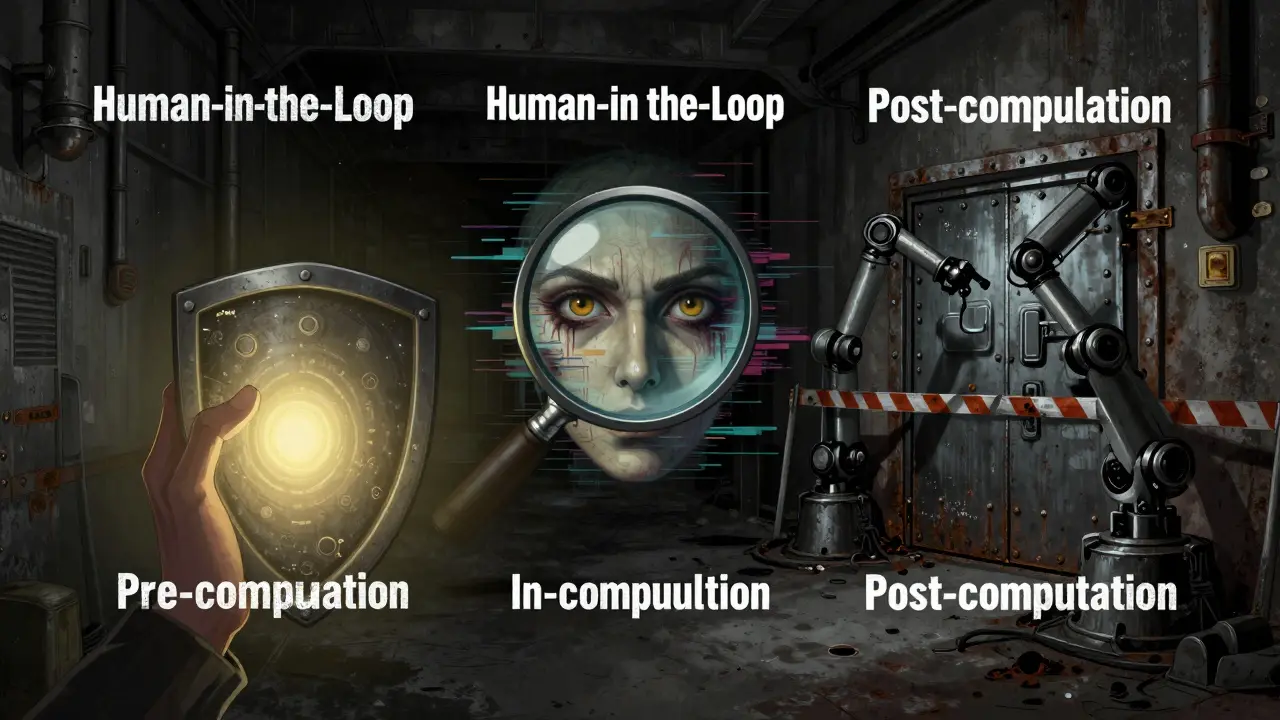
Implementing HITL in vibe coding isn't about slowing down; it's about creating feedback loops that improve accuracy over time. There are three distinct phases where human intervention is non-negotiable:
- Pre-computation (Prompt Engineering & Context Setting): The human defines the constraints, libraries, and security standards before the code is generated.
- In-computation (Real-time Validation): The human reviews generated snippets for logical consistency and security flaws immediately.
- Post-computation (Integration Testing & Refactoring): The human integrates the code, runs automated tests, and refactors for performance.
Each pillar serves a different purpose. Pre-computation reduces the search space for the AI, making its outputs more relevant. In-computation catches obvious errors early. Post-computation ensures the code works within the broader ecosystem. Skipping any of these steps increases the technical debt exponentially.
Practical HITL Strategies for Safer Code Generation
How do you actually apply these principles? Here are concrete practices that experienced developers use to make vibe coding safe and effective.
1. Constraint-Based Prompting
Never ask an AI to "write code." Always specify the boundaries. Instead of saying "build a user authentication system," say "build a user authentication system using Node.js, Express, and bcrypt for password hashing, following OWASP guidelines for session management."
This technique forces the LLM to operate within a narrow, well-defined domain. It reduces the chance of the model suggesting incompatible libraries or insecure defaults. You are essentially programming the programmer. The more specific your constraints, the higher the quality of the output.
2. The "Small Batch" Review Process
Do not let the AI generate an entire application in one go. Break the task into small, testable units. Generate a single function, review it, test it, and then move to the next. This modular approach makes it easier to spot errors. If a bug appears, you know exactly which prompt caused it.
Think of it like building a house. You don't pour the foundation, frame the walls, and install the roof all at once without checking the levelness at each stage. You check the foundation, then the framing, then the roof. Small batches mean smaller fixes.
3. Automated Security Scanning
Integrate static analysis tools into your workflow. Tools like SonarQube, ESLint, or Snyk can scan AI-generated code for common vulnerabilities. Set up your IDE to flag issues immediately. This creates an automated layer of HITL that runs alongside your manual review.
For example, if the AI generates a Python script that uses `eval()` on user input, a security scanner will flag it instantly. You catch the vulnerability before it reaches production. This combination of human intuition and machine precision is the gold standard for safe vibe coding.
4. Documentation as a Contract
Require the AI to generate documentation along with the code. Ask it to explain its reasoning, list dependencies, and describe edge cases. Then, read that documentation critically. Does it make sense? Are there contradictions?
If the AI cannot explain why it chose a particular algorithm, you probably shouldn't trust the code. Documentation forces the model to be explicit about its assumptions, giving you more material to evaluate during your review.
| Aspect | Pure Vibe Coding | HITL-Enhanced Vibe Coding |
|---|---|---|
| Speed | Very Fast | Fast (with slight overhead for review) |
| Security Risk | High (unverified code) | Low (validated against standards) |
| Maintainability | Low (inconsistent styles) | High (refactored and documented) |
| Debugging Difficulty | High (black box logic) | Medium (understood intent) |
| Technical Debt | Accumulates quickly | Managed proactively |

Building a Culture of Critical Thinking
Tools alone won't save you. The biggest factor in successful vibe coding is the mindset of the developer. You must shift from being a writer of code to a reviewer of code. This requires a different skill set. You need to understand the underlying concepts deeply enough to spot when the AI is wrong.
This means you still need to learn programming fundamentals. You need to know how memory management works, how APIs communicate, and how databases index data. If you don't know what good code looks like, you can't judge the AI's output. HITL assumes the human is competent. It amplifies competence; it does not replace it.
Encourage team discussions around AI-generated code. Share examples of where the AI failed and how you fixed it. Build a shared knowledge base of common pitfalls. Over time, your team will develop a collective intuition for what kinds of prompts yield safe results and which ones require extra scrutiny.
Future-Proofing Your Workflow
As AI models become more sophisticated, the nature of HITL will evolve. We may see agents that can run their own tests and fix their own bugs. However, the core principle remains: humans must define the goals and validate the outcomes. The complexity of software systems will always exceed the context window of any single AI model.
Stay updated on best practices. Follow security advisories. Participate in communities that discuss ethical AI usage. The landscape changes fast, and what is safe today might be vulnerable tomorrow. Continuous learning is part of the HITL contract.
Vibe coding is a powerful tool, but it is a tool, not a replacement. By embedding human judgment into every stage of the process, you ensure that the code you ship is not just fast to create, but safe, secure, and sustainable. The future of software development isn't human vs. AI. It's human with AI.
What is vibe coding exactly?
Vibe coding is a development methodology where programmers use large language models (LLMs) to generate code based on natural language descriptions or "vibes" rather than writing syntax manually. It emphasizes speed and intuition but requires careful oversight to ensure code quality and security.
Why is Human-in-the-Loop (HITL) important for AI coding?
HITL is crucial because LLMs can hallucinate, produce insecure code, or miss context. Human oversight ensures that generated code meets security standards, follows architectural guidelines, and functions correctly within the larger system. It acts as a quality control mechanism.
Can I use vibe coding for production applications?
Yes, but only with strict HITL practices. You must review, test, and refactor all AI-generated code. Never deploy unverified code directly to production. Use automated security scanners and maintain comprehensive documentation to mitigate risks.
What are the biggest security risks of vibe coding?
The main risks include injecting vulnerable code patterns (like SQL injection or XSS), using deprecated or insecure libraries, and creating logic errors that lead to data leaks. AI models do not inherently understand security implications unless explicitly prompted with security constraints.
How do I start implementing HITL in my workflow?
Start by breaking tasks into small modules. Write detailed prompts with specific constraints. Review each snippet of code before integrating it. Use static analysis tools to scan for vulnerabilities. Finally, document the AI's reasoning and your review notes for future reference.