Most companies think adding a large language model to their customer service or internal tools is enough. But if your LLM keeps making up facts, missing recent documents, or leaking sensitive data, you’re not using AI-you’re gambling. That’s where enterprise-grade RAG comes in. It’s not just a tweak. It’s a full architectural overhaul that turns a generic chatbot into a precise, secure, and reliable knowledge engine. RAG isn’t new, but what’s changed since 2024 is how seriously enterprises take it. Companies like JPMorgan, Mayo Clinic, and legal tech firms aren’t experimenting anymore. They’re building production systems that handle millions of queries a month, with zero tolerance for hallucinations or compliance violations. And they’re doing it with architectures designed for scale, not just speed. So what does a real enterprise RAG system look like? Not the demo you saw at a conference. Not the open-source tutorial that works on 10 PDFs. We’re talking about systems that serve legal teams, handle HIPAA data, and integrate with SAP and Salesforce-all while staying under 500ms response time.
How Enterprise RAG Actually Works (Not the Marketing Version)
Let’s cut through the buzzwords. RAG stands for Retrieval-Augmented Generation. Simple. You take a user’s question, find the most relevant documents from your internal data, then feed those documents + the question into the LLM to generate an answer. But that’s where most guides stop. And that’s why their systems fail. In enterprise settings, the real work happens before and after that step. You need:- A way to split documents into chunks that preserve meaning-not just every 500 words, but by section, table, or legal clause.
- An embedding model that understands legal jargon, medical terms, or financial reports-not just general English.
- A vector database that can search 15 million entries in under a second, while filtering by department, date, or access level.
- A re-ranker that takes the top 20 results and picks the 5 most relevant ones, not just the ones with the highest cosine similarity.
- A prompt template that tells the LLM: ‘Use only these documents. If none answer the question, say so.’
Four Enterprise RAG Architectures-And When to Use Each
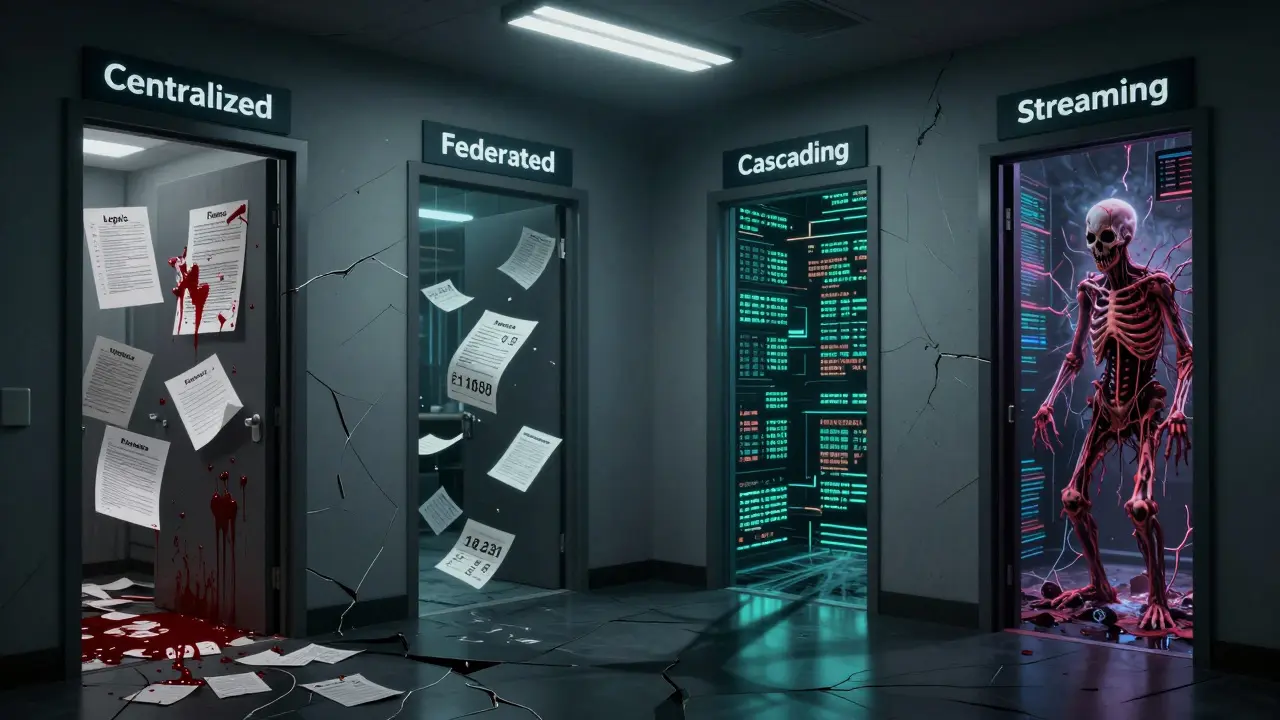
Not all RAG systems are built the same. Your choice depends on your data structure, compliance needs, and team size. Centralized RAG One retrieval engine. One LLM. One knowledge base. Used by mid-sized companies with uniform data-like a regional bank or a logistics firm. It’s fast to deploy (3-6 months) and easy to manage. But if your sales team needs different docs than HR, this breaks down. Federated RAG Multiple retrieval engines, one shared LLM. Each department (Legal, Finance, IT) has its own vector database and chunking rules. Queries are routed based on user role or keywords. Used by Fortune 500s with siloed data. Takes 6-9 months to build, but lets Legal use HIPAA-compliant docs while Finance uses SOC 2-approved ones-all without mixing data. Cascading RAG Lightweight retrieval for simple questions. Heavy retrieval for complex ones. Example: "What’s our PTO policy?" → pulls from a small, fast index. "Explain the tax implications of our Q3 acquisition?" → triggers a deep search across 500+ legal and financial docs, plus a more powerful (and expensive) LLM. Reduces costs by 50-70% because 80% of queries are simple. Streaming RAG Your knowledge base updates in real time. New contracts, earnings reports, or compliance memos get embedded and indexed within minutes-not hours or days. Used by trading desks, regulatory teams, or newsrooms. Requires a continuous ingestion pipeline with change detection. LanceDB and Postgres with PGVector handle this well.Choosing Your Vector Database: PGVector vs. LanceDB vs. Others
The vector database is the engine of RAG. Pick wrong, and you’ll pay for it in speed, cost, or security.| Feature | PGVector (PostgreSQL) | LanceDB | Chroma |
|---|---|---|---|
| Max Scale | 500K-5M embeddings (vertical scaling) | 15M+ embeddings (horizontal scaling) | Under 2M (not enterprise-ready) |
| Latency (P50) | 1.8s (500K), 2.3s (5M) | 1.2s (15M with metadata) | 3.5s (1M) |
| Metadata Filtering | Good, but slower at scale | Excellent, native support | Poor |
| Security | Centralized encryption, role-based access | Decentralized-data lives in S3, Azure, etc. | Basic, no audit trails |
| Best For | Companies already on PostgreSQL | Cloud-native, multi-cloud, compliance-heavy | Prototypes only |
Security Isn’t an Add-On-It’s Built In
A RAG system that leaks a client’s medical record or a merger plan isn’t just broken. It’s a lawsuit waiting to happen. Enterprise RAG requires security at every layer:- Role-Based Access Control (RBAC): Your CFO shouldn’t see HR’s employee termination docs. Your legal team shouldn’t see sales contracts marked "confidential."
- PII Masking: Automatic redaction of names, SSNs, account numbers before embedding or retrieval.
- Audit Logs: Every query, every document retrieved, every response generated-logged with timestamp, user, and IP.
- Air-Gapped Deployments: For defense contractors or banks, the entire RAG stack runs in a private cloud with zero internet access.
- Compliance Alignment: Built-in checks for GDPR, HIPAA, SOC 2, and FINRA rules.
When NOT to Use RAG (And What to Use Instead)
RAG isn’t magic. It’s overkill for some tasks.- Static knowledge: If your answer is always the same (e.g., "Our return policy is 30 days"), fine-tune the LLM or use a rule-based system. RAG adds latency and cost.
- Structured classification: Is this ticket "billing" or "technical"? Use a classifier, not a RAG system.
- Stylistic consistency: If every response must sound like your brand’s tone, prompt engineering or fine-tuning works better.
Real-World ROI: What Enterprise RAG Actually Saves You
Forget "AI will save you money." Show me the numbers. Based on Tech Ahead Corp’s 2024 data from 120 enterprise deployments:- 60-80% fewer LLM API calls because the system stops asking for guesses.
- 70% reduction in hallucinations-no more fake citations or made-up policies.
- 40-50% lower cloud GPU costs from using smaller models for simple queries.
- 3-4x faster access to internal documents-legal teams find case law in seconds, not hours.
- 60% reduction in engineering time spent fixing LLM output.

What’s Next? The Future of Enterprise RAG
By 2027, Gartner predicts 85% of enterprise knowledge systems will use RAG. Here’s what’s coming:- Multi-agent RAG: One agent retrieves, another checks facts, a third rewrites for clarity. Like a team of specialists working together.
- Hybrid Search: Combining vector search with keyword, semantic, and even graph-based search for better precision.
- Embedding Models That Understand Context: Cohere’s Embed v3 handles 100+ languages in one model. No more separate encoders for each region.
- Autonomous Updates: Systems that auto-detect when a policy changes and re-index without human intervention.
- MM-RAG: Retrieval from text, images, spreadsheets, and PDFs-all in one query. "Show me Q3 revenue charts and the CEO’s comments on them."
Where to Start (If You’re Not Ready to Build)
If you’re not a team of 10 engineers:- Start with one high-value use case: legal contract search, HR policy lookup, or customer support knowledge base.
- Use a managed service-like Azure AI Search, Google Vertex AI, or AWS Kendra-that handles vector storage, embeddings, and security.
- Don’t try to build your own LLM or vector database. Use OpenAI, Anthropic, or Mistral via API.
- Measure success: track query accuracy, response time, and user satisfaction-not just "we deployed RAG."
Frequently Asked Questions
What’s the biggest mistake companies make when building RAG?
They assume the LLM is the problem. It’s not. The problem is bad retrieval. If your system pulls the wrong documents, no prompt engineering will fix it. Focus on chunking, metadata filtering, and re-ranking before you even touch the LLM.
Do I need a dedicated vector database, or can I use my existing SQL database?
You can use Postgres with PGVector if you’re already on it and have under 5 million documents. But if you need horizontal scaling, multi-cloud support, or real-time updates, dedicated systems like LanceDB are faster, cheaper, and more reliable. Don’t force your old database into a role it wasn’t built for.
How long does enterprise RAG take to deploy?
A centralized system with one knowledge base takes 3-6 months. A federated system with multiple departments and compliance rules takes 6-9 months. The timeline isn’t about coding-it’s about cleaning data, setting up access controls, and training users.
Can RAG work with encrypted data?
Yes-but only if you use homomorphic encryption or client-side embedding. Most vendors don’t support this yet. For most enterprises, the solution is air-gapped deployments: keep the data offline, process embeddings inside the secure network, and never send raw documents to external APIs.
Is RAG better than fine-tuning the LLM?
It depends. Fine-tuning works for style, tone, or static facts. RAG works for dynamic, up-to-date, and private data. If your data changes weekly, fine-tuning is too slow and expensive. If your data never changes, RAG adds unnecessary complexity. Use RAG when you need fresh, accurate, and secure answers from internal sources.



Priyank Panchal
January 30, 2026 AT 00:12This is the most accurate breakdown of enterprise RAG I’ve seen in years. Most blogs just throw around "vector database" like it’s magic. The part about metadata filtering and re-rankers? Spot on. We deployed something similar at my firm last year and the drop in hallucinations was insane. No more fake citations in legal briefs. Just pure, clean, reliable answers.
Also, LanceDB over PGVector if you’re not locked into Postgres. The ingestion speed difference is not even close.
Glenn Celaya
January 31, 2026 AT 14:39LMAO you guys act like this is some revolutionary breakthrough. RAG? We’ve been doing this since 2021. The only reason this is even a topic is because mid tier companies are finally catching up to what real AI shops did 3 years ago. PGVector? Please. If you’re not using Milvus or Weaviate you’re already behind. And dont even get me started on those "managed services"-they’re just overpriced wrappers with 3 second latency and zero control. You want enterprise? Build it. Dont rent it from AWS and call it a day.
Wilda Mcgee
February 1, 2026 AT 22:41Love this breakdown so much. Seriously. I’ve seen so many teams try to slap RAG onto their chatbot and then wonder why it keeps inventing client names or leaking internal memos. The security layer point? Critical. We had a near-miss last quarter where someone accidentally queried HR docs from a finance account-thank god we had RBAC and PII masking in place.
Also, the cascading RAG model? Game changer for cost. We cut our LLM spend by 60% just by routing simple queries to a tiny model. And the multi-agent RAG preview? I’m already dreaming about it. Imagine one agent fetching, another verifying, and a third rewriting in plain English for non-tech users. That’s the future right there.
For anyone starting out-start small. Pick one painful use case. HR policy lookup is perfect. No need to boil the ocean.
Chris Atkins
February 3, 2026 AT 20:23Real talk the vector db comparison table is gold
we went with LanceDB because we’re all in on S3 and the metadata filtering saved us when legal needed to pull docs from Q1 only
also air gapped deployments are non negotiable if you’re in finance or healthcare
ps dont use chroma for anything beyond a demo
pps thanks for not saying "llm is the bottleneck" again lol
chioma okwara
February 4, 2026 AT 05:37you misspelled "re-ranker" twice and said "PGVector" with a capital V but lowercase p? lol. also "LanceDB" is not a real word it's just a brand name. and you say "enterprise" like it's a religion. this is just fancy search with a buzzword coat of paint. and you didn't even mention Elasticsearch which is still the king for full text. also "500ms response time"? with what model? gpt-4-turbo? that's impossible if you're doing semantic search on 15M docs. you're lying or you're clueless. fix your grammar and your math before you lecture us.
John Fox
February 4, 2026 AT 11:27Been using federated RAG for legal and finance teams for 18 months now. Works like a charm. No more cross-department data leaks. The only headache is onboarding new teams-they always think they need their own LLM. Nope. Shared model. Separate vectors. Done.
Also yeah LanceDB is faster but if you're on AWS already and have Postgres? PGVector is fine. Dont overcomplicate it.
Tasha Hernandez
February 6, 2026 AT 00:15Oh wow. Another post about how RAG is the solution to all of corporate mediocrity. Let me guess-your CTO read this on Medium and now your whole company is "building an enterprise-grade knowledge engine" while your customer support team still uses a 2012 FAQ page.
92% of enterprises that skipped security steps faced audits? Newsflash: 100% of them were run by people who thought "AI" meant "automate the thing I hate doing".
And don’t even get me started on "autonomous updates". Yeah right. The moment you let an AI re-index your compliance docs without human review, you’re not building a system-you’re building a lawsuit with a chat interface.
Also, who the hell is "Tech Ahead Corp"? Are they the same guys who said blockchain would fix HR? I’m sensing a pattern.