
Training a large language model used to be a niche experiment. Today, it is a financial marathon that can drain millions of dollars in weeks. If you are planning an LLM program in 2026, your biggest risk isn't technical failure-it's running out of money before the model learns anything useful. The gap between what these models need and what most organizations budget for is widening fast.
We have moved past the era where throwing more GPUs at a problem was a free solution. Compute costs are no longer just an IT expense; they are the central constraint on your product's viability. This guide breaks down how to build realistic compute budgets, map out scaling roadmaps, and avoid the common traps that sink AI initiatives. We will look at real numbers, hardware realities, and strategic choices that keep your project alive.
The Reality of Modern LLM Costs
To plan a budget, you first need to understand the scale of the beast. The trajectory has been exponential. In 2017, training the original Transformer architecture cost roughly $900. By 2020, GPT-3 ran between $500,000 and $4.6 million. Today, we are looking at figures that dwarf those early estimates. OpenAI’s GPT-4 reportedly cost between $78 million and $100 million to train. Google’s Gemini Ultra is estimated at around $191 million in compute costs alone.
These numbers are not static. According to Epoch AI’s analysis from mid-2024, training compute for the largest models doubles every eight months. That means if you budget based on last year’s data, you are already behind. IBM’s Institute for Business Value reported that average computing costs climbed 89% between 2023 and 2025, with generative AI as the primary driver. For context, energy consumption accounts for about 50% of total training costs, while hardware and infrastructure make up the rest.
This rapid escalation creates a specific pressure point for teams. You cannot simply "scale up" indefinitely without a clear financial ceiling. The key insight here is that cost does not just come from the initial training run. It comes from the entire lifecycle: pre-training, fine-tuning, evaluation, and, most critically, inference.
Mapping Your Compute Infrastructure
Your roadmap starts with hardware. You have two main paths: cloud-based services or on-premise deployments. Each has distinct trade-offs that affect your budget differently.
| Strategy | Typical Hardware | Cost Profile | Best For |
|---|---|---|---|
| Cloud API (e.g., OpenAI, Anthropic) | N/A (Provider managed) | High variable cost per token | Rapid prototyping, low-volume use cases |
| On-Premise Medium-Scale | 2x NVIDIA A100-80GB ($30k total) | High upfront, low marginal cost | Domain-specific models, high-volume inference |
| Large-Scale Training Cluster | Thousands of H100/A100 GPUs | $100M+ capital expenditure | Foundation model development by major tech firms |
For many organizations, the sweet spot is not building a foundation model from scratch but deploying medium-scale models on-premise. Research from September 2025 shows that models like gpt-oss-120B or GLM-4.5-Air can run efficiently on just two NVIDIA A100-80GB GPUs. At approximately $15,000 per GPU, this represents a $30,000 hardware investment. These setups often show less than 10% accuracy loss compared to much larger counterparts while offering significantly lower long-term ownership costs.
If you are stuck using cloud APIs, your costs will scale linearly with usage. Tom Tunguz noted in 2025 that a typical AI query resulting in a few hundred words might cost anywhere from $0.03 to $3.60 in compute. Multiply that by thousands of daily users, and your monthly bill becomes unpredictable. On-premise hardware shifts this to a fixed cost model, giving you predictability after the initial purchase.

Optimizing Inference: Where the Money Goes
Most teams focus heavily on training costs, but inference is where the operational bleed happens. Inference is the process of running the trained model to generate answers. As user adoption grows, inference costs can quickly exceed training expenses.
Consider OpenAI’s o1 model. While powerful, McKinsey reported in June 2025 that its inference costs are six times higher than GPT-4o. This is due to the complex reasoning steps involved. If your application requires deep reasoning for every query, your budget will explode. You need strategies to mitigate this.
- Model Cascades: Route simple queries to smaller, cheaper models and reserve expensive, large models for complex tasks. IBM experts recommend this "LLM routing" approach to ensure efficient resource utilization.
- Quantization: Reduce the precision of the model weights (e.g., from FP16 to INT8). This lowers memory requirements and speeds up processing, allowing you to fit larger models on cheaper hardware.
- Speculative Decoding: Use a smaller draft model to predict tokens, which a larger model then verifies. This can speed up generation and reduce the load on expensive GPUs.
DeepSeek demonstrated the power of efficiency in February 2025. Their V3 model reduced training costs by 18 times and inference costs by 36 times compared to GPT-4o through architectural innovations. This proves that parameter efficiency-getting more performance per parameter-is becoming a critical competitive advantage.
Building a Realistic Scaling Roadmap
A roadmap without a budget is just a wish list. Here is how to structure your plan for sustainable growth.
- Phase 1: Baseline and Benchmarking (Months 1-3)
Start small. Train or fine-tune a medium-sized model (e.g., 70B parameters) on a representative subset of your data. Measure performance against your business KPIs. Do not jump to the largest available model immediately. Use tools like DeepSpeed or Fully Sharded Data Parallel (FSDP) to manage resources efficiently even on limited hardware. - Phase 2: Efficiency Optimization (Months 4-6)
Implement quantization and model cascades. Analyze your inference logs to identify which queries are costing the most. Optimize these pathways. Consider switching to a hybrid cloud-on-prem setup where heavy batch processing happens on cheap cloud instances, and real-time inference runs on dedicated on-prem GPUs. - Phase 3: Strategic Scaling (Months 7-12)
Only now should you consider increasing model size or data volume. Use scaling laws to predict performance gains. MIT-IBM Watson AI Lab research suggests you can save costs by partially training target models to about 30% of their dataset and extrapolating results. This avoids full-scale experimentation waste.
Remember the rule from AIMultiple’s 2025 analysis: in high-usage environments, smaller models trained on more data can achieve the same performance as larger models at a lower total cost. Parameter count affects inference costs heavily, while training tokens only affect one-time training compute. Prioritize data quality over sheer model size if your inference volume is high.
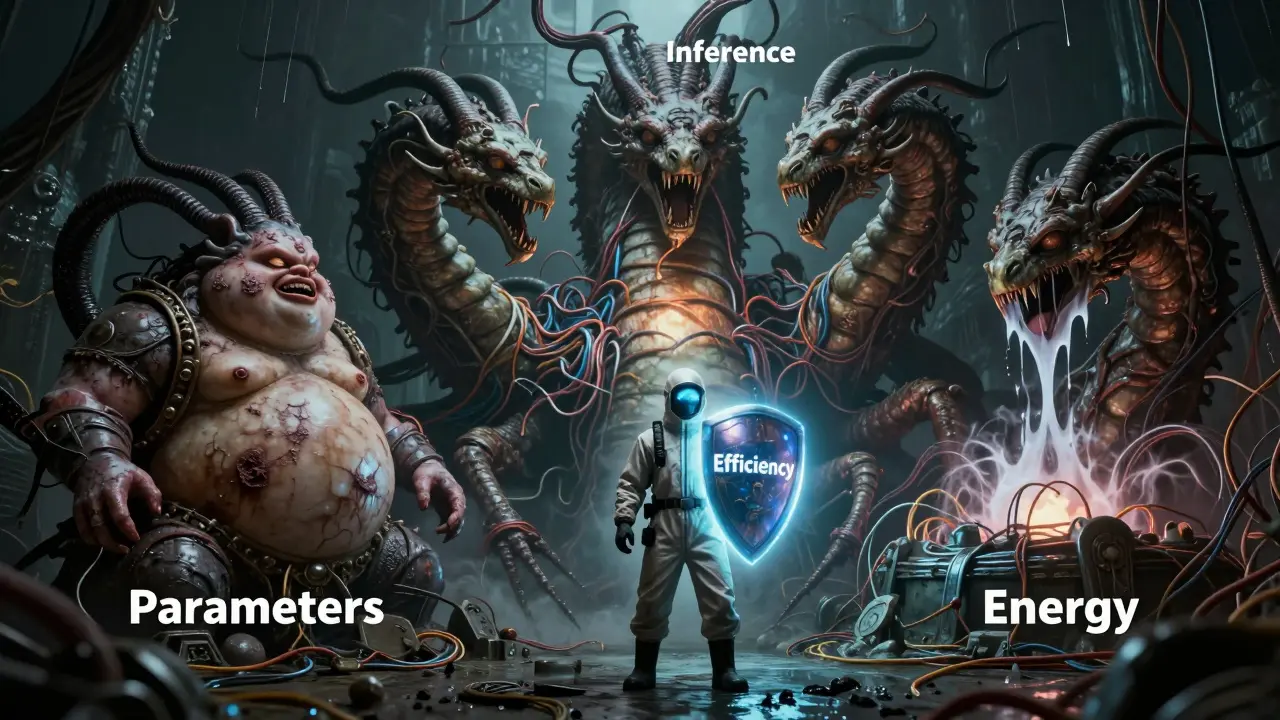
Avoiding Common Budget Traps
Many projects fail because they ignore hidden costs. Here are three traps to avoid:
The "More Parameters = Better" Fallacy: Larger models are not always better. They are slower and more expensive to run. If a 70B model solves 95% of your problems, do not spend ten times more to get a 700B model that solves 98%. The marginal gain rarely justifies the exponential cost increase.
Ignoring Energy Constraints: With data centers projected to require $6.7 trillion worldwide by 2030 to meet AI demand, energy availability is becoming a bottleneck. High-energy models may face regulatory hurdles or physical limitations in certain regions. Factor in power consumption when choosing your hardware location.
Underestimating Fine-Tuning Complexity: Fine-tuning a 70B model like LLaMA 2 can still cost tens of thousands of dollars. It is cheaper than pre-training, but it adds up if you iterate frequently. Automate your evaluation pipelines so you only fine-tune when necessary.
Strategic Recommendations for 2026
As you finalize your roadmap, keep these principles in mind. First, adopt a "right-sizing" mentality. Not every task needs a frontier model. Second, invest in infrastructure efficiency. Tools that shard model components across GPUs allow you to do more with less. Third, monitor your metrics closely. Track cost per token, latency, and accuracy weekly.
The landscape is shifting toward efficiency. Companies that master the art of doing more with less compute will survive the current inflationary period in AI. Those who chase raw scale without regard for unit economics will find themselves priced out of the market. Plan carefully, optimize relentlessly, and scale strategically.
How much does it cost to train a modern LLM?
Costs vary widely based on model size. Small to medium models (70B parameters) can cost tens of thousands to hundreds of thousands of dollars. Frontier models like GPT-4 or Gemini Ultra cost between $78 million and $191 million. Training compute costs are doubling every eight months.
Is it cheaper to host LLMs on-premise or in the cloud?
For high-volume inference, on-premise hosting is usually cheaper in the long run. A setup with two NVIDIA A100 GPUs costs around $30,000 upfront but eliminates recurring per-token fees. Cloud APIs are better for low-volume or experimental use cases where flexibility is prioritized over cost.
What is model cascading and why does it matter?
Model cascading involves routing simple queries to small, cheap models and complex queries to large, expensive ones. This strategy drastically reduces overall inference costs by ensuring you don't pay premium prices for easy tasks.
How can I reduce inference costs for my LLM application?
You can reduce costs by using quantization (lowering model precision), implementing speculative decoding, optimizing batching sizes, and employing model cascades. Additionally, choosing architecturally efficient models like DeepSeek V3 can offer significant savings compared to older architectures.
Do larger models always perform better?
Not necessarily. Smaller models trained on high-quality, extensive datasets can match the performance of larger models for many tasks. Since larger models incur significantly higher inference costs, smaller models often provide better economic value unless advanced reasoning capabilities are strictly required.



Bineesh Mathew
June 9, 2026 AT 19:39The sheer hubris of believing we can budget for infinity is the true tragedy of our age. We sit in our glass towers, clicking buttons that burn forests to ash, and call it 'innovation.' The article speaks of financial marathons, but it ignores the moral bankruptcy of consuming more energy than entire nations just to generate a poem about a cat. It is not a technical failure you fear, but a spiritual one. You are building monuments to vanity on a dying planet, and the cost is measured in carbon, not dollars. Wake up.
Patrick Dorion
June 10, 2026 AT 15:45Look, I get the existential dread, but let's talk shop for a second because the hardware reality check here is actually pretty solid. Most folks aren't training GPT-4 from scratch; they're fine-tuning Llama or Mistral variants. The bit about using two A100s for inference is spot on for mid-sized teams. I've been running a local cluster with exactly that setup for customer support routing, and the savings after month three were insane compared to paying per token to OpenAI. Just make sure your cooling is up to snuff, those cards run hot as hell.
Oskar Falkenberg
June 11, 2026 AT 21:34hey patrick i totally agree with you there! its so true about the cooling issues honestly i learned that the hard way when my server room turned into a sauna last summer lol. but yeah the point about fine tuning being cheaper is huge. i think people forget that you dont always need the biggest model. like if you are just doing classification tasks a tiny model works wonders. also did you see the part about quantization? i tried int8 on my end and the speed boost was crazy without losing much accuracy at all. its really nice to have more control over costs instead of getting surprised by the cloud bill every month. what kind of data were you using for your fine tuning though? curious if it was mostly text or mixed media?
Patrick Dorion
June 12, 2026 AT 10:05Thanks Oskar! Yeah, the thermal management is no joke. I ended up upgrading to liquid cooling blocks which added to the upfront cost but paid off in stability. Regarding the data, it was primarily structured logs and unstructured support tickets, so mostly text. We cleaned it up heavily before feeding it to the model. The key was removing noise early so the fine-tuning didn't waste compute on garbage data. Quantization is definitely the friend of the budget-conscious engineer these days.
Jeanne Abrahams
June 12, 2026 AT 21:56Oh, please. Another group of tech bros patting themselves on the back for 'optimizing' their digital drug habit. In South Africa, we are dealing with actual load shedding while you guys worry about whether INT8 is cool enough for your LinkedIn post. The 'efficiency' you speak of is just a slower trip to the same resource apocalypse. Save your money, save your soul, maybe plant a tree instead of buying another GPU.
Stephanie Frank
June 13, 2026 AT 10:03Jeanne, your sarcasm is as misplaced as your understanding of basic economics. While you're busy playing the martyr card about load shedding, the rest of us are trying to build tools that might actually solve problems rather than just complaining about them. The article isn't suggesting we ignore the environment; it's suggesting we stop wasting money on inefficient models. If you can't handle the nuance of balancing profit with planetary health, maybe stick to gardening. At least flowers don't require a PhD to understand why they need water.
Marissa Haque
June 14, 2026 AT 15:25Wow!! That was incredibly harsh Stephanie!!! 😱 I mean... Jeanne has a point about the environmental impact, doesn't she?! But Patrick makes some really valid technical points too!! It's so frustrating when everyone gets so defensive!!! Can't we just discuss the merits of on-premise vs cloud without turning it into a personal attack fest?!??! The table in the article was super helpful though!!! Especially the part about the $30k investment!!!
Caitlin Donehue
June 14, 2026 AT 20:48I just noticed the date range on this thread is wild. Anyway, the section on speculative decoding was interesting. I haven't tried it yet but the idea of a draft model seems promising for latency.