| Feature | Traditional Development | Vibe Coding Approach |
|---|---|---|
| Primary Tool | IDE / Compiler | LLM Prompting / Natural Language |
| Verification | Unit Tests & Manual Code Review | Behavioral Testing & Peer Vibe Review |
| Skill Requirement | Syntax Proficiency | Iterative Prompting & Domain Logic |
| Risk Point | Syntax Errors / Logic Bugs | Hidden Security Flaws / Hallucinations |
Why Vibe Coding Needs a Community of Practice
Most people starting with LLM-based development do it in isolation. They join a bootcamp, like the Claude Cowork BootCamp or a PromptingBirds workshop, learn the ropes, and then go off to build. While these courses are great for skill acquisition, they aren't communities. A Community of Practice is different; it is a group of people who share a concern or a passion for something they do and learn how to do it better as they interact regularly. In the context of vibe coding, a CoP solves the "black box" problem. When you prompt an AI to create a feature, the AI might produce code that works on the surface but lacks validation logic or contains security gaps. If you aren't a seasoned developer, you won't notice these issues until the app crashes in production. By forming a community, practitioners can share their prompt patterns, reveal common AI pitfalls, and create a shared standard for what "good" looks like in an AI-generated codebase.Implementing Peer Reviews for Non-Coders
In traditional software, a peer review is where another human reads your code to find bugs. In vibe coding, we have to shift the focus from the syntax to the intent and the outcome. A Peer Review in a vibe coding CoP isn't about checking if a variable is named correctly-it's about validating the logic and the prompt sequence. To make this work, the community should adopt a structured review process. Start with a Markdown plan. Before the AI generates a single line, the practitioner maps out the app's logic in a simple document. The peer reviewer looks at this plan first: Does the logic hold up? Are there edge cases the prompter missed? Once the code is generated, the review shifts to behavioral validation. Instead of reading the Python or JavaScript, the reviewer tries to "break" the app. They act as the adversarial tester, pushing the AI-generated features to their limits. If the app fails, the pair doesn't just fix the code; they fix the prompt. This iterative loop-Prompt $ ightarrow$ Build $ ightarrow$ Peer Review $ ightarrow$ Refine Prompt-is the only way to ensure that AI-generated software is actually robust.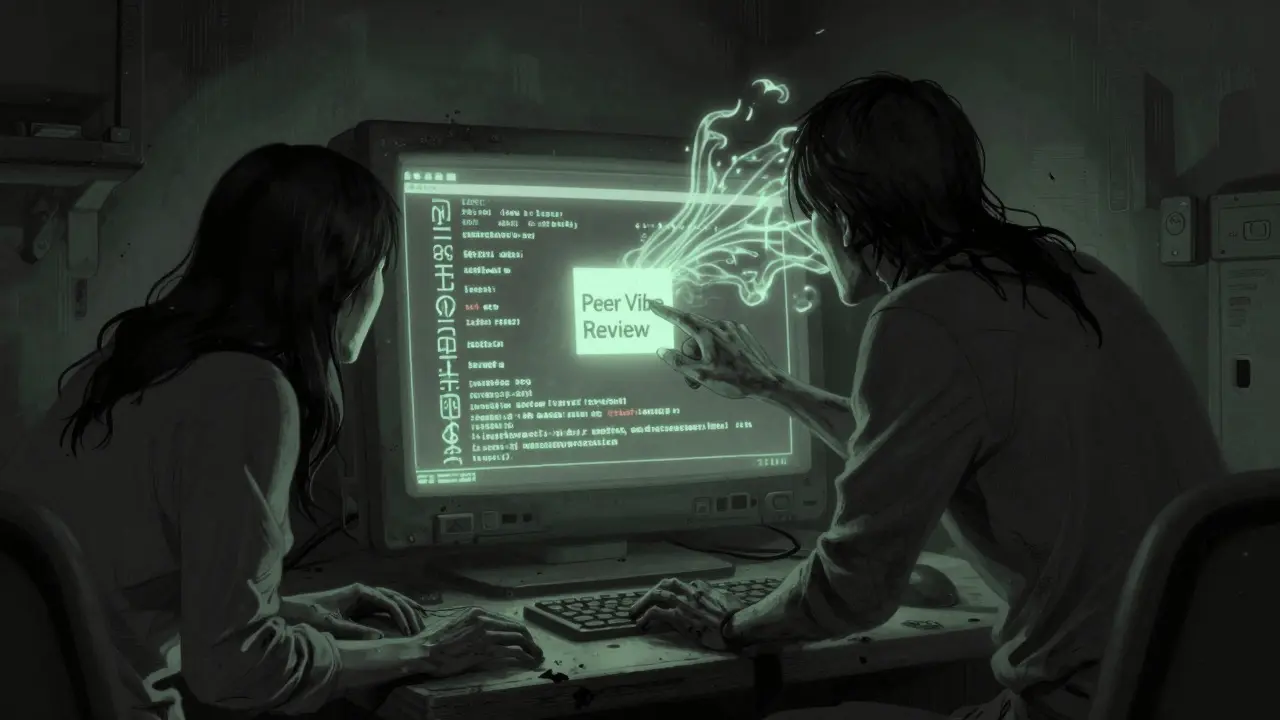
The Role of Office Hours in Rapid Adoption
Learning to vibe code is less about memorizing rules and more about developing an intuition for how an AI "thinks." This is a steep learning curve that can't be solved by a static PDF guide. This is where Office Hours become essential. Office hours provide a low-pressure environment where a beginner can bring a prompt that simply isn't working. For example, imagine a user trying to build a CRUD scaffold for a manufacturing inventory system. The AI keeps looping or generating incomplete tables. In a scheduled office hour session, an experienced vibe coder can watch the user interact with the AI in real-time. They can suggest a different framing, such as "Act as a senior database architect" or "Break this request into three smaller prompts," providing an immediate leap in the learner's capability. Unlike a formal class, office hours are diagnostic. They allow the community to identify systemic hurdles. If ten different people show up to office hours struggling with the same API integration issue, the CoP knows it needs to create a shared "prompt library" or a best-practices guide for that specific challenge.Bridging the Gap Between AI Generation and Security
We can't ignore the elephant in the room: security. Industry insights from groups like AlmCorp have pointed out that AI-generated code often misses critical validation logic. When you vibe code, you are essentially trusting a statistical model to be a security expert. It isn't. To mitigate this, a Community of Practice should integrate a "Security Vibe Check" into every peer review. This means having a checklist of common AI failures, such as:- Does the app handle empty inputs without crashing?
- Is there any hardcoded API key visible in the prompt or output?
- Does the AI-generated logic allow a user to access data they shouldn't see?

Scaling the Community: From Bootcamps to Governance
Right now, most vibe coding activity is fragmented into short-term events. We see the Vibe Coding Weekend Bootcamp or various online tutorials, but these are transactional. To move toward a sustainable model, the community needs a basic governance structure. This doesn't mean corporate bureaucracy. It means establishing a shared repository of "Golden Prompts"-the specific phrasing that consistently produces high-quality, secure code. It means creating a rotation for who hosts office hours. When the community owns the knowledge rather than relying on a single instructor, the adoption of vibe coding moves from a niche experiment to a professional standard. For those in small field-service or manufacturing teams, this is particularly powerful. A small team doesn't need a full DevOps department if they have a community-driven process for peer-reviewing their AI-automated routine work. They can leverage the collective intelligence of the wider vibe coding world to maintain high standards without needing a computer science degree.What exactly is vibe coding and how is it different from regular programming?
Vibe coding is a high-level approach to software creation where the "developer" uses natural language prompts to guide an AI to write and iterate on code. Unlike traditional programming, where you must know the specific syntax of a language like Java or Python, vibe coding focuses on the intent, the flow, and the "vibe" of the application. You describe what you want, test the result, and refine your instructions until the software behaves correctly, often without ever manually editing the source code.
Why do I need peer reviews if the AI is doing the coding?
AI can produce code that looks perfect and works in a demo but contains hidden flaws, such as security vulnerabilities or inefficient logic. Peer reviews provide a second set of human eyes to validate the app's behavior and the prompts used to create it. In a vibe coding community, peer review is less about syntax and more about ensuring the app's logic is sound and that no critical edge cases were ignored by the AI.
How do vibe coding office hours work?
Office hours are scheduled time slots where experienced vibe coding practitioners are available to help others troubleshoot their prompts and builds. Instead of a lecture, it's a live problem-solving session. A user shares their screen, shows the AI's output, and the mentor helps them refine their prompting strategy in real-time to achieve the desired result.
Can non-engineers really build professional apps this way?
Yes, but with a caveat: they must embrace professional habits. Non-engineers who use Markdown planning, participate in peer reviews, and follow a structured testing process can build highly functional tools. The risk is that without these "engineering-lite" habits, they may create fragile software that is hard to maintain or insecure.
What is the best way to start a Community of Practice for my team?
Start by setting up a shared space (like a Discord or Slack channel) specifically for prompt sharing. Schedule a weekly one-hour "Office Hour" session where anyone can bring a challenge. Finally, implement a rule that no AI-generated feature is deployed until at least one other team member has attempted to "break" the feature and reviewed the logic plan.

sampa Karjee
April 14, 2026 AT 02:55Calling this "coding" is an insult to the profession. It's essentially just glorified guessing where the user hopes the machine hallucinates something functional. The idea that a "community of practice" can replace actual computer science fundamentals is laughable and frankly dangerous for the industry
Patrick Sieber
April 16, 2026 AT 01:53I think the focus on behavioral testing here is spot on. Even if you aren't a pro at syntax, treating the app as a black box and trying to break it is a timeless strategy. It's a great way to democratize tool building for people who just want to solve a specific problem without spending four years on a degree.
Kieran Danagher
April 17, 2026 AT 02:59Oh sure, let's just let everyone "vibe" their way into production. I'm sure the security implications will be totally fine once a few buddies in a Discord channel give it a "vibe check." Truly a foolproof plan for the modern era.
Sheila Alston
April 17, 2026 AT 16:23It's honestly quite concerning that we are promoting a culture where people skip the hard work of learning the basics. We have a moral obligation to ensure software is reliable and safe, not just something that "kind of works." It feels like we're prioritizing speed over the basic integrity of the craft, which is just disappointing.
poonam upadhyay
April 18, 2026 AT 11:11Wait... wait... wait!!! This whole thing is a total circus!!! 🤡 Who actually thinks a "Golden Prompt" is a real standard??? It's like trying to build a skyscraper out of glitter and hope!!! The sheer audacity of calling this a "professional standard" is absolutely delicious... truly, a gourmet disaster!!!
Shivam Mogha
April 19, 2026 AT 09:27Interesting perspective on the CoP.
mani kandan
April 20, 2026 AT 01:39The concept of using a Markdown plan to map logic before prompting is a stellar approach. It bridges the gap between intuitive creation and structured engineering beautifully. This method creates a symphony of human intent and machine execution that could really empower small teams in manufacturing.
rahul shrimali
April 21, 2026 AT 10:31Let's do this! Time to build fast and learn together!
OONAGH Ffrench
April 21, 2026 AT 19:40the shift from syntax to intent is a fundamental evolution in how we perceive creation
we are moving away from the mechanical act of typing and toward the conceptual act of architecture
if we view the llm as a mirror of our own logic the errors it produces are merely reflections of our own conceptual gaps
the community of practice then becomes a collective mirror helping us see the blind spots in our reasoning
this is less about software and more about the philosophy of communication between human and machine
the security check is not just a list but a discipline of mindfulness regarding the fragility of automated logic
we must ask what it means to be an author when the prose is written by a ghost
the office hours mentioned are essentially socratic seminars for the digital age
where the question is more important than the answer
it is a slow unfolding of understanding that cannot be rushed by a boot camp
the real value lies in the shared struggle of the prompt failure
the a-ha moment is the only true currency in this new economy of knowledge
we are witnessing the birth of a new kind of literacy
one that requires a level of precision in language we have long forgotten
this is a quiet revolution in the way we manifest tools from thought