
By 2024, nearly every major language model - GPT-4, Llama 3, Claude 3 - ran on the same architecture: the transformer. It wasn’t always this way. Just a few years earlier, Recurrent Neural Networks (RNNs) and their smarter cousins, LSTMs and GRUs, were the gold standard for processing language. They handled text one word at a time, like reading a book from left to right, remembering what came before. But something broke. As sentences got longer, models got slower. And worse - they forgot. The deeper the network, the more details vanished. By 2017, researchers hit a wall. Then came the transformer. And everything changed.
The Problem with RNNs: Too Slow, Too Short-Sighted
RNNs process words one after another. That sounds fine until you realize how much time that adds up to. For a 100-word sentence, an RNN has to make 100 separate calculations, each one waiting for the last. That’s called sequential processing. It’s like building a house brick by brick, but only having one hand. You can’t speed it up by adding more workers - each brick depends on the one before it.
And then there’s the forgetting problem. When an RNN tries to link a word at the start of a 50-word sentence to a word at the end, the signal weakens. It’s like trying to shout across a crowded room - the farther you are, the less you’re heard. Studies showed RNNs struggled to remember connections beyond 10-20 words. Gradients - the signals that teach the model - dropped below 10-7 in deep layers. That’s practically zero. So if you wanted a model to understand that “he” in the last sentence referred to “John” mentioned in the first, the RNN would often guess wrong.
Training times reflected this. A 100-million-parameter LSTM could take 72 hours on a single GPU. And that was for a modest model. Scaling up was impossible without massive slowdowns. For real-world applications - customer service bots, translation tools, summarization - that kind of delay wasn’t just annoying. It was a dealbreaker.
How Transformers Fixed It: Attention and Parallelization
The transformer threw out the old idea of processing words in order. Instead, it looked at the whole sentence at once. Every word could pay attention to every other word. That’s the self-attention mechanism. It calculates a score for how much each word relates to every other word. “John” and “he” get a high score. “John” and “the cat” get a low one. This isn’t guesswork - it’s math. The formula is Attention(Q,K,V) = softmax(QKT / √dk)V, where Q, K, and V are learned representations of each word. The result? Instant context. No waiting. No fading memory.
Because every word is processed simultaneously, transformers unlock parallelization. Where RNNs were stuck in a single-file line, transformers moved to a highway with 100 lanes. Google’s original paper showed training speeds improved by up to 7.3x. On identical hardware, a transformer trained in 9.5 hours what an LSTM took 72 hours to finish. That’s not a small gain - it’s a revolution.
Positional encoding solved another problem: transformers didn’t know the order of words. RNNs knew because they processed them in sequence. Transformers had to be told. So researchers added sine and cosine waves to each word’s embedding - a clever trick that gave the model a sense of position without changing how attention worked. A word at position 10 got a unique pattern of waves that told the model: “I’m the tenth word.”

Performance Gaps: Accuracy, Scale, and Real-World Results
The numbers don’t lie. On the GLUE benchmark - a standard test for language understanding - transformers scored 89.4% accuracy. LSTMs? 82.1%. RNNs? Just 76.2%. That gap widened with longer texts. In the Long Range Arena test, where models had to track relationships across 4,096 tokens, transformers hit 84.7% accuracy. LSTMs? 42.3%. GRUs? 38.9%. The transformer didn’t just win - it left the competition behind.
Scale followed. While the biggest RNNs maxed out around 100 million parameters, transformers pushed past 1 trillion with Google’s Switch Transformer. BERT used 12 layers. GPT-3 used 96. Each layer added depth, not just complexity. And because attention connects any two words directly, depth didn’t mean slower training. It meant better understanding.
Enterprise adoption exploded. By 2024, 98.7% of new NLP models were transformer-based. IBM Watson cut customer response times by 47%. Google Translate reduced errors by 58% compared to its old RNN system. Startups built chatbots that understood context across entire documents. Even small teams could fine-tune a pre-trained model like BERT in hours, not weeks.
The Hidden Costs: Memory, Energy, and Complexity
But transformers aren’t perfect. They pay for their power with memory. Self-attention calculates relationships between every pair of words. For a 1,000-word sentence, that’s 1 million attention scores. That’s O(n²) complexity. It doesn’t scale smoothly. Long documents - legal contracts, research papers - become expensive to process.
Training giants like GPT-3 needed 1,024 A100 GPUs and 3,640 petaFLOPs of compute. The carbon footprint? Around 552 tons of CO₂ - equal to 120 cars driven for a year. That’s why many startups stopped after fine-tuning Llama 2 and saw their AWS bill hit $14,000 a month.
Developers also struggled. Positional encoding broke models until they scaled it right. Attention patterns looked like noise - no clear way to explain why the model made a decision. And fine-tuning often caused catastrophic forgetting: the model forgot what it learned during pre-training. Solutions like LoRA and sparse attention helped, but they added layers of complexity. A beginner might spend 80-120 hours just to feel comfortable. RNNs? Maybe 40-60.
Where RNNs Still Hang On
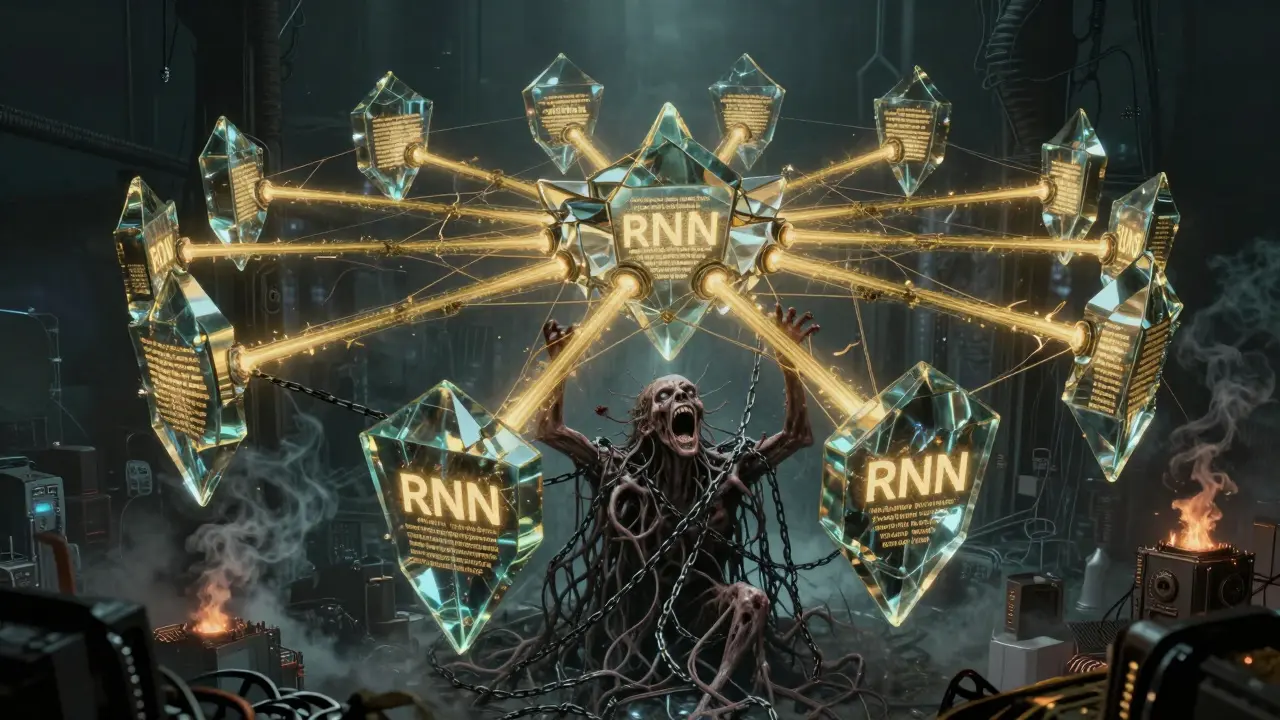
Don’t write RNNs off just yet. In tiny, fast systems - embedded sensors, real-time voice assistants with under 10ms latency - RNNs still win. They use 3-5x less memory on short sequences. For predicting the next value in a sensor reading (temperature, pressure), where local patterns matter more than long context, RNNs are simpler and faster.
Even in biology, RNNs hold ground. A 2023 study on molecular property prediction found RNNs outperformed transformers on tasks focused on local chemical features. The transformer’s global view wasn’t helpful - the signal was too local. Sometimes, less attention is better.
But these are exceptions. In 2024, less than 1.3% of new NLP projects used RNNs. They’re relics, not rivals. The industry moved on.
The Future: Beyond Transformers?
Transformers aren’t the end. They’re the current peak. New models are already fixing their flaws. Google’s Gemini 1.5 handles up to 1 million tokens - thanks to a mixture-of-experts design that only activates parts of the model when needed. Meta’s Llama 3 cut training costs by 37% with smarter attention. Sparse attention (BigBird) reduces memory from O(n²) to O(n1.5). Relative positional encoding (T5) improved how models understand word order.
Some researchers are blending transformers with symbolic logic. Google’s AlphaGeometry, released in March 2024, solved complex geometry problems by combining neural attention with rule-based reasoning - something pure transformers can’t do. Others are exploring quantum-inspired attention or hybrid architectures that might one day replace transformers entirely.
But for now, the balance of power stays. Transformers give us speed, scale, and context. They turned language models from slow, forgetful machines into systems that can read a 50-page report and answer questions about it - in seconds. The trade-offs are real: energy, cost, complexity. But the gains? Unmatched.
As Yoshua Bengio put it, self-attention wasn’t an upgrade. It was the missing piece. The one that let machines finally grasp how language works - not by memorizing patterns, but by seeing how every word connects to every other.
Why did transformers replace RNNs in large language models?
Transformers replaced RNNs because they process entire sequences in parallel, making training much faster, and use self-attention to capture relationships between any two words - even those far apart. RNNs process words one at a time and struggle to remember context beyond 10-20 tokens due to vanishing gradients. Transformers solved both problems at once, enabling models like GPT-3 and Llama 3 to handle long documents and complex reasoning.
What is the key difference between transformers and RNNs?
The key difference is how they handle sequence order. RNNs process words sequentially, building context step by step. Transformers process all words at once using self-attention, where each word directly links to every other word. This lets transformers understand long-range relationships without relying on memory chains. Positional encoding adds word order back into the model, since transformers don’t naturally know sequence.
Are transformers always better than RNNs?
No. Transformers excel with long texts and large datasets but need far more memory and computing power. For very short sequences (under 20 tokens) or systems with strict latency limits (like embedded devices), RNNs are still faster and more efficient. Some biological and time-series tasks also favor RNNs because they focus on local patterns, not global context.
How do transformers handle long-range dependencies?
Transformers use self-attention to directly connect any two words in a sequence. If “John” appears at the start of a 1,000-word document and “he” appears near the end, the attention mechanism calculates a high score between them. This bypasses the need to pass information through dozens of layers, which is what causes RNNs to forget. As a result, transformers maintain strong performance even on sequences longer than 4,000 tokens.
What are the biggest downsides of transformers?
Transformers require massive amounts of memory - their attention mechanism scales quadratically with sequence length. Training large models like GPT-3 uses thousands of GPUs and emits hundreds of tons of CO₂. They’re also hard to interpret - you can’t easily see why a model made a decision. And they need huge datasets to train well, making them expensive and unsustainable for small teams.
Will transformers be replaced soon?
Not in the near future. Even with new models like Gemini 1.5 and Llama 3 pushing boundaries, transformers still dominate 98.7% of state-of-the-art NLP systems. Research is moving toward hybrids - combining attention with symbolic logic or sparse architectures - but these are improvements, not replacements. For now, transformers remain the most efficient way to balance speed, scale, and context in language models.


Andrew Nashaat
December 15, 2025 AT 07:37Okay but let’s be real - RNNs were never even close to being viable for real-world use. I’ve seen teams waste MONTHS trying to tune LSTMs just to get 78% accuracy on a 500-word task. Transformers? Just throw it at BERT and boom - 89%. It’s not even a debate anymore. If you’re still using RNNs in production in 2024, you’re either a masochist or your boss doesn’t know what a GPU is.
Gina Grub
December 16, 2025 AT 12:07Transformers are a computational cancer. O(n²) attention? For a 10k-token legal doc that’s 100M attention weights. We’re training models that cost more than a small country’s GDP in electricity just to answer ‘what’s the capital of Belarus?’ The ‘revolution’ is just a glorified attention heatmap over a landfill of carbon.
Nathan Jimerson
December 18, 2025 AT 09:02This is one of the clearest breakdowns I’ve read on why transformers won. The parallelization point alone is game-changing - it’s like going from dial-up to fiber optic overnight. Even if they’re greedy with memory, the speed and accuracy gains are worth it. The future isn’t just brighter - it’s faster.
Sandy Pan
December 19, 2025 AT 21:41It’s fascinating how we’ve replaced biological metaphor with mathematical abstraction. RNNs tried to mimic the human brain’s sequential thought - but we never really understood how the brain remembers. Transformers don’t remember at all - they just compute relationships. Is that understanding? Or just pattern matching on steroids? We built a machine that can write poetry but can’t explain why it chose that word. Maybe the real question isn’t ‘why transformers?’ but ‘what have we lost by not needing to remember?’
Eric Etienne
December 21, 2025 AT 18:18Ugh. I read the whole thing. Honestly? I just want to know if I can run this on my laptop without melting it. Answer: no. So yeah. Cool tech. Useless for me. Next.
Dylan Rodriquez
December 23, 2025 AT 06:15There’s something beautiful in how this shift reflects our broader relationship with technology - we stopped trying to replicate biological processes and started optimizing for scale and efficiency. RNNs were like handwritten letters; transformers are like a global messaging network. One is intimate, the other is infinite. Neither is ‘better’ - they serve different purposes. But the fact that we could even make this leap? That’s the real miracle.
Amanda Ablan
December 24, 2025 AT 11:09For anyone wondering if transformers are worth the cost - yes, if you’re building something users will interact with daily. But if you’re just prototyping or working on edge devices? Don’t ignore RNNs. They’re not dead - just niche. And that’s okay. Not every tool needs to be a sledgehammer.
Janiss McCamish
December 26, 2025 AT 05:49Transformers don’t forget. RNNs did. That’s it. End of story.
Kendall Storey
December 27, 2025 AT 06:24Let’s not romanticize this. Transformers aren’t magic - they’re just really good at brute-forcing context. The attention mechanism is just a fancy way of saying ‘check everything, all the time.’ That’s why they need a billion parameters. The real win isn’t intelligence - it’s throughput. We traded elegance for speed, and honestly? The market chose right.
Andrew Nashaat
December 28, 2025 AT 17:31And don’t even get me started on people who say ‘but RNNs are simpler!’ - simpler? Sure. Like a horse is simpler than a Tesla. Doesn’t mean you don’t want the Tesla when you’re late for work. Also, LoRA? That’s the real MVP. Fine-tune a 70B model on your 24GB GPU. We’re living in the future.