
It’s 2026, and software teams are no longer estimating delivery dates with spreadsheets and gut feelings. They’re using Vibe Coding data to predict when features will ship-with surprising accuracy. If you’re still relying on old-school sprint planning or Jira-based guesswork, you’re not just behind. You’re flying blind.
Vibe Coding isn’t just another AI tool. It’s a complete shift in how code gets built. Instead of writing lines of code manually, developers describe what they want in plain language. AI generates the structure, the tests, the API endpoints, even the UI components. And because every step is logged, tracked, and measured, you can pull real-time data on how fast each type of task is getting done. That’s the key: you’re not guessing anymore. You’re forecasting.
What Vibe Coding Actually Does
Vibe Coding blends AI-powered code generation with automated testing and natural language workflows. Think of it like having a supercharged pair programmer who never sleeps, never gets distracted, and remembers every pattern you’ve ever used. But unlike traditional AI assistants, Vibe Coding systems are designed to collect data at every stage-how long it took to generate a login screen, how many revisions were needed for a payment API, how often the AI misunderstood a business rule.
Companies like Hexaware Technologies and Relanto AI have turned this into a measurable system. Hexaware’s platform, for example, delivers production-ready features in under 12 weeks, compared to the traditional 6-9 months. Relanto reports cutting coding cycles by 40-60%. These aren’t marketing claims. They’re backed by internal metrics from teams using the system daily.
The magic isn’t just in speed. It’s in consistency. When an AI generates a React component, it doesn’t forget how you like your state management. It learns your patterns. Over time, it builds a personalized profile of your team’s style, preferences, and common mistakes. That’s what makes forecasting possible.
Why Traditional Estimation Fails
Remember when you’d say, “This feature should take two weeks”? And then it took five? Or worse-you said “three days,” and it turned into a month-long debugging nightmare?
Traditional estimation relies on human memory, past experience, and wishful thinking. You think, “Last time we built a user dashboard, it took 10 days. This one’s similar.” But every project is different. Different team members. Different constraints. Different edge cases. And if you’re using legacy codebases, you’re not just building-you’re untangling.
Vibe Coding removes the guesswork. It doesn’t ask you to estimate. It observes. Every time the AI generates a function, it logs:
- How many prompts were needed
- How long the generation took
- How many edits were made after generation
- How many tests passed on the first run
- Which parts required manual override
That’s a goldmine of data. You’re not predicting based on vague memories. You’re predicting based on real, recorded behavior.
How to Start Forecasting With Vibe Coding Data
Here’s how real teams are doing it in 2026:
- Start small. Pick one non-critical feature-maybe a new settings page or a simple report generator. Use Vibe Coding to build it. Don’t try to migrate your whole stack.
- Track everything. Use your Vibe Coding platform’s built-in analytics. Look at the time-to-generate, edit count, test pass rate. Save this as your baseline.
- Classify tasks. Not all code is the same. UI components? 51% faster on average. API integrations? 67% faster. Business logic? 34% faster. Security code? Only 12% faster. Tag each task type as you go.
- Build a model. After 5-10 tasks, start grouping your data. If a new feature looks like your last “API integration” task, look up the average time it took. Adjust for team size. Smaller teams (2-5 people) see 68% faster delivery. Larger teams (15+) only see 31% gains.
- Adjust for complexity. If the task involves novel algorithms or compliance rules, add a 30-50% buffer. Vibe Coding struggles with these. The AI doesn’t “get” HIPAA or PCI-DSS the way a human engineer does. You still need to validate.
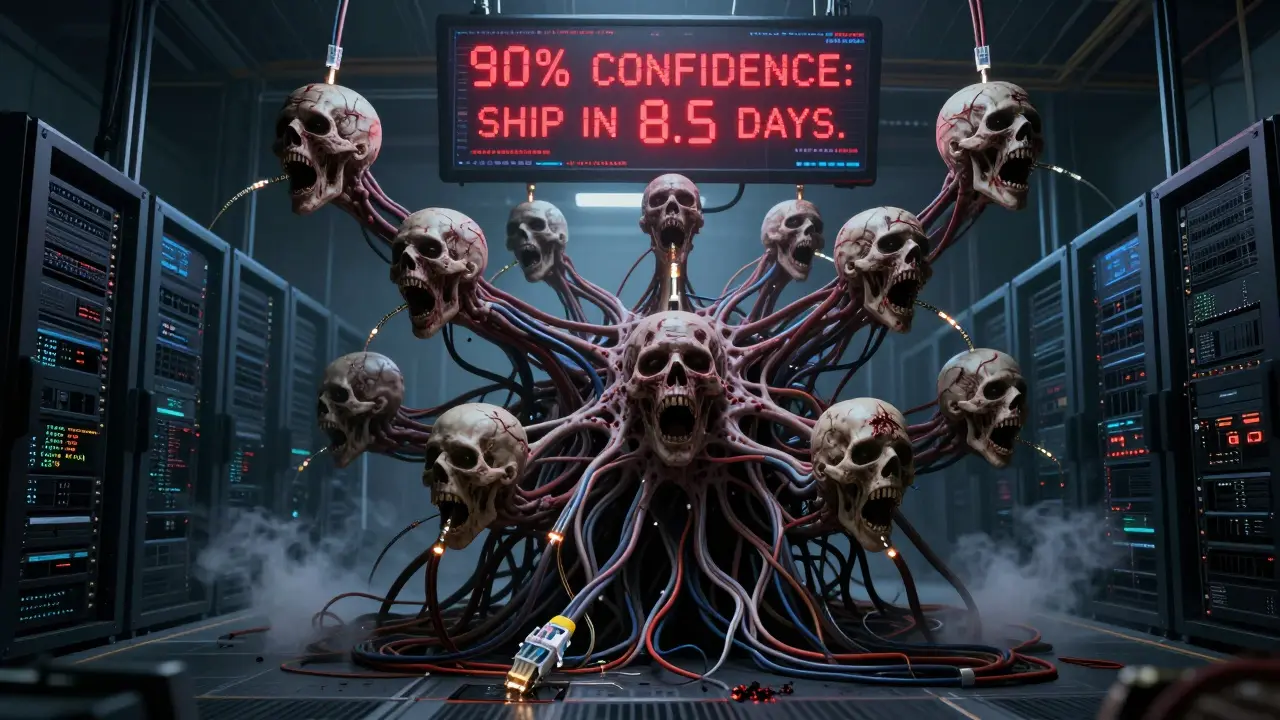
One team at a fintech startup in Austin used this method to forecast delivery for a new KYC verification module. They had 12 similar tasks logged. Their model predicted 9 days. It took 8.5. They shipped early. No overtime. No panic.
What the Data Really Shows
Second Talent’s 2025 report analyzed 1,200 development teams using Vibe Coding. Here’s what they found:
| Task Type | Speed Improvement | Notes |
|---|---|---|
| Boilerplate & configuration | 81% | Almost no human input needed |
| API integration & data parsing | 67% | Works best with well-documented endpoints |
| UI components | 51% | Design system consistency boosts results |
| Business logic | 34% | Requires clear specs; prone to hallucinations |
| Complex algorithms | 18% | Still better with humans |
| Security-critical code | 12% | Validation overhead cancels speed gains |
These numbers aren’t theoretical. They’re pulled from actual development logs. If you know what kind of task you’re facing, you can predict the timeline within a day or two.
Who Benefits the Most
Vibe Coding isn’t for everyone. It shines brightest in specific scenarios:
- Lean startups with 2-5 developers. They move fast. They need to validate ideas quickly. Vibe Coding lets them build MVDs (Minimum Valuable Demonstrations) in 2-4 weeks instead of quarters.
- Product teams building repetitive features-onboarding flows, reporting dashboards, email templates. These are perfect for AI automation.
- Enterprise teams stuck in legacy systems. Vibe Coding can help them modernize without rewriting everything from scratch.
But if you’re in healthcare or finance, and you’re building compliance-heavy code? You’ll see slower gains. The validation overhead eats into the speed. That’s not a flaw-it’s a reality. You still need human reviewers for HIPAA, SOC2, or GDPR checks.
And if your team has never used AI tools before? There’s a learning curve. Hexaware’s onboarding takes 2-3 weeks. Relanto’s users report a “steep learning curve for non-AI-native developers.” You’re not just learning a tool. You’re learning a new way to think.
The Hidden Risk: Overreliance
Here’s what no one talks about enough: the more you use Vibe Coding, the more you forget how to build without it.
One developer on Reddit (u/DevInAustin) wrote: “We cut our delivery time from 6 weeks to 10 days. But when the AI broke on a weird edge case, no one on the team knew how to fix it. We had to hire a consultant.”
That’s the trap. If your team only knows how to prompt the AI and click “approve,” you’re not building skills-you’re building dependency. And if the AI goes down? Or if your vendor changes pricing? You’re stuck.
The smart teams don’t just use Vibe Coding. They use it as a training wheel. They assign senior engineers to review every AI-generated block. They write documentation. They teach juniors how to debug the outputs. They keep their core logic in-house.
As Andrew Chen put it in his 2025 update: “Vibe Coding is the fastest way to build-and the quickest way to break.”
Where This Is Going
By 2027, up to 90% of boilerplate and configuration code will be AI-generated. That’s the prediction from TowardsAI. Salesforce plans to raise AI-generated code from 20% to 50% by Q3 2026. GitHub says its Copilot already saves developers 55% of coding time.
Forecasting delivery timelines won’t be a skill you learn-it’ll be built into your tools. Your project management software will pull data from your Vibe Coding platform, auto-calculate timelines based on task type, team size, and historical performance, and update the schedule in real time.
PMs won’t say, “When can we ship this?” They’ll say, “What’s the 90% confidence interval for this feature based on last month’s data?”
The future isn’t about writing more code. It’s about asking better questions-and using data to answer them.
Final Thought: You’re Not Replacing Developers. You’re Elevating Them.
Vibe Coding doesn’t make engineers obsolete. It frees them from the grind. No more spending three days writing CRUD APIs. No more copying and pasting the same validation logic across ten services.
Instead, engineers focus on what matters: architecture, edge cases, security, and user experience. They become the validators, the strategists, the problem-solvers.
And that’s the real forecast: teams that use Vibe Coding data to plan will ship faster, with higher quality, and with less burnout. The ones that don’t? They’ll keep guessing. And losing.
Can Vibe Coding predict delivery times for complex features like machine learning models?
Not reliably. Vibe Coding excels at routine tasks like UI components and API integrations, but complex algorithms like machine learning models require deep domain expertise and iterative testing. AI can generate starter code, but the training loops, data preprocessing, and validation steps still need human oversight. Expect only 18% faster development here, with significant review time added.
Do I need to train my team to use Vibe Coding?
Yes. Teams need 2-3 weeks of onboarding to learn prompt engineering, how to validate AI outputs, and how to spot hallucinations. Simply installing the tool won’t work. Your developers must shift from writing code to directing AI. This includes learning how to write clear, specific prompts and how to interpret generated code.
Is Vibe Coding secure for financial or healthcare apps?
Use with caution. While Vibe Coding can speed up non-security parts of these apps, security-critical code (like encryption, authentication, or compliance logic) only sees 12% speed gains. Validation overhead cancels out most benefits. Always have senior engineers review AI-generated security code. Never auto-deploy it without manual audit.
How accurate are Vibe Coding forecasts?
For routine tasks, forecasts are within ±1 day 85% of the time after 5-10 tracked tasks. Accuracy improves as you collect more data. For complex tasks, accuracy drops to ±3-5 days. Always add a 20-30% buffer for business logic and integration work.
Can Vibe Coding work with legacy codebases?
Yes, but with limits. Vibe Coding works best with modern stacks like React, Node.js, or Salesforce Apex. Legacy systems (like COBOL or outdated Java) require manual wrappers or API layers. Teams report integration challenges with older CI/CD pipelines. Start by applying Vibe Coding to new modules, not rewriting old ones.
What’s the biggest mistake teams make with Vibe Coding?
Assuming AI-generated code is production-ready. Many teams skip reviews because “the AI got it right last time.” That’s how bugs slip into production. Always validate. Always test. Always document. Speed without quality is just technical debt waiting to explode.
How do I convince my manager to adopt Vibe Coding?
Start with a pilot. Pick one small feature, use Vibe Coding to build it, and track the time saved. Show the data: “We delivered this in 8 days instead of 21.” Then compare cost savings. Hexaware reports 70% cost reduction. Even if you get half that, it’s a win. Use real metrics, not opinions.


King Medoo
January 24, 2026 AT 10:23Look, I get it-AI writes code now, and that’s cool 🤖✨. But let’s not pretend this is some magic wand. I’ve seen teams go all-in on Vibe Coding, then panic when the AI generates a login flow that sends passwords in plaintext. No one caught it because ‘the AI said it was fine.’ We’re not replacing engineers-we’re outsourcing critical thinking to a bot that doesn’t know what HIPAA is unless you spell it out in all caps. And don’t even get me started on the ‘90% faster’ claims. Where’s the audit trail? Who’s liable when the AI auto-deploys a vulnerability? 🤔
Rae Blackburn
January 25, 2026 AT 11:35LeVar Trotter
January 26, 2026 AT 02:53There’s a lot of valid excitement here, but the real win isn’t the speed-it’s the data fidelity. When you log every prompt, revision, and test pass, you’re not just forecasting delivery-you’re building a living knowledge graph of your team’s engineering DNA. That’s transformative for onboarding, retrospectives, even compensation modeling. The key is treating Vibe Coding as a co-pilot, not a replacement. Senior engineers should be auditing outputs, not approving them. And yes, training is non-negotiable. Teams that treat this like a plug-and-play tool are setting themselves up for technical debt avalanches. Start small, track rigorously, and let the data inform-not dictate-your decisions.
Tyler Durden
January 27, 2026 AT 18:29Aafreen Khan
January 28, 2026 AT 15:09Renea Maxima
January 29, 2026 AT 21:42It’s fascinating how we’ve turned engineering into a performance art where the AI is the star and the human is the audience. We’ve outsourced not just the typing, but the thinking. And now we’re surprised when the script doesn’t make sense? The real forecast isn’t about delivery timelines-it’s about the slow erosion of craftsmanship. We used to build things. Now we curate hallucinations. And we call it innovation. I wonder what the next generation will think when they find these logs in a digital museum labeled: 'How Humans Learned to Stop Coding.'
Megan Ellaby
January 30, 2026 AT 16:15