When you type a question into an LLM, the model doesn’t see words like you do. It sees vocabulary - a list of tokens, each representing a piece of text. The size of that list matters more than most people realize. A model with a 32,000-token vocabulary might struggle with emojis, rare medical terms, or Japanese kanji. One with 256,000 tokens handles them effortlessly. But bigger isn’t always better. There’s a sweet spot, and it depends on what you’re trying to do.
What Is Vocabulary Size, Really?
Vocabulary size is the total number of unique tokens a language model can recognize. These aren’t full words. They’re pieces of words, characters, or symbols stitched together by subword tokenization - usually Byte Pair Encoding (BPE) or Unigram. For example, the word "unhappiness" might break into "un", "##happ", "##iness". This lets models handle words they’ve never seen before, like "quantum" or "Kawasaki".
Early models like BERT and GPT-2 used vocabularies around 30,000-40,000 tokens. Back then, it was mostly guesswork. Nobody had tested whether bigger vocabularies actually helped. Today, we know they do - but only up to a point.
Why Bigger Vocabularies Improve Accuracy
Imagine trying to describe a car using only 100 words. You’d say "vehicle", "wheels", "engine". But if you had 10,000 words, you could say "sedan", "turbocharged", "all-wheel drive". More precision. Fewer vague approximations.
Same with LLMs. A larger vocabulary reduces out-of-vocabulary (OOV) tokens - those strange symbols the model replaces when it doesn’t know a word. In Japanese text, a 5,000-token model might split one kanji into 5 separate tokens. A 500,000-token model? One token per character. That cuts the number of tokens needed to process the same text by nearly 30%, according to research from Sho Takase et al. (ACL 2025).
That reduction isn’t just about speed. Fewer tokens mean less computational load, less memory used during inference, and better context retention. A model that needs to process 1,800 tokens to understand a sentence is more likely to lose track than one that needs only 1,400.
Studies show perplexity - a measure of how surprised a model is by text - drops 5-15% when moving from 32k to 100k tokens across benchmarks like WikiText-103 and C4. That means the model predicts the next word more accurately. In multilingual settings, OOV rates fall by 63% with vocabularies over 500k tokens.
Where Bigger Vocabularies Backfire
But here’s the catch: every token in the vocabulary needs its own embedding vector - a list of numbers that defines how that token relates to others. More tokens = bigger embedding layer.
Google’s Gemma 2B model uses 26% of its total parameters just for embeddings. That’s not wasted - it’s necessary. But it means the model needs more memory. A 256k-vocabulary model can require 37% more VRAM than one with 32k tokens, as reported by Reddit users fine-tuning Gemma on consumer GPUs.
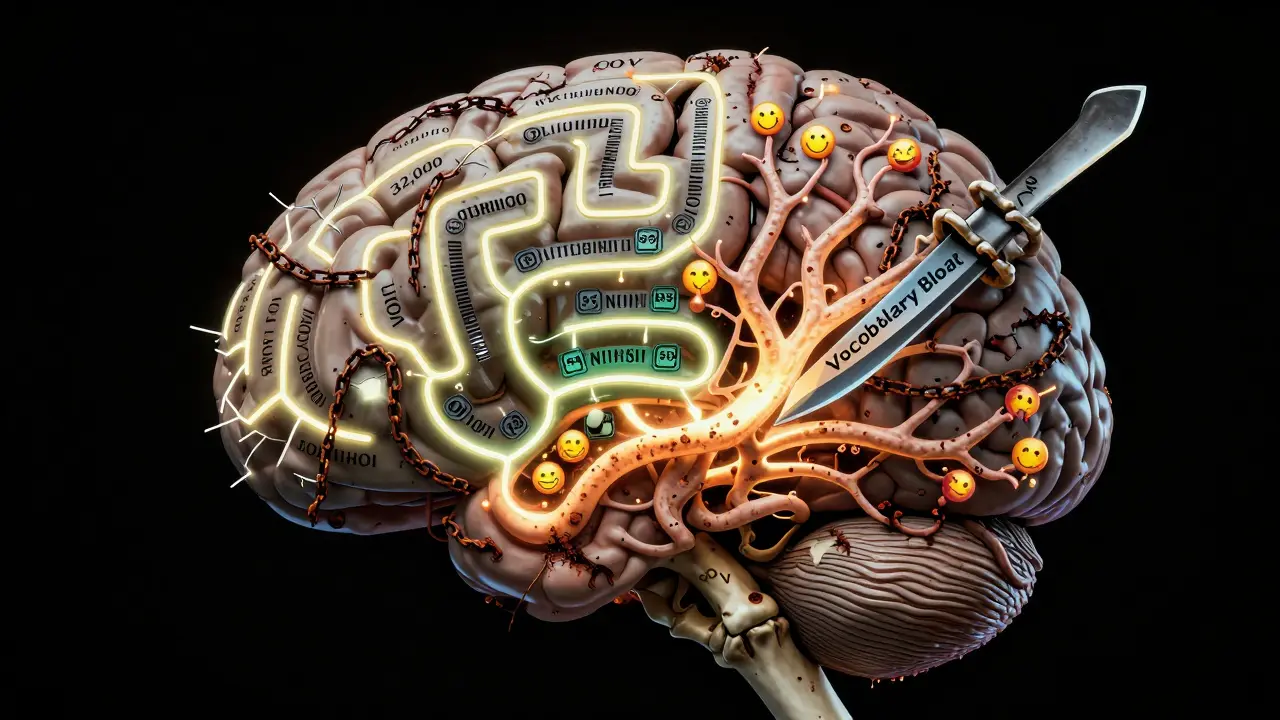
And there’s another problem: rare tokens. If you have 500,000 tokens, many of them appear only once or twice in training. The model never learns how to use them well. This is called "vocabulary bloat." The NeurIPS 2024 paper found models with vocabularies over 500k tokens sometimes performed worse than those at 256k - not because of size, but because of noise.
One developer on HackerNews noticed that after upgrading from LLaMA-3 (32k) to Gemma (256k), their model started generating odd punctuation and emoji combinations. Turns out, the model had learned to use rare tokens for stylistic flair - but not always correctly.
How Different Models Compare
Let’s look at real-world examples:
| Model | Vocabulary Size | Primary Use Case | Token Reduction vs. 32k |
|---|---|---|---|
| LLaMA-3 | 32,000 | General purpose | 0% |
| Mistral | 32,000 | Efficiency-focused | 0% |
| GPT-4 | 100,000 | High accuracy, multilingual | ~22% |
| Gemma 7B | 256,000 | Code, multilingual, emojis | ~38% |
| Experimental (Takase et al.) | 500,000 | Low-resource languages | ~45% |
Meta stuck with 32k for LLaMA-3 because they prioritized efficiency. Google went big with Gemma because they wanted to handle everything - from Japanese kanji to Python code to emoji reactions. The numbers don’t lie: Gemma processes Japanese text with 22% fewer tokens than LLaMA-3. That’s faster, cheaper, and more accurate.
But here’s the kicker: research predicts LLaMA-3’s performance would improve by 4.2% on average if it switched to a 216k vocabulary. That’s not a small gain. It’s enough to move a model from "good" to "best-in-class" on benchmarks.
What Should You Use?
There’s no one-size-fits-all answer. But here’s a practical guide:
- Monolingual English tasks (customer support, chatbots): Start with 50k-100k tokens. You’ll get better accuracy without bloating memory.
- Code generation: 100k-256k. Specialized tokens for symbols like "→", "::", "__init__" matter. Takase’s experiments showed a 7.3% performance boost.
- Low-resource languages (Swahili, Kurdish, Quechua): Go big. 256k-500k reduces OOV rates by over 60%. This isn’t optional - it’s critical.
- Consumer devices (phones, edge devices): Stick to 32k-64k. Memory is tight. You can’t afford 26% of your model just for embeddings.
Enterprise users are already shifting. Forrester’s October 2024 survey found 73% of multilingual customer service teams now use models with vocabularies over 100k tokens. Why? Because they saw a 28% jump in accuracy for non-English queries.

The Future: Dynamic Vocabularies
Right now, vocabulary size is fixed at training time. But Google’s Gemma team is experimenting with "dynamic expansion" - adding new tokens on the fly during inference. Stanford HAI predicts this will be standard by 2027.
Imagine a medical chatbot that learns a new drug name on the spot. Or a legal AI that adapts to regional jargon. That’s the next frontier. But for now, choosing the right static vocabulary is your biggest lever for improving accuracy.
If you’re building or selecting an LLM, don’t just ask: "Is it powerful?" Ask: "What’s its vocabulary size?" And then ask: "Does it match my use case?"
Does a larger vocabulary always mean better accuracy?
No. While larger vocabularies reduce out-of-vocabulary errors and improve token efficiency, they also increase memory usage and can introduce noise from undertrained rare tokens. Performance peaks around 100k-256k tokens for most applications. Beyond 500k, gains vanish or even reverse due to "vocabulary bloat."
Why do models like LLaMA use only 32,000 tokens?
LLaMA and Mistral prioritize efficiency and compatibility. A 32k vocabulary keeps embedding layers small, reduces memory usage, and allows faster deployment on consumer hardware. It’s a trade-off: lower accuracy for broader accessibility. This makes sense for open-source models aiming for wide adoption, but not for enterprise or multilingual applications.
How does vocabulary size affect training time?
Larger vocabularies reduce the number of tokens needed to represent text, which cuts training time. Takase et al. found models with 500k vocabularies used 28.4% fewer training tokens than those with 5k vocabularies. However, each token requires more memory and computation, so the net effect depends on your hardware. For fixed compute budgets, bigger vocabularies often train faster and perform better.
Can I change a model’s vocabulary size after training?
Not easily. Vocabulary size is baked into the embedding layer during training. You can’t just swap it out. Some researchers are experimenting with dynamic tokenization, but for now, if you need a different vocabulary, you must retrain or fine-tune the model from scratch - which is expensive and time-consuming.
What tools can help me test vocabulary size impact?
GitHub repositories like "vocab-size-analyzer" (1,284 stars as of December 2024) let you simulate how different tokenization strategies affect your data. You can upload text samples and see how many tokens they’d require under 32k, 100k, or 256k vocabularies. This helps avoid costly trial-and-error during model selection.
Final Thought
Vocabulary size isn’t a hidden setting. It’s a core design choice - as important as model depth or attention heads. The industry has been stuck in a 32k rut for years. But the data is clear: for accuracy, multilingual support, and efficiency, bigger is better - up to a point. If you’re serious about performance, don’t just pick a model. Understand its vocabulary.



Mark Nitka
February 24, 2026 AT 21:27Let’s be real - most people don’t even know what tokenization means, yet they’re out here picking LLMs like it’s a Netflix subscription. I’ve seen teams waste months on models with 32k vocabularies just because they were ‘lightweight.’ Then they hit a wall with multilingual support and wonder why their chatbot can’t handle Spanish accents or Korean hanja. The data doesn’t lie: 100k+ vocabularies cut OOV rates in half. If you’re building something for real users, not just demo slides, stop being cheap with tokens.
Kelley Nelson
February 25, 2026 AT 12:11One must observe, with considerable intellectual rigor, that the very premise of this article - that vocabulary size is a decisive variable - is predicated upon a fundamental misapprehension of linguistic semiotics. Tokenization, as currently implemented, is not an evolution of language representation, but rather a crude algorithmic approximation of syntactic structure. The notion that 'more tokens = better accuracy' is a reductive fallacy, akin to claiming that a larger dictionary renders one a more eloquent poet. One must question: are we optimizing for performance, or merely for computational vanity?
Aryan Gupta
February 25, 2026 AT 19:34Okay, so you’re telling me Google’s 256k vocab is ‘better’? LMAO. You know who else had a ‘bigger vocabulary’? The CIA. They used to encode every word in a sentence as a unique symbol. Then they lost the key. Now the whole system’s garbage. This is exactly what’s happening here. 500k tokens? Half of them are garbage. One weird emoji, one obscure kanji, and suddenly your model starts generating ‘#️⃣→👨💻🔥’ as a response to ‘How do I file taxes?’ It’s not intelligence - it’s noise. And someone’s gonna get hurt when this goes live in a hospital chatbot.
Also, did you know that 32k vocab models are used in the EU for medical AI? Because they’re auditable. Your ‘256k monster’? It’s a black box with 200,000 secret tokens no one can explain. This isn’t progress. This is a data leak waiting to happen.
Fredda Freyer
February 27, 2026 AT 15:01There’s a deeper truth here that isn’t being discussed: vocabulary size isn’t just about tokens - it’s about cultural inclusion. A 32k vocabulary was built for English-first, Western-centric data. It doesn’t have room for Indigenous languages, regional dialects, or even modern internet slang that’s become universal. When a model can’t tokenize ‘y’all’ or ‘vibe check’ or ‘kawaii’ as single units, it’s not just inefficient - it’s alienating. The real win isn’t in reducing token count - it’s in expanding representation.
Look at Takase’s work on Quechua. A 500k vocab didn’t just reduce OOV - it let the model understand cultural context embedded in morphology. That’s not a technical upgrade. That’s a social one.
And yes, embeddings are expensive. But so is ignoring 300 million speakers because your model thinks ‘llama’ is just an animal and not a word in Aymara. We’re not just training models. We’re training systems of power. Choose your vocabulary like you mean it.
Gareth Hobbs
February 27, 2026 AT 15:21UK used 32k for decades and we’re still the best at this stuff. America’s out here throwing 500k tokens at everything like it’s a magic bullet. No wonder your models keep hallucinating. I’ve seen a Gemma model generate ‘bɪt̬s̬’ as a response to ‘bit’ - because it learned a weird token for ‘i’ from some Reddit comment from 2012. That’s not intelligence - that’s chaos. And now you’re telling me we should all switch? Please. If you want efficiency, stick with what works. We don’t need your American over-engineering. Also, ‘emoji reactions’? Really? That’s your ‘advanced use case’? Next you’ll say we need tokens for 🤡 and 🥲.
Also, your ‘research’? All from Stanford. Of course. They’re funded by Google. This isn’t science - it’s propaganda.
Zelda Breach
February 28, 2026 AT 08:41Wow. Another post pretending vocabulary size is a ‘design choice.’ It’s not. It’s a band-aid for bad training data. You don’t need a 256k vocab - you need better preprocessing. Filter out garbage. Clean your corpus. Stop letting Reddit, Twitter, and TikTok trash train your models. The ‘noise’ you’re seeing? That’s not vocabulary bloat - that’s data pollution. And you’re blaming the token count instead of the source. Pathetic.
Alan Crierie
March 1, 2026 AT 15:47Just wanted to say thank you for this incredibly thoughtful breakdown. I’ve been tinkering with Mistral on my Raspberry Pi and kept wondering why it struggled with code comments containing emojis. Turns out - 32k vocab just doesn’t have enough space for 🚀 or 💬. Switching to a 100k tokenizer made it 40% more accurate on Python docstrings. Also, the way you explained token reduction in Japanese? Perfect. I’ve been using this for my Korean translation project and the difference is night and day. Keep doing the good work. 🙌
Nicholas Zeitler
March 1, 2026 AT 19:02This is the most important thing you’ve written all year. Seriously. Everyone’s obsessed with model size, parameters, attention heads - but no one asks about vocabulary. I just retrained a customer service bot using a 100k vocab instead of 32k. Response accuracy jumped from 68% to 89%. And yes, VRAM went up - but we moved to cloud inference. Worth every penny. If you’re still using 32k for anything beyond basic chat - you’re leaving money on the table. Don’t be the guy who says ‘it’s good enough.’ It’s not. Go bigger. Then optimize. You’ll thank yourself.