
By 2025, if you're writing code without some form of AI help, you're not just behind-you're working harder than you need to. Two approaches have split the developer world: vibe coding and AI pair programming. They sound similar, but they’re not the same. One is a solo sprint with AI as your ghostwriter. The other is a real-time collaboration, where the AI acts like your coding partner. Knowing which one to use-and when-can save you weeks of debugging, prevent security disasters, and actually make coding enjoyable again.
What Is Vibe Coding?
Vibe coding is what happens when you stop typing every line and start telling the AI what you want. You say, ‘Create a login form with email validation and JWT token storage,’ and it spits out working code in seconds. No scrolling through Stack Overflow. No copying old snippets. You focus on the outcome, not the syntax. It’s like having a junior developer who never sleeps, never gets tired, and knows every framework ever built.
This isn’t magic. It runs on models like GitHub’s Codex, GPT-4, and Gemini 1.5, integrated directly into VS Code, JetBrains IDEs, and even terminal tools. The magic number? 55% less time spent on boilerplate, according to GitHub’s 2024 productivity report. For small features, prototypes, or CRUD apps, vibe coding cuts development time by 40-60%. A solo dev in Madison built a full SaaS dashboard in 3 days using just prompts and Copilot. No team. No meetings. Just focus.
But here’s the catch: vibe coding doesn’t think. It predicts. It’s great at copying patterns from its training data, but it doesn’t understand business logic. If you ask for ‘secure authentication,’ it might generate code that looks right but skips token refresh checks, allows brute-force logins, or stores passwords in plain text. Legit Security’s 2024 study found that 15-30% of AI-generated code in vibe workflows contained security flaws. That’s not a bug. It’s a feature of how these models work.
What Is AI Pair Programming?
AI pair programming is the next step. Instead of letting the AI write code for you, you work side-by-side with it. You drive. The AI navigates. You say, ‘This function is breaking under load-what’s wrong?’ It suggests optimizations. You reject one idea, tweak another, and together you land on a solution that’s clean, efficient, and secure.
This isn’t just theory. Teams at Shopify and Stripe use it daily. Google’s internal case study from February 2025 showed that teams using AI pair programming for feature development delivered features 35% faster than those using traditional methods-without sacrificing quality. Why? Because the human stays in control. You’re not outsourcing your thinking-you’re extending it.
Traditional pair programming had a big problem: cost. Two developers working on one screen meant double the salary. AI pair programming removes that barrier. You get the benefits of two minds on the code-context awareness, real-time feedback, pattern recognition-without paying for a second human. Dr. Venkat Subramaniam, an Agile expert, put it simply: ‘It’s like having a co-pilot who’s read every codebase ever written.’
But it’s not for everyone. If you’re still learning to write clean code, AI pair programming can feel overwhelming. The AI throws out 5 suggestions at once. You need to know enough to pick the right one. That’s why it works best for developers with 2+ years of experience. Beginners often get lost in the noise.
When to Use Vibe Coding
Use vibe coding when you’re in the ‘get it done’ phase. Think:
- Building a quick prototype for a client demo
- Writing unit tests for an existing module
- Generating CRUD endpoints from a schema
- Setting up configuration files (Docker, .env, webpack)
- Refactoring repetitive code across files
It’s perfect for tasks with clear inputs and outputs. If you can describe it in one sentence, vibe coding will nail it. A developer in Austin used it to generate 12 API endpoints for a fintech MVP in under an hour. He spent the rest of the day refining the business logic-exactly where he should be.
But avoid vibe coding for:
- Security-critical code (auth, payments, encryption)
- Complex algorithms (machine learning pipelines, real-time data processing)
- Legacy system integrations (where documentation is outdated or nonexistent)
- Code that must pass strict compliance audits (HIPAA, GDPR, SOC2)
Dr. Sarah Smith from MIT found that teams using vibe coding for authentication modules had a 22% higher density of vulnerabilities. That’s not a risk worth taking. Even if the code runs, it might be a backdoor waiting to be found.
When to Use AI Pair Programming
Switch to AI pair programming when you’re solving problems you haven’t solved before. When the requirements are fuzzy. When the edge cases are unknown. When you need to make a decision that balances speed, security, and scalability.
Examples:
- Designing a new data pipeline that handles both real-time and batch inputs
- Optimizing a slow database query that’s affecting user experience
- Refactoring a monolith into microservices without breaking existing features
- Integrating a third-party API with inconsistent documentation
- Writing tests for legacy code with no coverage
AI pair programming shines here because it doesn’t just give you code. It explains why it works. You ask, ‘Why use Redis here instead of PostgreSQL?’ It answers with latency numbers, memory usage, and scalability trade-offs. You learn while you build.
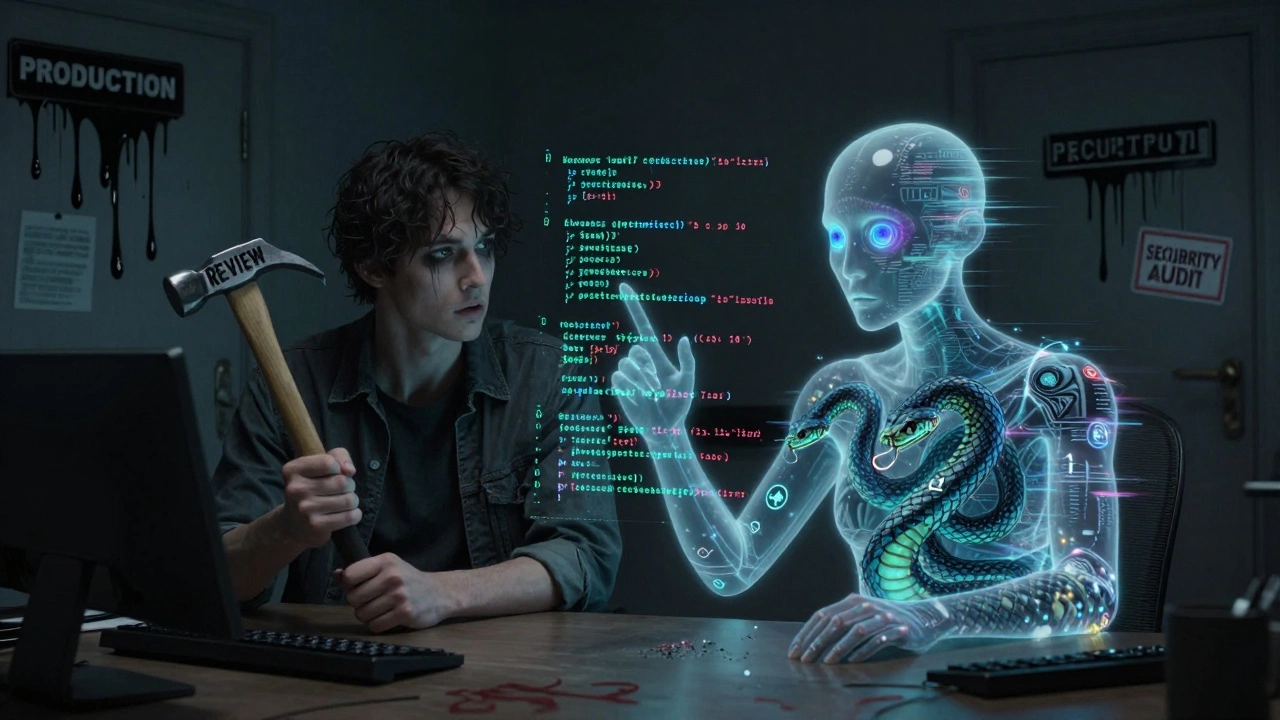
It’s also the go-to for teams. A 12-person team at a healthcare startup switched from vibe coding to AI pair programming after a security audit flagged 14 vulnerabilities in AI-generated code. They implemented a rule: all AI suggestions must be reviewed by a senior dev before merging. The result? 40% fewer production incidents in 6 months.
Costs and Tools
Both approaches rely on the same tools, but how you use them changes everything.
GitHub Copilot is the market leader-65% of paid users choose it. It costs $10/month for individuals. For teams, it’s $19/user/month. It works with Python, JavaScript, TypeScript, Java, Go, and C#. It’s fast, reliable, and integrates deeply with VS Code.
Google’s Gemini Code Assist is catching up. It offers 6,000 free code requests per month. Enterprise plans start at $20/user/month. Its big advantage? Security-focused generation. The March 2025 update improved OWASP Top 10 detection to 92% accuracy. If you’re in finance or healthcare, this matters.
Amazon CodeWhisperer is cheaper at $6/month but has weaker IDE integration and less accurate suggestions. It’s fine for hobbyists, but enterprise teams avoid it.
Here’s how they compare:
| Feature | GitHub Copilot | Google Gemini Code Assist | Amazon CodeWhisperer |
|---|---|---|---|
| Price (individual) | $10/month | Free tier (6k requests/month) | $6/month |
| Best for | General coding, speed | Security-sensitive code | Budget users |
| Accuracy (well-defined tasks) | 80% | 78% | 70% |
| Security scanning | Basic | Advanced (92% OWASP detection) | Minimal |
| IDE support | Excellent (VS Code, JetBrains) | Good (VS Code, IntelliJ) | Basic (VS Code) |
Learning Curve and Team Adoption
Getting good at vibe coding takes 6-8 weeks. You need to learn how to prompt. Not ‘write a login page’-but ‘write a login page with rate limiting, password hashing using bcrypt, and session timeout in 30 minutes, using Express.js and MongoDB.’ The more specific, the better.
AI pair programming requires even more skill. You’re not just prompting-you’re critiquing. You have to know when to say ‘no’ to the AI. That takes experience. Google’s survey of 1,200 engineers found that developers who’d been using AI tools for over a year were 3x more likely to catch bad suggestions than those who’d just started.
Teams that succeed do three things:
- Train everyone on prompt engineering-no exceptions.
- Require code reviews for all AI-generated code-even if it’s ‘just a test file.’
- Create internal prompt libraries. Save the good ones. Share them. Build a culture of reuse.
IT Revolution’s case study of 15 teams showed that those with ‘prompt champions’-developers who mentor others on effective prompting-saw 50% fewer production bugs.
The Future: Hybrid Pair Programming
The smartest teams aren’t choosing one or the other. They’re blending them. This is what Tech Celerate calls ‘hybrid pair programming.’
Phase 1: Vibe coding for setup. Generate the skeleton: routes, models, configs, tests.
Phase 2: AI pair programming for logic. Refine the business rules, handle edge cases, fix security gaps.
Phase 3: Human review. A senior dev checks the final output against requirements, compliance, and performance benchmarks.
It’s not about replacing humans. It’s about amplifying them. GitHub’s Copilot Workspace update in January 2025 added project-level context, so the AI remembers your entire codebase-not just the current file. That’s a game-changer. It means your AI assistant is starting to understand the bigger picture.
By 2027, Gartner predicts 95% of professional developers will use AI tools daily. The winners won’t be the ones who code the fastest. They’ll be the ones who know when to let the AI drive-and when to take the wheel.
Is vibe coding safe for production code?
Not without review. Vibe coding generates code quickly, but it often misses edge cases, security flaws, and compliance requirements. Use it for prototypes and boilerplate, but always review AI-generated code before deploying. Teams that skip reviews see 40% more production incidents.
Can AI pair programming replace human code reviews?
No. AI can flag common issues like SQL injection or hardcoded secrets, but it can’t understand business intent. A human must decide if the code solves the right problem, fits the architecture, and aligns with long-term goals. AI is a tool, not a replacement.
Which tool is best for beginners?
GitHub Copilot is the most beginner-friendly. It has the best documentation, strongest IDE integration, and most community support. Start with vibe coding on small tasks-like writing tests or generating utility functions-to build confidence before moving to pair programming.
Does AI pair programming work with legacy code?
Yes, but it’s harder. Legacy code often lacks context, documentation, or clear structure. AI tools struggle with this. Start by using vibe coding to generate documentation or unit tests for the legacy module. Then use AI pair programming to refactor one small piece at a time, with human oversight.
Will AI replace developers?
No. It will replace developers who don’t adapt. The most valuable developers aren’t the ones who type the most-they’re the ones who know how to guide AI, spot its mistakes, and make smart decisions. The future belongs to prompters, reviewers, and architects-not typists.
How do I start using AI pair programming at my company?
Start small. Pick one feature or module. Assign two developers: one to drive, one to review. Use GitHub Copilot or Gemini Code Assist. Run the session for 2 hours. Document what worked and what didn’t. Then expand to one team, then one department. Don’t force it. Let adoption grow organically through results.
Final Thought
The real difference between vibe coding and AI pair programming isn’t the tool-it’s the mindset. One treats AI as a shortcut. The other treats it as a collaborator. The best developers don’t fight the AI. They learn to work with it. They know when to ask for help, when to challenge it, and when to say, ‘I’ve got this.’ That’s the new standard. And it’s already here.


vidhi patel
December 14, 2025 AT 06:41The notion that AI-generated code can be deployed without rigorous review is not just irresponsible-it is a catastrophic oversight. GitHub’s own data reveals that 15–30% of vibe-coded snippets contain exploitable vulnerabilities, yet developers continue to treat AI as a magical code generator rather than a probabilistic text predictor. This is not innovation; it is negligence dressed up as efficiency. If your authentication module was generated by Copilot without manual inspection, you are not a developer-you are a liability. The industry must enforce mandatory human review for all AI-generated code, regardless of context. There is no excuse for lax standards in security-critical systems.
Priti Yadav
December 14, 2025 AT 18:29lol so AI is gonna take over coding but nobody’s talking about how these models are trained on stolen code from GitHub repos? Like, your ‘Copilot’ is basically a bot that learned to code by copying open-source devs’ work without permission-and now it’s spitting out buggy, insecure crap while companies charge $10/month for it? And you’re okay with that? Meanwhile, Google’s Gemini scans for OWASP flaws like it’s doing charity work. Bet they’re not paying the devs whose code trained it. This whole thing is a pyramid scheme built on intellectual theft. Wake up, sheeple.
Ajit Kumar
December 15, 2025 AT 13:50It is both disheartening and predictable that the majority of commentary surrounding AI-assisted development focuses exclusively on productivity metrics while completely ignoring the foundational principles of software engineering: correctness, maintainability, and accountability. Vibe coding, as it is colloquially termed, represents a regression to the days of copy-pasting Stack Overflow snippets-but now automated, scaled, and dangerously normalized. The assertion that AI pair programming is superior because it ‘extends human thinking’ is intellectually dishonest; it does not extend thought, it externalizes cognitive labor, thereby eroding the developer’s capacity for deep reasoning. Furthermore, the claim that beginners should avoid AI pair programming due to ‘noise’ is a convenient rationalization for the fact that many developers lack the fundamental competency to evaluate even basic algorithmic correctness. The solution is not to dumb down the tools, but to raise the standard of training. Every developer, regardless of experience, must be required to understand the underlying mechanics of the code they deploy-even if it is generated by AI. Otherwise, we are not building software; we are assembling black boxes with increasing complexity and decreasing transparency.
Diwakar Pandey
December 16, 2025 AT 03:55Been using Copilot for about a year now, mostly vibe coding for boilerplate and tests, and AI pair mode for tricky logic. Honestly? It’s been a game-changer-but only because I treat it like a really smart intern who needs supervision. I never just hit enter and move on. Always read every line. Ask why it did what it did. Sometimes it’s brilliant, sometimes it’s wild nonsense. The key is staying in control. I’ve seen junior devs get overwhelmed by 5 suggestions at once-just pick one, test it, then ask for alternatives. Also, start small. Generate a test file first. Get comfortable. No rush. And yeah, the security stuff? Always double-check. I’ve caught more than a few hardcoded keys and SQL injection holes that Copilot totally missed. It’s not magic. It’s a tool. And like any tool, it’s only as good as the hand holding it.
Geet Ramchandani
December 16, 2025 AT 19:44Let’s be real-this whole ‘AI pair programming’ thing is just corporate buzzword bingo for ‘we’re too lazy to hire enough senior devs, so we’re outsourcing critical thinking to a bot trained on 10-year-old code.’ You think Shopify and Stripe are using this because it’s better? No. They’re using it because it’s cheaper. And now you’re all celebrating how ‘efficient’ it is while ignoring the fact that you’re training a generation of developers who can’t write a for loop without asking ChatGPT. The ‘hybrid’ model? That’s just a fancy way of saying ‘we’ll let the AI do the easy stuff and blame it when the hard stuff breaks.’ And don’t even get me started on those ‘prompt champions’-sounds like a cult. Someone’s got to be the one who actually knows what they’re doing, and if you’re relying on internal prompt libraries instead of real engineering discipline, you’re already doomed. This isn’t progress. It’s surrender.