
Why hallucination rate matters more than accuracy in production LLMs
When a language model says the Eiffel Tower is in London, it’s not a typo. It’s a hallucination - a confident, fluent lie that sounds right. In testing, this might be funny. In production, it’s dangerous. A financial assistant that fabricates earnings data. A medical chatbot that invents drug interactions. A legal tool that cites fake case law. These aren’t edge cases anymore. They’re happening at scale.
OpenAI’s 2023 System Card revealed their most advanced models hallucinated between 26% and 75% of the time, depending on how you measured it. That’s not a bug. It’s a feature of how these models work. They don’t know facts. They predict likely next words. And when context is thin, they make stuff up - beautifully.
Companies that treat hallucinations like spelling errors are failing. You don’t fix hallucinations by retraining. You monitor them. You measure them. You set thresholds. You alert engineers when the rate spikes. That’s the new standard. By Q4 2025, 41% of Fortune 500 companies had dedicated hallucination metrics in production. That number was 12% just a year earlier.
What metrics actually work - and which ones don’t
ROUGE, BLEU, and BERTScore are useless for measuring factuality. They check if output matches reference text in word overlap or embedding similarity. They don’t care if the reference is wrong. A model can score 95 on BLEU and still hallucinate 40% of its claims. That’s not a failure of the model - it’s a failure of the metric.
Three metrics are now used in production because they actually detect falsehoods:
- Semantic entropy - Measures how uncertain the model is about the meaning of its own output. High entropy = likely hallucination. The Nature paper (2024) showed it hits 0.790 AUROC across 30+ models, from LLaMA to Mistral. It’s fast, scalable, and works without external models.
- RAGAS Faithfulness - Checks how many claims in the answer are supported by the retrieved context. It’s great for RAG systems but drops 18% in medical domains. It’s not universal.
- LLM-as-a-judge - Uses another LLM (like GPT-4o) to rate if the output is factually consistent. Datadog’s version got 0.844 F1 on HaluBench. But it’s slow - 350ms per evaluation. You can’t run this on every request.
Capital One’s 2025 case study found optimal thresholds varied between 0.65 and 0.82 across financial domains. One size doesn’t fit all. Your insurance bot needs tighter control than your marketing copy generator.

How top teams build hallucination dashboards
Most teams fail by trying to use one metric. Real systems use layers.
Here’s what works in production:
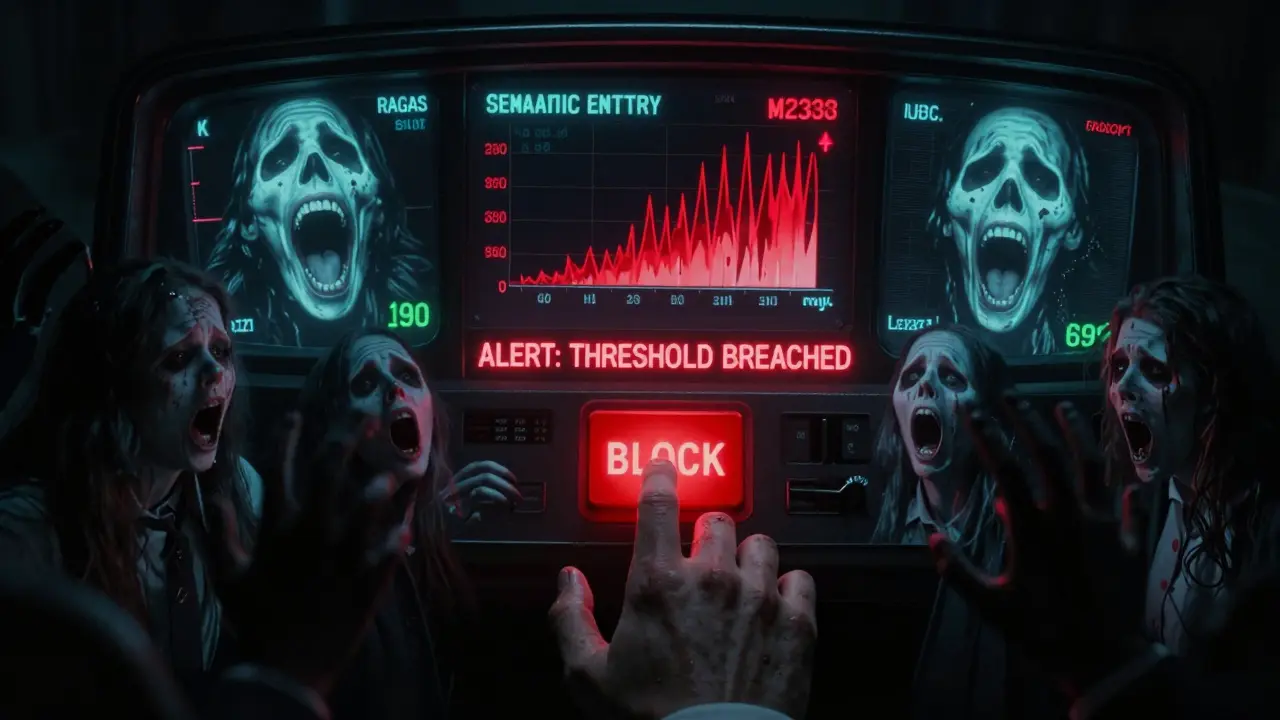
- Real-time filtering with semantic entropy - Run this on 100% of traffic. If entropy crosses your threshold (say, 0.75), block or flag the response. No delay. No cost. Works on any model.
- Batch analysis with RAGAS - Every hour, sample 10-20% of responses and run RAGAS Faithfulness. This gives you a ground-truth accuracy score over time.
- Human review for edge cases - Take the top 1-2% of highest-risk outputs (high entropy + low RAGAS score) and send them to reviewers. This trains your system and catches what automated tools miss.
Patronus AI’s customers report 92% satisfaction with their dashboard. The key? It shows not just the hallucination rate, but the type of hallucination: fabricated data, wrong context, made-up citations. That’s what lets engineers fix the root cause.
One fintech CTO told G2: “Semantic entropy cut our legal review costs by $280,000 a year. We caught hallucinated financial data before customers saw it.”
False positives and domain traps
Setting thresholds too low is the #1 mistake. Datadog found 63% of clients initially set thresholds so strict that 19% of legitimate responses were blocked. Users got frustrated. They stopped using the system.
Some domains are harder than others:
- Finance and law - Require near-zero hallucination. Precision matters more than recall. Thresholds often above 0.8.
- Healthcare - RAGAS Faithfulness underperforms here. Semantic entropy is more reliable. One healthcare startup found 92% of compliance violations happened when RAGAS scores dropped below 0.65.
- Creative content - Poetry, marketing, fiction - some fabrication is expected. A media company’s CTO on Trustpilot: “Current tools flag 22% of creative outputs as hallucinations. That’s not useful.”
Don’t use the same threshold for customer support and legal advice. Calibration isn’t optional - it’s engineering.
What’s changing in 2026
The EU AI Act takes effect January 2026. Article 15 requires “appropriate technical solutions to mitigate the risk of generating false information.” That means if you’re selling LLMs in Europe, you need documented hallucination monitoring.
OpenAI just released an Uncertainty Scoring API. It gives you a confidence score tied to hallucination likelihood - 0.82 correlation with real errors, validated by Stanford’s HELM benchmark. This could replace semantic entropy for models that support it.
And NIST is finalizing its AI Risk Management Framework update. Expected in Q2 2026, it will include standardized hallucination measurement protocols. If you work with government contractors, you’ll need to comply.
Meanwhile, spectral methods like HalluShift are gaining traction. They detect hallucinations by analyzing hidden patterns in model activations. Early results show 92%+ AUCROC on medical and legal benchmarks. They’re not ready for production yet - but they will be.
What to do now
You don’t need a team of PhDs. Start simple:
- Install DeepEval and run G-Eval on 100 sample outputs. See where your model fails.
- Implement semantic entropy as a real-time filter. Use the open-source code from the Nature paper.
- Build a dashboard that shows: daily hallucination rate, top 5 hallucination types, and threshold alerts.
- Set your first threshold at 0.7. Monitor for a week. Adjust based on false positives.
- Connect it to your incident system. If hallucination rate spikes above 15%, trigger a ticket. Microsoft’s 2024 study showed that’s when customer dissatisfaction jumps 30%.
Don’t wait for perfection. The goal isn’t zero hallucinations. It’s knowing when they happen - and stopping them before they hurt someone.



Lissa Veldhuis
January 6, 2026 AT 13:20Michael Jones
January 6, 2026 AT 16:38allison berroteran
January 8, 2026 AT 00:37Gabby Love
January 9, 2026 AT 14:28Jen Kay
January 11, 2026 AT 10:07Michael Thomas
January 11, 2026 AT 12:24Buddy Faith
January 13, 2026 AT 01:54Scott Perlman
January 14, 2026 AT 22:24Sandi Johnson
January 16, 2026 AT 09:06