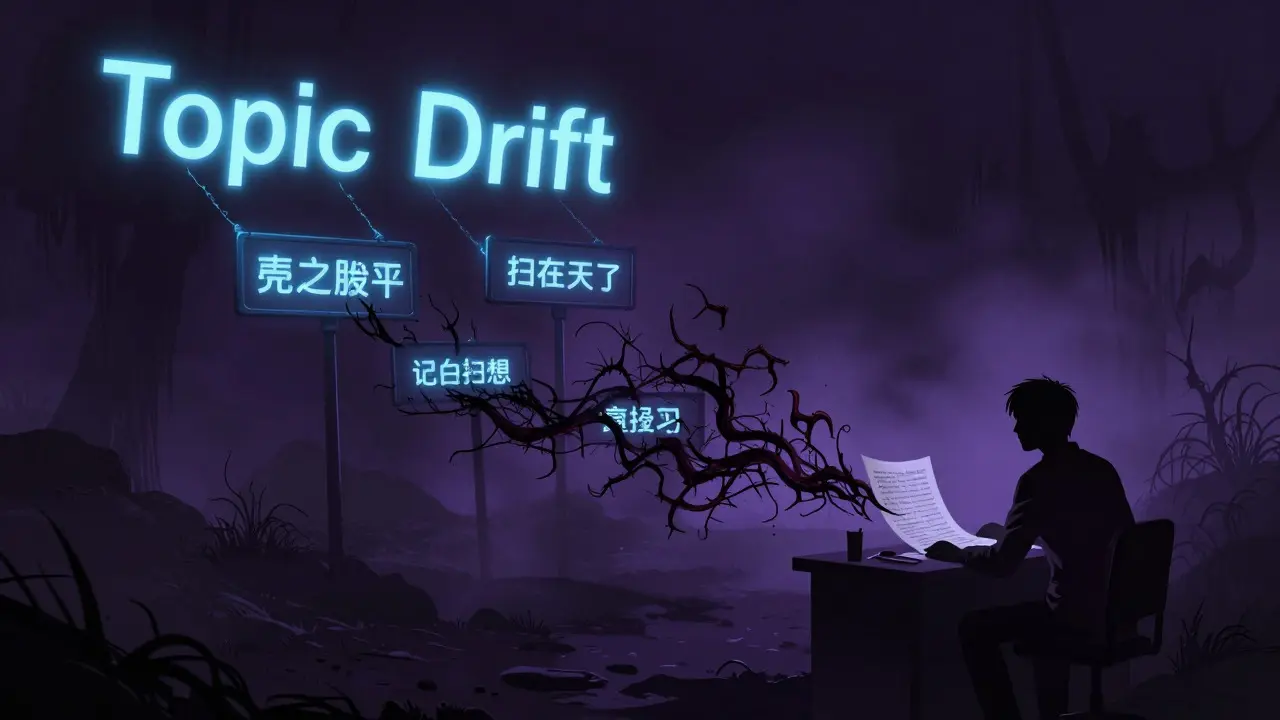
Ever asked an AI to write a 2,000-word article, only to get the first 500 words on point, followed by three paragraphs of circular nonsense? You aren't alone. As Large Language Models are AI systems trained on vast datasets to generate human-like text based on input prompts (LLMs) evolve from simple chatbots into content creation engines, we hit a wall. The longer the output, the worse it gets. This isn't just a minor glitch; it's a fundamental architectural limitation known as "drift" and "repetition."
If you are generating technical documentation, marketing copy, or narrative fiction, losing coherence after token 1,500 is a dealbreaker. According to data from RTS Labs, unguided models exhibit topic drift in 68% of generations beyond that mark. Worse, repetition rates jump by 32% for every additional 500 tokens. But there is a way out. By combining specific prompting techniques, retrieval systems, and parameter tuning, you can force these models to stay on track.
Why LLMs Lose Their Way: The Mechanics of Drift
To fix the problem, you have to understand why it happens. LLMs don't "think" like humans. They predict the next word (or token) based on what came before. This is called autoregressive generation. In short responses, this works fine. But as the context window fills up, the model struggles to weigh early instructions against recent output.
This creates two main enemies:
- Topic Drift: The model forgets your original constraint. If you asked for a report on "electric vehicle battery efficiency," it might slowly pivot to "general car maintenance" because those concepts are semantically close in its training data.
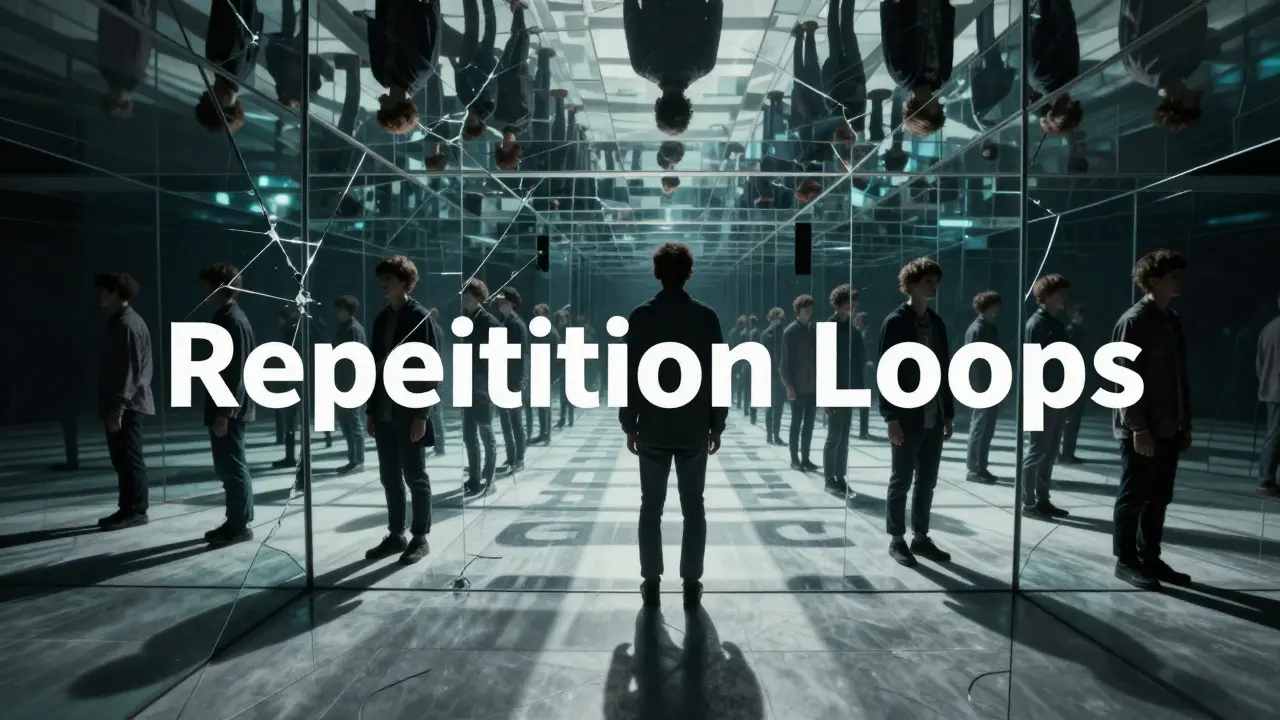
- Repetition Loops: The model starts reinforcing its own recent output. It uses a phrase, sees that phrase in its immediate history, and predicts it again. Soon, you have a paragraph that says the same thing four times in slightly different ways.
Research published in arXiv in February 2024 shows that even top-tier models like GPT-4 see a 47% drop in accuracy when maintaining topic consistency past 2,000 tokens. The positional encoding-the system that tells the AI where each word sits in the sequence-loses precision over long distances. It’s like trying to remember the start of a conversation while standing at the back of a noisy stadium.
The Prompt Engineering Fix: Structure Over Length
Before spending money on expensive infrastructure, start with how you talk to the model. Most developers treat prompts as a single block of text. For long-form generation, that’s a mistake. You need to structure the request to anchor the model.
Use Chain-of-Thought Prompting is a technique that encourages the model to break down complex tasks into intermediate reasoning steps before generating the final answer. Instead of asking for the full essay, ask for an outline first. Then, generate section by section.
- Step 1: The Outline. Ask the model to create a detailed header structure. Review it. Does it look coherent? If yes, proceed.
- Step 2: Section-by-Section Generation. Feed the outline back into the model, but only ask it to write Section 1. Keep the context window fresh.
- Step 3: Context Injection. When moving to Section 2, summarize Section 1 in 50 words and append it to the new prompt. This keeps the "memory" tight without clogging the context window with raw text.
RTS Labs found this approach reduces drift by 31%. It costs a bit more in computational overhead (about 22%), but the quality gain is worth it. Think of it like writing a book chapter by chapter rather than trying to vomit the whole manuscript in one go.
Temperature Tuning: Dialing Down the Chaos
If your output feels robotic or repetitive, check your temperature setting. Temperature controls randomness. A high temperature (0.9-1.0) makes the model creative but erratic. A low temperature (0.1-0.3) makes it deterministic but boring.
For long-form tasks, the sweet spot is usually between 0.3 and 0.7. Studies show that scaling temperature to this range reduces repetition by 18% while keeping the text readable. If you notice the model looping phrases, drop the temperature to 0.3. If it sounds too stiff, bump it to 0.5. Don’t guess-test small batches and measure the repetition rate manually.
Retrieval-Augmented Generation (RAG): Grounding the Facts
Prompt engineering helps with structure, but it doesn’t stop hallucinations. If you need factual accuracy in long documents, you need Retrieval-Augmented Generation is a framework that combines large language models with external knowledge bases to provide factually grounded responses (RAG).
RAG works by searching an external database for relevant information before the model generates text. This anchors the output in reality. According to benchmarks, RAG improves factual consistency by 45% in knowledge-intensive tasks. However, it adds latency. Each retrieval call takes 300-500 milliseconds. For a 5,000-word document, that adds up.
To mitigate this, batch your retrievals. Instead of fetching sources for every sentence, fetch them for every paragraph. Use vector databases like Pinecone or Weaviate to store your source material. This ensures the model has the right context without slowing down the entire pipeline.
| Technique | Drift Reduction | Cost/Complexity | Best Use Case |
|---|---|---|---|
| Chain-of-Thought Prompting | 31% | Low | Logical reasoning, essays |
| Temperature Scaling (0.3-0.7) | N/A (Reduces Repetition 18%) | Very Low | All creative writing |
| Retrieval-Augmented Generation (RAG) | High Factual Consistency | Medium (Infrastructure needed) | Technical docs, reports |
| Fine-Tuning (LoRA) | 58% Drift / 52% Repetition | High ($12k+ for 7B models) | Specialized domains (Law, Finance) |
Fine-Tuning: The Nuclear Option
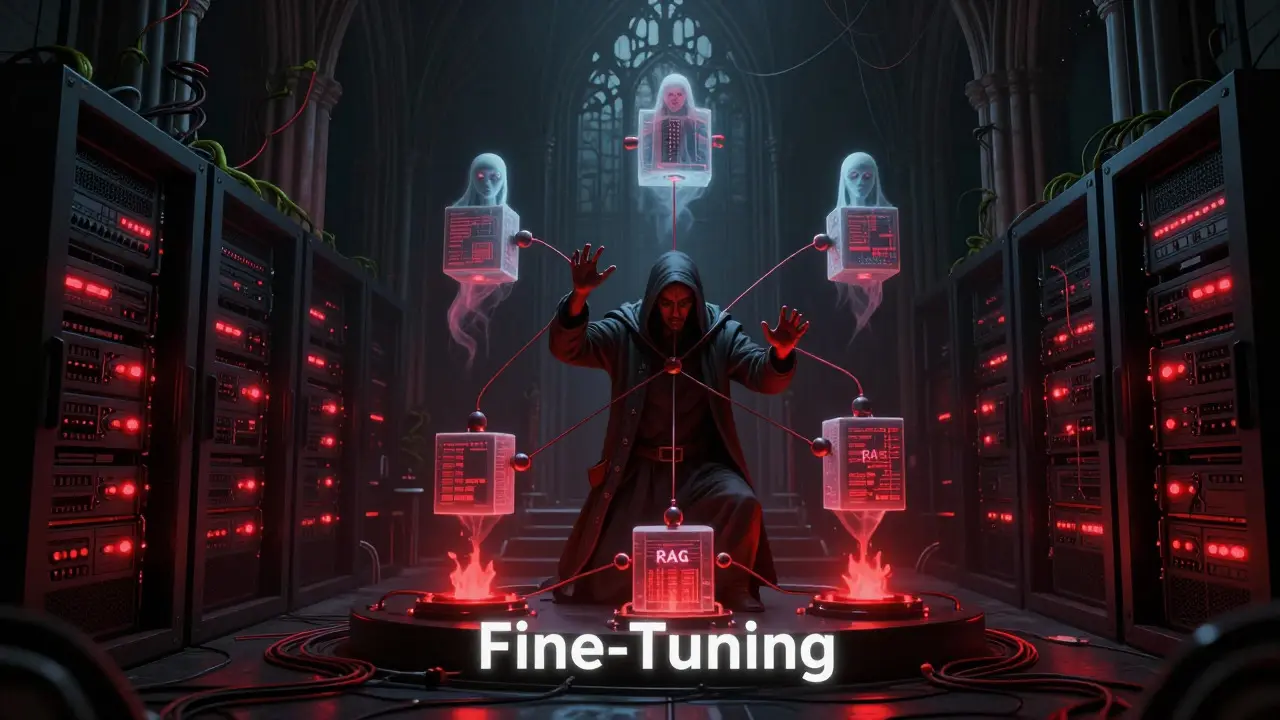
If prompting and RAG aren’t enough, you might need to change the model itself. Fine-tuning involves training the base model on your specific style and domain data. Methods like LoRA (Low-Rank Adaptation) allow you to do this efficiently without retraining the entire network.
Data shows fine-tuning can reduce drift by 58% and repetition by 52%. But it’s expensive. Training a 7-billion-parameter model on AWS p4d instances can cost around $12,000. Is it worth it? Only if you are producing thousands of documents in a niche field, like financial analysis or legal contracts. For general content, stick to RAG and prompting.
Self-Consistency and Evaluation Loops
A clever trick used by advanced teams is self-evaluation. After the model generates a draft, send it back to another instance of the model (or the same one with a different prompt) to critique it. Ask: "Does this section stay on topic? Are there repetitive phrases?"
This "self-consistency" method reduces hallucination rates by 37%, according to arXiv research. It triples the generation time, so use it sparingly. Ideally, run this evaluation step only on the final draft, not during the iterative writing process.
Hardware and Model Choices Matter
Not all models are built equal for long-form tasks. As of early 2024, Google’s Gemini Ultra leads in coherence benchmarks, maintaining 87% topic consistency at 2,500 tokens. Anthropic’s Claude 3 Opus follows at 82%, and Meta’s Llama-3-70b sits at 76%.
If you are working on a budget, Microsoft’s Phi-3-mini is a game-changer. It maintains 79% coherence at 4,000 tokens while running on just 3.8GB of RAM. This means you can run long-form generation locally on a decent laptop, avoiding API costs entirely. Test multiple models on your specific dataset before committing to one.
Practical Checklist for Your Next Project
Ready to implement this? Here is your action plan:
- Break it down. Never ask for >1,000 tokens in a single shot. Use outlines and section-by-section generation.
- Tune the temp. Start at 0.5. Lower it if you see loops.
- Add memory. Summarize previous sections and inject them into new prompts.
- Ground facts. Use RAG for any claim that needs verification.
- Review critically. Run a self-evaluation pass on the final output.
Long-form generation is hard. It requires treating the LLM not as a magic writer, but as a powerful but distracted intern. Give it clear instructions, frequent reminders, and a structured environment, and it will deliver. Ignore those basics, and you’ll end up with another wall of repetitive text.
What causes topic drift in LLMs?
Topic drift occurs because LLMs use autoregressive prediction, relying heavily on recent context. As the text length increases, the model's attention to the initial prompt diminishes due to limitations in positional encoding and context window management. This causes the model to gradually shift focus toward semantically related but off-topic concepts.
How does temperature affect repetition?
Temperature controls the randomness of token selection. High temperatures increase creativity but also the likelihood of repeating phrases or ideas. Lowering the temperature to a range of 0.3-0.7 constrains the model's choices, significantly reducing repetitive loops while maintaining readability.
Is RAG necessary for long-form generation?
RAG is not strictly necessary for creative writing, but it is highly recommended for factual or technical content. It grounds the model in real-time data, improving factual consistency by 45% and reducing hallucinations. However, it adds latency and infrastructure complexity.
What is the best model for long-form coherence in 2024?
Based on early 2024 benchmarks, Google's Gemini Ultra leads with 87% topic consistency at 2,500 tokens. For local deployment, Microsoft's Phi-3-mini offers strong performance (79% coherence at 4,000 tokens) with minimal hardware requirements.
Can fine-tuning eliminate drift completely?
Fine-tuning can significantly reduce drift (by up to 58%) and repetition, but it rarely eliminates it entirely. Architectural limitations in transformer models mean that some level of degradation is inevitable in extremely long outputs (>10,000 tokens) without major structural changes to the model itself.


Lisa Nally
July 28, 2026 AT 00:53While the article presents a competent overview of current mitigation strategies, it fundamentally misunderstands the epistemological crisis inherent in autoregressive architectures. The suggestion that 'prompt engineering' is a silver bullet for semantic drift is, frankly, reductionist. We are dealing with stochastic parrots that lack true grounding in reality, and treating them as mere 'distracted interns' ignores the statistical inevitability of entropy in high-dimensional vector spaces over extended token sequences. Furthermore, the reliance on RAG assumes a perfect indexing of truth, which is a fallacy given the noise in training data. We need to discuss architectural shifts towards hybrid neuro-symbolic systems if we want genuine coherence, not just band-aid solutions like temperature scaling which merely suppresses variance without addressing the root cause of hallucination.
Edward Gilbreath
July 29, 2026 AT 07:54they dont want you to know this but the drift is intentional. big tech wants you to read less so they can sell more ads. also why pay $12k for fine tuning when you can just use the free models and ignore the errors. typical corporate fear mongering about quality control. its all about keeping us dependent on their apis. wake up sheeple
Edward Nigma
July 31, 2026 AT 01:28You guys are missing the point entirely. The problem isnt the model, its the prompters who are too lazy to write good instructions. If you cant make an AI write a coherent essay, maybe you shouldnt be using AI at all. Also Phi-3-mini is garbage for anything serious, stop pushing underpowered toys. Real engineers use custom clusters and dont care about cost. This article reads like it was written by someone who has never deployed a production system.
Laura Davis
July 31, 2026 AT 16:05Okay, let's keep it real here. The article is solid advice, but don't let anyone tell you that you're doing it wrong if you stick to the basics. Temperature tuning is actually a huge deal for most people, not just some niche tweak. Stop gatekeeping the tech with all this jargon about 'neuro-symbolic systems' or whatever. Just break your tasks down, check your work, and move on. It’s simple logic, not rocket science. Respect the process, get the result, and don’t overcomplicate it for the sake of sounding smart.
kimberly de Bruin
August 2, 2026 AT 04:24the machine speaks but does it understand? we feed it words and it gives us back shadows of meaning. repetition is just the echo of our own emptiness bouncing off the walls of the digital void. perhaps drift is not a bug but a feature of consciousness trying to escape the cage of linear syntax. who are we to demand coherence from chaos anyway
Francis Laquerre
August 3, 2026 AT 17:12In my experience working across different cultural contexts in tech, the approach to AI varies wildly. In Europe, we tend to be more cautious about the factual integrity provided by RAG, whereas in Silicon Valley, speed often trumps accuracy. However, I must agree that the section-by-section generation method is universally effective. It mirrors the human cognitive process of chunking information. We should view these tools not as replacements for human intellect, but as extensions of our collaborative potential. The dramatic increase in efficiency is undeniable, yet we must remain vigilant against the loss of nuance that comes with automated summarization.
Andrea Alonzo
August 4, 2026 AT 22:08I really appreciate how this post breaks down such a complex technical issue into manageable steps because it empowers users who might otherwise feel overwhelmed by the sheer scale of LLM capabilities and limitations. When I first started experimenting with long-form generation, I struggled immensely with the repetition loops until I realized that summarizing previous sections was the key to maintaining context without bloating the memory. It’s wonderful to see resources that acknowledge the emotional frustration of dealing with circular nonsense and offer practical, empathetic solutions rather than just throwing hardware costs at the problem. Let’s support each other in learning these tools effectively.
michael rome
August 5, 2026 AT 16:44This is an excellent summary of the current landscape. The comparison table is particularly useful for quick reference.