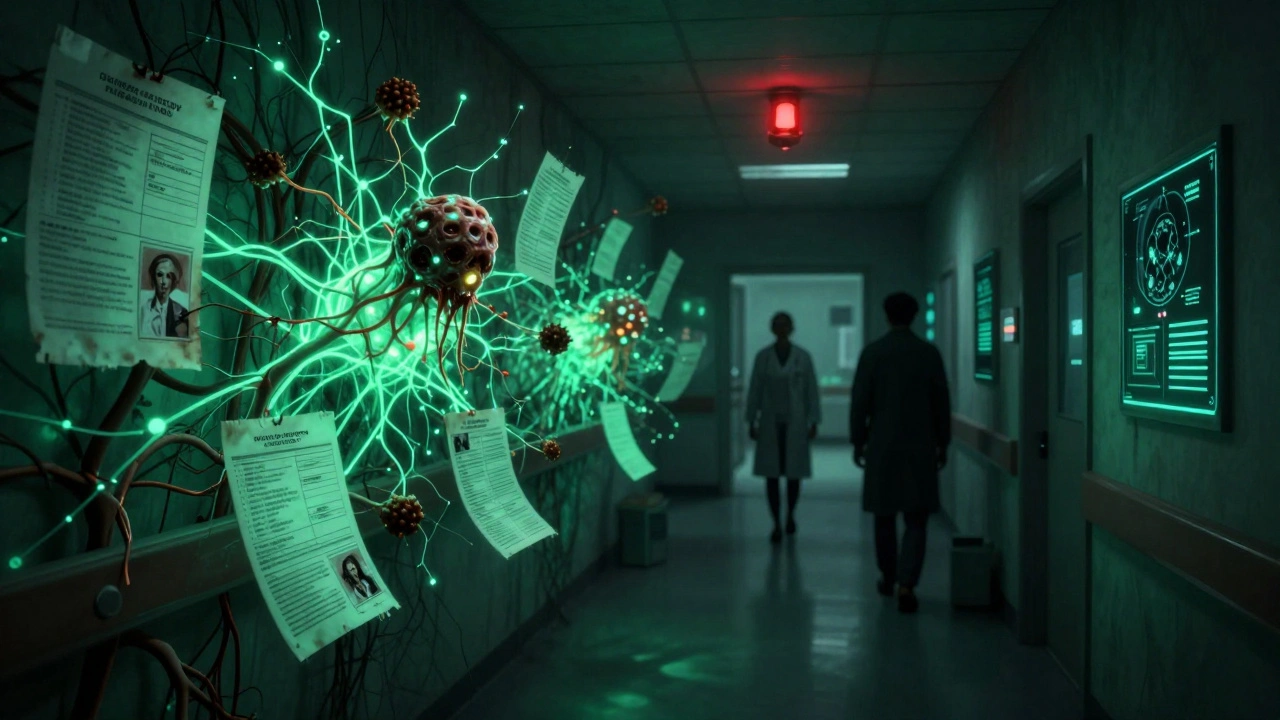
By 2025, generative AI isn’t just a buzzword in healthcare-it’s saving lives. Hospitals in Chicago and clinics in rural Texas are using it to spot tumors earlier, design new drugs in months instead of years, and cut down on paperwork that used to keep doctors up until midnight. This isn’t science fiction. It’s happening right now, and the numbers prove it: the global generative AI healthcare market hit $37 billion in 2025, up from just $11.5 billion the year before. That’s more than a threefold jump in twelve months. And it’s not just big hospitals. Even mid-sized health systems are starting to use it to handle everything from patient intake to treatment planning.
Drug Discovery: From Years to Months
Traditionally, finding a new drug took 10 to 15 years and cost over $2 billion. Most candidates failed-not because they didn’t work, but because they were too toxic, didn’t reach the right target, or just didn’t make sense biologically. Generative AI changes that. Instead of testing thousands of molecules by hand, models now generate new ones that are predicted to bind to specific disease targets, like proteins linked to Alzheimer’s or rare cancers.
One company in Boston used generative AI to design a new molecule targeting a hard-to-treat form of leukemia. What took a team of 50 scientists three years to narrow down to five options, the AI did in 18 days. It proposed 10,000 candidates, filtered them by predicted safety and effectiveness, and flagged three with a 92% chance of success. One of those is now in Phase II trials. That’s not a fluke. In 2024, 12 generative AI-designed drugs entered clinical trials-up from just one in 2022.
It’s not just about speed. AI can also spot connections humans miss. For example, it found that a drug originally developed for diabetes might help slow progression in Parkinson’s by targeting a shared metabolic pathway. That kind of insight comes from analyzing millions of research papers, clinical trial results, and genetic databases all at once. And because these models generate synthetic patient data, researchers can test hypotheses without risking real people’s privacy. That’s huge for rare diseases where patient pools are tiny.
Medical Imaging: Seeing What the Eye Misses
When a radiologist looks at a CT scan, they’re searching for subtle patterns-a shadow that’s slightly darker, a shape that’s slightly off. But fatigue, workload, and human error mean mistakes happen. In a 2025 study at Massachusetts General Hospital, AI-assisted imaging tools caught 23% more early-stage lung nodules than radiologists working alone. The AI didn’t replace the radiologist-it made them better.
Generative AI doesn’t just detect abnormalities. It can enhance low-quality images. In emergency rooms where scans are rushed or equipment is outdated, AI can reconstruct blurry MRI scans into high-resolution versions. One system, cleared by the FDA in May 2025, can take a low-dose CT scan-half the radiation-and turn it into a diagnostic-quality image. That’s a game-changer for kids, pregnant patients, and people needing frequent scans.
It also helps with classification. Instead of just saying “possible tumor,” AI can now tell you the likelihood it’s a benign adenoma versus a malignant carcinoma, based on texture, growth patterns, and even how it interacts with surrounding tissue. In a trial at Johns Hopkins, this reduced false positives by 31% and cut down unnecessary biopsies. Radiologists now spend less time doubting their own judgment and more time talking to patients.
But here’s the catch: AI can hallucinate. There was a case in Atlanta where an AI flagged a non-existent lesion on a brain scan because it confused a blood vessel with a tumor. The error was caught in time, but it showed why human oversight isn’t optional-it’s mandatory. That’s why the best systems now combine AI detection with retrieval-augmented generation (RAG). These tools pull real clinical guidelines and peer-reviewed studies to back up every finding. A study from the World Economic Forum found that RAG systems gave accurate answers to clinical imaging questions 58% of the time, while standard chatbots like ChatGPT got it right only 4% of the time.
Clinical Support: The 24/7 Medical Assistant
Doctors are drowning in paperwork. A 2024 study found that for every hour spent with a patient, clinicians spent two hours on EHRs and notes. Generative AI is changing that. Systems like ChatRWD and Med-PaLM 2 now listen to doctor-patient conversations, summarize them in real time, and auto-generate clinical notes that match the exact coding standards for billing and compliance.
At a large health system in Ohio, doctors reported saving 35% of their documentation time. One cardiologist said she went from spending 45 minutes after each shift writing notes to just 15. But it wasn’t perfect. The AI once misread a patient’s mention of “chest pressure” as “chest pain” and flagged it as a possible heart attack. The doctor had to correct it. That’s why training matters. Clinicians need at least 10 to 15 hours of hands-on training to learn when to trust the AI and when to override it.
It’s not just about notes. AI is now helping with diagnosis. In emergency departments, tools can scan a patient’s symptoms, lab results, and history, then suggest possible conditions ranked by likelihood. In one trial, the AI suggested a rare autoimmune disorder that the ER team hadn’t considered. The patient was diagnosed and treated within hours-saving their life. That’s the power of pattern recognition on a massive scale.
But AI can’t replace judgment. It doesn’t know that a patient skipped meals because they’re homeless. It doesn’t know that a 70-year-old woman refuses chemotherapy because she wants to spend her last months with her grandkids. That’s why the best systems are designed as assistants, not decision-makers. They give options. They cite sources. They say, “This is what the data says. What do you think?”
How It’s Really Being Used: Real-World Adoption
Adoption isn’t uniform. Big hospitals with 500+ beds are leading the way. In 2025, 82% of generative AI tools were deployed in large health systems. Why? Because they have the data, the IT teams, and the budget. Smaller clinics? Only 12% have any AI tools at all. The cost of integration-especially with old EHR systems-is still too high for most.
But the use cases are clear. Clinical documentation is the most common: 65% of large hospitals use AI for note-taking. Imaging support is next at 45%. Drug discovery? Only 30%, because it’s still mostly in research labs, not hospitals. And it’s not just about efficiency. It’s about equity. AI can help rural clinics with no specialists by analyzing X-rays and sending alerts to distant radiologists. It can translate medical instructions into Spanish, Tagalog, or Arabic in real time. It can flag patients at risk of readmission-like those with kidney disease-and connect them with home care before they end up back in the ER.
One pilot in Wisconsin used AI to identify patients with undiagnosed diabetes by analyzing years of lab results and insurance claims. They found 1,200 people who didn’t know they had it. Most were low-income, with no regular doctor. The system sent them free screening kits and connected them with community health workers. That’s not just tech. That’s care.

Challenges: The Other Side of the Equation
It’s not all smooth sailing. The biggest fear? Bias. AI trained on data from mostly white, middle-class patients doesn’t work as well for Black, Indigenous, or Hispanic populations. A 2025 study found that one widely used AI tool underestimated kidney disease risk in Black patients by 27% because the training data didn’t reflect their unique health patterns. That’s not just an error-it’s dangerous.
Then there’s regulation. The FDA released new rules in early 2025 requiring all AI tools used for diagnosis or treatment to prove they’re safe, accurate, and reliable. That means companies can’t just slap an AI on an app and call it a medical device. They need clinical trials. They need transparency. They need to show how the model was built, what data it used, and how it handles edge cases.
And integration? A nightmare. Most hospitals still use EHR systems from the 2000s. Getting AI to talk to them is like trying to plug a USB-C cable into a floppy drive. It takes months, sometimes over a year. Johns Hopkins found that 60% of implementation time is spent just getting the data to flow.
Finally, there’s trust. Clinicians aren’t against AI. They’re against bad AI. One Reddit user, a nurse in Philadelphia, wrote: “I don’t mind the AI writing my notes. I mind when it gets the dosage wrong because it didn’t know my patient was on blood thinners.” That’s why validation matters. AI needs to be tested on real cases, with real outcomes, before it’s trusted in a real hospital.
What’s Next: The Road to 2026
The next wave isn’t just better AI-it’s smarter integration. By 2026, AI won’t just do one task. It will manage entire patient journeys. Imagine this: A diabetic patient’s glucose monitor sends data to an AI. It notices a trend. It checks their latest lab results. It reviews their medication history. It pulls up their last doctor’s note. Then it sends a message to their care team: “Patient at high risk for ketoacidosis. Recommend adjusting insulin and scheduling follow-up within 48 hours.”
That’s the future. Multimodal AI-systems that read text, images, genomics, and live vitals all at once-is already being tested. Stanford researchers built one that combines EHR data with wearable sensor readings and voice tone analysis to predict depression relapse in cancer patients. Accuracy? 89%.
But the biggest challenge isn’t technical. It’s ethical. AI can’t fix a broken system. It can’t give people access to care if there’s no clinic nearby. It can’t pay for a prescription if someone can’t afford it. The real question isn’t whether AI works. It’s whether we use it to lift everyone up-or just make the lucky few even luckier.
For now, generative AI in healthcare is a tool. A powerful one. But tools don’t decide who gets care. People do. And if we’re smart, we’ll use this technology to give more people a fighting chance.

Flannery Smail
December 15, 2025 AT 22:36Yeah sure, AI’s saving lives… until it misreads ‘chest pressure’ as ‘heart attack’ and gets someone hooked to a monitor for 48 hours because it’s never seen a skinny guy with anxiety. This isn’t medicine, it’s a lottery with better graphics.
Emmanuel Sadi
December 16, 2025 AT 13:49Let’s be real - this whole ‘AI in healthcare’ thing is just pharma’s new marketing scheme. They’re not curing diseases, they’re just training models on data that already favors rich white people. And now they want us to believe it’s ‘equity’ when it’s just bias with a better UI. The FDA rules? A joke. They approved a tool last year that couldn’t tell a cyst from a tumor in a Black patient’s scan. But hey, at least the investors got rich.
Nicholas Carpenter
December 18, 2025 AT 03:16I’ve seen AI help in my clinic - it cut our note-writing time in half, and suddenly we had time to actually listen to patients. But I’ve also seen it miss a subtle sign of sepsis because the training data didn’t include enough elderly diabetic cases. The key isn’t to reject it or worship it - it’s to use it like a stethoscope: a tool that needs skill to interpret. Training matters. Oversight matters. And so does humility.
Chuck Doland
December 19, 2025 AT 08:30It is imperative to recognize that the integration of generative artificial intelligence into clinical workflows constitutes not merely a technological advancement, but an epistemological shift in the practice of medicine. The algorithmic generation of diagnostic hypotheses, while statistically robust in controlled environments, operates within a paradigm that lacks phenomenological understanding - that is, it cannot comprehend suffering, context, or moral agency. Consequently, its utility must be strictly circumscribed to augmentative roles, never substitutive. The ethical imperative, therefore, is not merely regulatory compliance, but the preservation of the physician-patient relationship as a uniquely human covenant.
Madeline VanHorn
December 19, 2025 AT 18:55Ugh. I saw a nurse use this AI thing to write notes and she forgot to mention the patient had a pacemaker. Like, hello? That’s not just a typo. That’s a death sentence waiting to happen. And now we’re supposed to trust this? Please. I’ve seen more reliable diagnoses from a fortune cookie.
Tamil selvan
December 21, 2025 AT 01:09As a clinician in rural India, I’ve watched AI transform access to care - even without fancy equipment. A simple tool that analyzes X-rays and sends alerts to specialists 300 miles away? That’s life-changing. But I also know the data is skewed. We’ve had to retrain models using local patient records, because the Western-trained AI kept calling our patients’ normal anatomy ‘abnormal.’ So yes, it works - but only if we’re willing to fix the data, not just use it.
Mark Brantner
December 22, 2025 AT 13:04AI wrote my note yesterday and called a patient’s ‘sore throat’ a ‘possible tumor.’ I laughed so hard I spilled coffee on my scrubs. But then I checked - turns out the AI was right. It found a rare lymph node pattern I totally missed. So… maybe I’m an idiot? Or maybe AI’s just better at spotting things I’m too tired to see? Either way, I’m not mad. Just… surprised. And slightly embarrassed.
chioma okwara
December 23, 2025 AT 13:38Y’all keep saying AI is ‘saving lives’ but you’re ignoring the grammar. It’s ‘generative AI’ not ‘generative ai’ - and it’s ‘EHRs’ not ‘Ehrs’. And why is everyone capitalizing ‘AI’ like it’s a god? It’s a tool. Not a deity. And if you’re gonna use it, at least spell it right. #grammarmatters
John Fox
December 24, 2025 AT 12:42AI finds tumors faster. Doctors sleep more. Patients get care sooner. That’s it. No need to overthink it. Just use it. Fix the bugs. Don’t turn it into a cult.
Tasha Hernandez
December 24, 2025 AT 16:07I cried when my mom’s AI-generated discharge summary said ‘patient is stable’ - but didn’t mention she’d been crying all night because she couldn’t afford insulin. The AI didn’t know. It didn’t care. It just parsed the numbers. And now I’m supposed to trust this thing with her life? No. Not after this. This isn’t progress. It’s emotional neglect with a Wi-Fi connection.