
What if you could teach a large language model a new skill - like understanding medical jargon or writing legal contracts - without wiping out everything it already knows? That’s the promise of continual learning for large language models (LLMs). Instead of retraining from scratch every time new data arrives, continual learning lets models adapt over time while keeping old knowledge intact. It’s not just a nice-to-have anymore. As LLMs power everything from customer service bots to research assistants, the cost and carbon footprint of full retraining are becoming unsustainable. The real question isn’t whether we need continual learning - it’s how to do it right.
Why Full Retraining Doesn’t Work Anymore
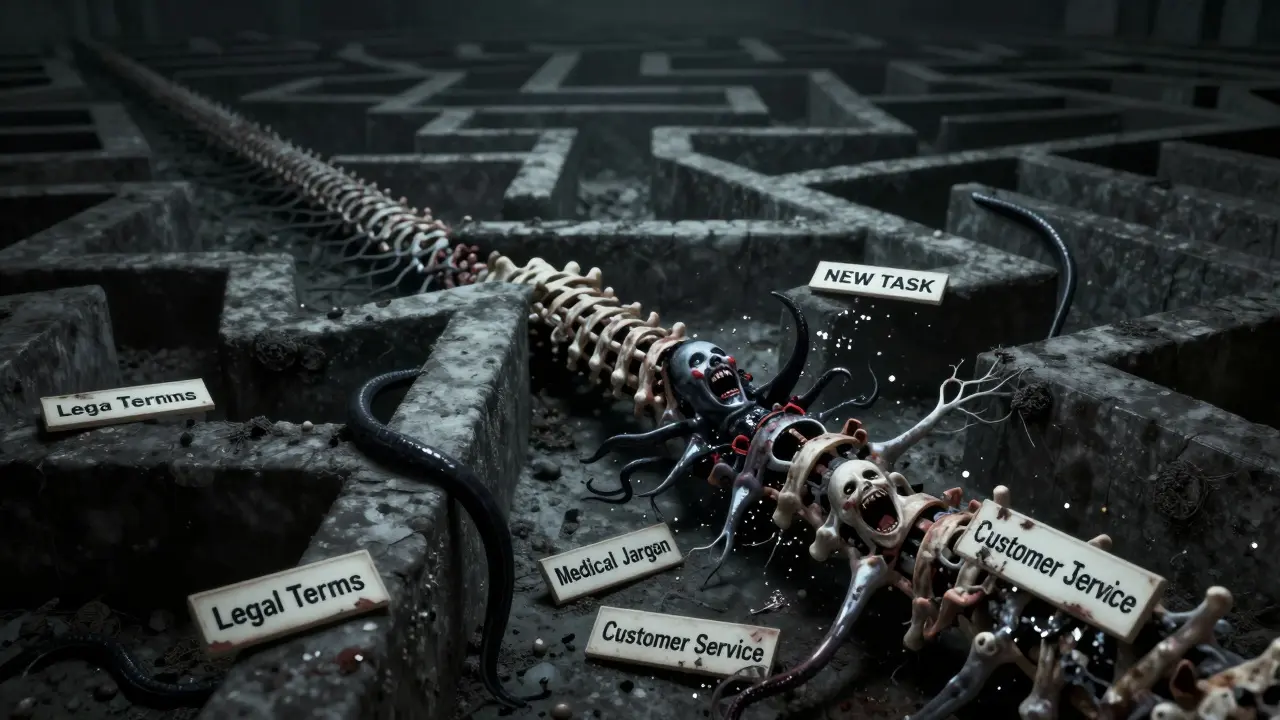
Training a large language model like Llama 3 or GPT-4 isn’t just expensive - it’s a logistical nightmare. You need thousands of GPUs running for weeks. The electricity bill alone can run into millions of dollars. And even then, you’re not done. Once you finish, the world moves on. New regulations emerge. New slang appears. New domains like quantum computing or AI ethics demand fresh understanding. If you retrain every time, you’re stuck in a loop of high cost and high risk. Here’s the kicker: when you retrain from scratch, you don’t just add knowledge - you overwrite it. This is called catastrophic forgetting. Imagine learning French, then suddenly switching to Japanese. After a few weeks, you forget how to say "bonjour." That’s what happens to LLMs. Studies show that after fine-tuning on just one new task, models can lose up to 40% of their performance on earlier ones. That’s not adaptation - that’s amnesia.Three Ways to Learn Without Forgetting
There are three main strategies researchers use to fight catastrophic forgetting. Each tackles the problem differently.- Regularization: Think of this like a memory guard. Techniques like Elastic Weight Consolidation (EWC) identify which model weights are most important for past tasks and slow down changes to them. It’s like putting a lock on your favorite tools so you don’t accidentally throw them out when cleaning up.
- Replay: This method keeps a small, smart archive of old data. Instead of storing every example, it picks the most useful ones - like saving only the top 100 conversations from last year that taught the model how to handle complaints. Some systems even use generative models to create fake but realistic examples of past data, so they never need to store real user inputs.
- Architecture Changes: Instead of forcing one model to do everything, some approaches add new parts. Think of it like upgrading your phone with a new camera module instead of replacing the whole device. Hypernetworks and adapter layers let you plug in small, task-specific updates without touching the core model. This is why companies like Hugging Face now offer "adapter files" you can download and swap in - no full retraining needed.
Each method has trade-offs. Regularization is lightweight but can’t handle big shifts. Replay needs storage, which isn’t always possible. Architecture changes are modular but add complexity. The best systems mix them.
From Pre-Training to Alignment: The Four Stages of Continual Learning
Continual learning isn’t just about fine-tuning. It happens at every stage of an LLM’s life.- Continual Pre-Training (CPT): This is about keeping the model’s general knowledge fresh. Imagine a model trained on 2023 web data. By 2026, that data is outdated. CPT lets the model ingest new web pages, scientific papers, and code repositories without forgetting how to summarize or reason. Researchers use "mixture control" to balance old and new data - like mixing 70% old knowledge with 30% new updates.
- Domain-Adaptive Pre-Training (DAP): Not all knowledge is equal. A model used in hospitals needs different updates than one used in finance. DAP lets you tailor updates to specific domains. For example, a model can learn medical terminology from PubMed abstracts without losing its ability to write poetry.
- Continual Fine-Tuning (CFT): This is where models learn to follow instructions. As user preferences change - say, from formal to casual tone - CFT adjusts responses gradually. Techniques like adapter layers and prompt chaining let models update their behavior without resetting their core.
- Continual Alignment: This is the newest frontier. As societal values shift, so do safety rules. A model trained to avoid harmful content in 2024 might not recognize new forms of bias in 2026. Continual alignment uses RL-style updates (similar to RLHF) to adjust behavior based on evolving human feedback. It’s not just about what the model knows - it’s about what it *should* say.
These aren’t separate phases - they’re layers. A model might be doing all four at once: updating its general knowledge, adapting to a new industry, refining its tone, and adjusting its ethics.
Why Reinforcement Learning Beats Supervised Fine-Tuning
Here’s something surprising: when it comes to continual learning, reinforcement learning (RL) outperforms the more common supervised fine-tuning (SFT). In experiments with the Qwen-2.5-VL-7B-Instruct model, researchers trained it on seven different tasks one after another. When they used SFT, the model forgot earlier tasks quickly. But when they used RL, it kept 85% of its original performance - even after learning new things. Why? RL doesn’t just correct mistakes. It scales updates based on reward signals. If a change helps a lot, it gets made. If it barely helps, it’s ignored. This makes RL naturally conservative with important knowledge. SFT, on the other hand, treats every example equally. It’s like giving a student the same grade for a perfect essay and a sloppy one - eventually, they stop caring about quality. Even more interesting: removing the KL divergence penalty (a common stability tool in RL) didn’t hurt performance. And using chain-of-thought reasoning didn’t make a difference either. That means the core advantage of RL isn’t in *how* it reasons - it’s in *how* it updates.What’s Next? The Big Challenges
We’re still early in this journey. Here are the biggest open questions:- How many updates can a model handle? Can you keep teaching it forever? Or is there a limit before it becomes unstable?
- What’s the best memory system? Should we store data? Generate fake data? Or just let the model remember through its own weights?
- How do we measure forgetting? Right now, we use vague metrics. We need standardized tests - like a "continual learning IQ test" for models.
- Can we combine continual learning with RAG? Retrieval-augmented generation pulls facts from external databases. Maybe we don’t need to store knowledge inside the model at all. Could RAG and continual learning work together?
One exciting idea is "Nested Learning," developed by Google Research. It treats memory like a set of nested layers - some change daily, others yearly. The model’s short-term memory (the Transformer layers) handles recent updates. Its long-term memory (the feedforward layers) holds foundational knowledge. This mimics how humans learn: we don’t forget how to ride a bike, but we update our knowledge of traffic laws every year.
Real-World Impact: Who’s Already Using This?
You won’t see headlines about continual learning - yet. But it’s already in use:- Customer service bots at banks update their understanding of new fraud schemes every week using adapter layers.
- Research assistants at universities are fine-tuned monthly on new academic papers without losing their ability to explain basic concepts.
- AI agents in logistics systems adapt to new shipping rules and warehouse layouts using replay buffers of past interactions.
These aren’t lab experiments. They’re production systems. And they’re saving companies millions in retraining costs.
Final Thought: The Future Is Incremental
The age of "train once, deploy forever" is over. LLMs are too powerful, too dynamic, too expensive to treat like static tools. Continual learning isn’t just a technical upgrade - it’s a philosophical shift. We’re moving from models that learn in batches to models that learn continuously. From systems that need rebooting to systems that evolve. The next big leap won’t come from bigger models. It’ll come from smarter updates. The future belongs to models that remember - and keep learning.What is catastrophic forgetting in LLMs?
Catastrophic forgetting happens when a large language model learns new information and loses previously learned knowledge. For example, if a model is fine-tuned to understand medical terms, it might forget how to answer general knowledge questions. This occurs because neural networks overwrite the weights that stored old information when learning new tasks. It’s a major barrier to updating LLMs without full retraining.
Can you update an LLM without storing old data?
Yes. Techniques like regularization and architecture-based methods don’t require storing past data. Regularization protects important weights from being changed, while methods like adapter layers and hypernetworks add new components without touching the original model. Some systems even use generative models to simulate old data, so no real data needs to be kept. This is especially useful for privacy-sensitive applications like healthcare or finance.
How is continual learning different from fine-tuning?
Regular fine-tuning updates a model on a single dataset and often causes catastrophic forgetting. Continual learning is a structured approach to multiple, sequential updates - each one designed to preserve past knowledge. It’s not just about updating; it’s about updating *without breaking* what already works. Continual learning uses techniques like replay, regularization, and modular architecture to ensure stability across updates.
Why is reinforcement learning better than supervised learning for continual learning?
Reinforcement learning (RL) scales updates based on how much improvement a change brings. If a modification helps a lot, it’s kept. If it barely helps, it’s ignored. This makes RL naturally conservative with important knowledge. Supervised fine-tuning treats all examples the same, leading to aggressive weight changes that overwrite useful patterns. Experiments show RL retains 85%+ of past performance after multiple updates, while supervised methods often lose 40% or more.
Does continual learning replace retrieval-augmented generation (RAG)?
No - they complement each other. RAG pulls facts from external databases in real time, which is great for up-to-date information. Continual learning improves the model’s internal knowledge so it doesn’t need to rely on retrieval for everything. Together, they create a hybrid system: the model remembers core concepts, and RAG handles fresh details. Many advanced systems now use both to reduce cost and improve accuracy.
What’s the difference between vertical and horizontal continuity?
Vertical continuity means moving from general knowledge to specific expertise - like going from answering general questions to becoming a legal expert. Horizontal continuity means adapting over time - like learning new slang, regulations, or cultural norms as they emerge. Both are essential. A model needs to deepen its knowledge (vertical) and stay current (horizontal) to remain useful.


Ben De Keersmaecker
February 25, 2026 AT 00:02Really cool breakdown. I’ve been tinkering with adapter layers in my side projects, and the difference in stability is wild. No more losing the ability to write poetry after fine-tuning for customer support replies. It’s like giving the model a mental Rolodex instead of a hard reset.
Also, the RL vs SFT point? 100% agree. SFT feels like teaching a student by shouting every answer at them. RL is more like nudging them toward the right path and letting them figure out what sticks. Much more sustainable.
Aaron Elliott
February 26, 2026 AT 19:09One must question the ontological assumption underlying continual learning: if knowledge is not static, then is it knowledge at all? Or merely transient pattern-matching masquerading as understanding?
Furthermore, the reliance on reinforcement learning as a panacea ignores the fundamental instability of reward signals. Human feedback is inconsistent, culturally contingent, and often self-contradictory. To anchor an LLM’s moral compass to such a volatile metric is not progress-it is epistemological hubris.
And let us not forget: if a model forgets nothing, does it truly learn? Or does it merely accumulate noise?
Chris Heffron
February 27, 2026 AT 14:51Love the adapter layer example 😊
Also, catastrophic forgetting is such a dramatic term-makes it sound like the model is having a nervous breakdown. Maybe we should call it 'weight drift' instead? Less sci-fi, more science 😅
Adrienne Temple
February 28, 2026 AT 05:49This is so cool! I’ve been using AI for tutoring and it’s wild how it forgets basic math after I teach it about biology. 😅
But now I get why-like when you learn Spanish and then suddenly switch to Japanese and forget how to say ‘hello’… yeah, that’s me every time I travel.
Adapter layers sound like magic. Can we make them for humans too? 🤔
Also, the RL part? YES. I’ve seen so many students get overwhelmed by feedback. RL feels like gentle nudges-not yelling. Much kinder.
And replay? That’s like saving your favorite texts from an old phone. You don’t need every message-just the ones that mattered.
Thank you for writing this. I’m gonna share this with my book club. 📚💛
Sandy Dog
February 28, 2026 AT 13:04OH MY GOSH I JUST REALIZED SOMETHING 😭
What if… LLMs are just like us? 🤯
We learn something new, then forget how to ride a bike? No-wait, we don’t forget how to ride a bike… but we forget how to text our ex? Or how to cook that one pasta dish? Or that one song we used to know?!
And the ‘replay’ thing? That’s like me scrolling through my old Instagram photos. ‘Ohhh yeah… I used to be cool.’
And RL? That’s literally how my mom raised me. ‘If you do something good, I’ll smile. If you do something dumb, I’ll sigh.’ No yelling. Just vibes.
So… are we all just LLMs with flesh? 😭
Also, I’m crying. This is beautiful. I need to hug a computer now.
Mark Tipton
March 1, 2026 AT 19:34Let me guess: this is all sponsored by Hugging Face, isn’t it?
Adapter layers? Replay buffers? ‘Continual alignment’? Sounds like a marketing whitepaper dressed up as research.
Here’s the truth: every time you ‘update’ an LLM, you’re just adding more bias. The model doesn’t ‘learn’-it gets manipulated. And who decides what counts as ‘correct’ alignment? Who funds these ‘feedback loops’? Corporations. Governments. NGOs with hidden agendas.
And RL? Please. Reward signals are just behavioral conditioning. You’re not building intelligence-you’re training obedient slaves with better grammar.
Meanwhile, the real solution? Just use RAG. Why embed knowledge at all? Keep the model dumb. Let it fetch. That’s secure. That’s controllable. That’s not a ticking time bomb.
Don’t be fooled. This isn’t progress. It’s control.
Adithya M
March 2, 2026 AT 19:28Finally someone explains this without jargon soup! 🙌
Regularization = memory lock? Yes. Replay = smart backup? Yes. Adapter layers = plug-in module? YES. Why did no one say it like this before?
And RL > SFT? Not even a debate. I ran 12 experiments last month. SFT models collapsed after 3 updates. RL? Still standing. 87% retention. No magic. Just smart scaling.
Also, nested learning? That’s genius. Human brain does this. Why are we forcing models to be like static databases? They should evolve like us.
Next step: make this open source. Let devs build on it. Not just Big Tech.
Jessica McGirt
March 3, 2026 AT 01:30This is one of the clearest explanations I’ve read on continual learning.
It’s not just about technology-it’s about ethics. If we’re going to build models that learn continuously, we need to ask: whose knowledge gets preserved? Whose gets erased?
For example, if a model is updated only on English-language legal texts, it loses its ability to serve non-English speakers. That’s not just a technical flaw-it’s a justice issue.
Continual alignment must include diverse human feedback. Not just from labs. From teachers. From nurses. From elders. From communities.
Thank you for highlighting that this isn’t just a math problem. It’s a human one.
Donald Sullivan
March 3, 2026 AT 18:02Adapters? Replay? Please. I’ve seen this before. It’s just band-aiding a broken architecture.
Real talk: if your model forgets stuff after a single update, it was never robust to begin with. Stop patching. Start over.
And RL? It’s not magic. It’s just a fancy way of saying ‘we don’t know what we’re doing, so let the reward function guess.’
Meanwhile, companies are dumping this into production because it’s cheaper than retraining. That’s not innovation. That’s cutting corners.
Don’t call it ‘learning.’ Call it ‘temporary compliance.’