You know that feeling when you look at a photo and instantly understand the joke, the emotion, or the context? Your brain doesn't process pixels and words in separate boxes. It blends them. For years, AI tried to mimic this by keeping vision and language in different silos. One model looked at pictures; another read sentences. They barely talked to each other.
That changed with Vision-Language Transformers. These architectures don't just glue two models together; they unify image and text into a single sequence of tokens. This allows a single neural network to see an image and write a caption, or read a prompt and generate an image, using the same underlying logic. If you're building applications today, understanding how these transformers bridge the gap between visual data and natural language is no longer optional-it's the foundation of modern multimodal AI.
The Core Problem: Why Separate Models Failed
Before unified transformers, we relied on dual-stream approaches. Think of VilBERT or early BERT-based vision models. They had one encoder for images (often based on Faster R-CNN) and another for text. They interacted through co-attention mechanisms, but they remained distinct entities. The image stream learned visual features; the text stream learned linguistic patterns. When you asked the system to do something complex, like Visual Question Answering (VQA), it was essentially trying to translate between two foreign languages without a common dictionary.
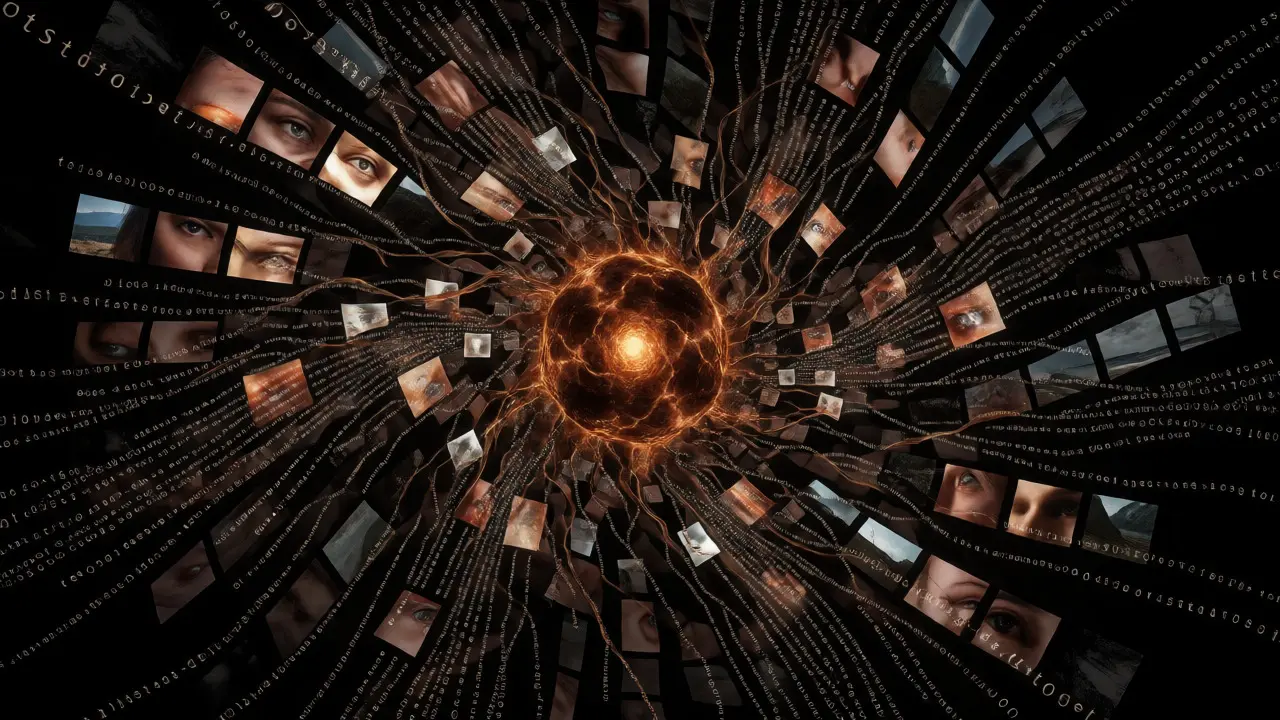
This separation caused friction. Aligning visual regions with specific words is hard when the representations live in different vector spaces. Vision-Language Transformers solve this by converting both modalities into a shared token space. An image isn't just a grid of pixels anymore; it's a sequence of discrete tokens, just like words in a sentence. This simple shift-treating images as sequences-allows the standard Transformer architecture to handle both inputs natively.
How Unified Architecture Works
The magic lies in tokenization. In a traditional pipeline, an image goes through a Convolutional Neural Network (CNN) to extract features. In a Vision-Language Transformer, we use a technique similar to what CLIP does, but extended for generation. We break the image into patches, flatten them, and project them into embeddings that look exactly like word embeddings. Now, a single Transformer can attend to both "[CLS]" tokens from text and "[IMG_1]" tokens from the image simultaneously.
Researchers at Sun Yat-sen University, including Yutong Lu, demonstrated this with a unified framework where image-to-text and text-to-image tasks are treated as sequence generation problems. You feed the model a mixed sequence: some real text tokens, some masked image tokens, and vice versa. The model predicts the missing pieces. It learns that "dog" often appears near "leash" in text, and that those concepts correlate with specific pixel clusters in the image.
There are three main ways these models fuse information:
- Fusion Encoders: Combine image and text embeddings immediately after extraction. Good for classification but less flexible for generation.
- Dual Encoders: Process modalities separately until the final layer. Efficient for retrieval tasks (like searching images with text).
- Hybrid/Cross-Attention: Allows layers to switch between attending to self-modality or cross-modality. This is where the heavy lifting happens for complex reasoning.
Key Examples: VL-T5 and Beyond
You might ask, "Which model actually does this well?" Look at VL-T5. It takes the T5 architecture-a text-to-text transformer-and adapts it for vision. Instead of building a new model for every task, VL-T5 uses text prefixes to tell the model what to do. Prefix with "caption:" and it describes an image. Prefix with "vqa:" and it answers questions about it. All within one set of weights.
This versatility is huge. You don't need five different models deployed on your server. You need one large transformer that understands instructions via text prompts. Recent benchmarks show improvements ranging from 100% to over 120% in image-to-text generation metrics like MS-COCO scores compared to older, fragmented systems. That’s not incremental; that’s a leap.
| Architecture Type | Processing Method | Best Use Case | Complexity |
|---|---|---|---|
| Dual-Stream (e.g., VilBERT) | Separate encoders + Co-attention | Retrieval, Classification | Moderate |
| Unified Sequence (e.g., VL-T5) | Single Transformer on mixed tokens | Generation, VQA, Captioning | High |
| Contrastive (e.g., CLIP) | Independent encoders aligned via loss | Zero-shot Classification, Search | Low |
Practical Applications You Can Build Today
Why should you care about the architecture if you're just shipping a product? Because it unlocks capabilities that felt like science fiction five years ago.
Text-to-Image Generation: Tools like DALL-E 3 or Midjourney rely on this unification. You type "a cyberpunk cat wearing sunglasses," and the model maps those tokens to visual latent spaces. It’s not magic; it’s attention heads linking "sunglasses" to specific texture patterns.
Accessible Media: For visually impaired users, automated image captioning has moved beyond "person holding dog." Modern VLMs describe scenes, emotions, and actions. They can say, "A smiling woman laughing while holding a golden retriever in a park," providing context that raw object detection misses.
Smart Search: Imagine searching your photo library by typing "birthday party with blue balloons." Traditional tags fail here. A Vision-Language Transformer understands the semantic relationship between "blue," "balloons," and the visual cluster in the image, retrieving results even if no human ever tagged the photo that way.

Challenges and Pitfalls
It’s not all smooth sailing. Tokenizing images creates massive sequences. A high-res image can turn into hundreds or thousands of tokens. Multiply that by text length, and you hit memory limits fast. Engineers have to optimize attention mechanisms-using sparse attention or windowed attention-to keep training costs manageable.
Another issue is alignment. Just because a model sees a cat and reads the word "cat" doesn't mean it understands the concept deeply. Hallucinations happen. The model might invent details not present in the image because the textual prior is strong. Fine-tuning on high-quality, paired datasets is critical to mitigate this.
Getting Started with Multimodal Transformers
If you want to experiment, don't start from scratch. The open-source ecosystem on HuggingFace and GitHub provides pre-trained checkpoints. Start with models like BLIP-2 or Flamingo. Use libraries like PyTorch and Transformers to load these models. Remember, the key is fine-tuning on your specific domain data. A general-purpose model knows what a car looks like; a fine-tuned model knows what *your* company's specific car parts look like.
What is the difference between CLIP and Vision-Language Transformers?
CLIP is primarily a contrastive learning model used for aligning images and text in a shared embedding space, ideal for zero-shot classification and search. Vision-Language Transformers (like VL-T5) are generative models that treat images and text as sequences, allowing them to perform complex tasks like image captioning, visual question answering, and text-to-image generation by predicting token sequences.
Do I need separate GPUs for image and text processing?
Not necessarily. Unified Vision-Language Transformers process both modalities on the same hardware. Since both are converted into token sequences, a single GPU handles the entire forward pass. However, due to the increased sequence length (combining image patches and text tokens), you may need more VRAM than a pure text model would require.
Can these models generate images from text?
Yes. By treating image generation as a sequence prediction problem, these models can predict image tokens sequentially. This is the core mechanism behind tools like DALL-E and Stable Diffusion (when combined with diffusion processes). The transformer predicts the next likely visual patch given the previous ones and the text prompt.
What datasets are used to train these models?
Common datasets include LAION-400M and LAION-5B, which contain billions of image-text pairs scraped from the web. Smaller, curated datasets like COCO and Visual Genome are used for fine-tuning specific tasks like captioning and VQA to ensure higher quality and factual accuracy.
Are Vision-Language Transformers computationally expensive?
Yes, they are resource-intensive. Processing images as long token sequences increases computational complexity quadratically with sequence length. Optimizations like Flash Attention, quantization, and efficient tokenizers are essential to make these models viable for production environments.