
Training a modern Large Language Model is like trying to fill an Olympic-sized swimming pool with a garden hose if you stick to traditional methods. The computational cost is staggering, and the time it takes to iterate can stretch into weeks or even months. But there is a way to turn that hose into a fire hydrant without breaking the pipes. That method is mixed-precision training. This technique isn't just a nice-to-have optimization anymore; it is the absolute standard for anyone serious about building or fine-tuning AI models today. By strategically mixing different numerical formats-primarily BF16 (Brain Floating Point) and FP16 (Half Precision)-you can slash training times by up to three times and cut memory usage in half. More importantly, you don't have to sacrifice accuracy. In fact, the slight noise introduced by lower precision often acts as a form of regularization, sometimes improving your model's generalization. If you are looking to speed up your training pipeline, understanding the difference between these formats and how to implement them correctly is critical. Let’s break down why this works, which format you should choose, and how to avoid the common pitfalls that crash training runs.
Why Mixed Precision Works
At its core, mixed-precision training exploits the hardware capabilities of modern GPUs. Specifically, it leverages Tensor Cores, specialized processing units found in NVIDIA GPUs starting from the Volta architecture. These cores are designed to perform matrix multiplications much faster when using lower-precision data types like FP16 or BF16 compared to the traditional FP32 (Single Precision).
Here is the catch: lower precision means less room to store numbers. If you use only low precision, small gradients can vanish (underflow) or large ones can explode (overflow), causing your model to fail to learn. Mixed precision solves this by keeping the best of both worlds:
- Computation: Weights and activations are converted to FP16 or BF16 for the forward and backward passes. This allows the Tensor Cores to work at peak speed.
- Storage & Updates: A master copy of the weights is kept in FP32. Gradients are accumulated in higher precision before being used to update the master weights. This ensures numerical stability.
The result? You get the speed of low-precision arithmetic with the stability of high-precision storage. According to benchmarks from Lightning AI in August 2023, this approach delivers up to 3x faster training speeds while maintaining identical accuracy to full FP32 training.
FP16 vs. BF16: Which One Should You Use?
This is the most common question developers face. Both FP16 and BF16 use 16 bits of memory, but they allocate those bits differently, leading to very different behaviors during training.
| Feature | FP16 (Half Precision) | BF16 (Brain Floating Point) |
|---|---|---|
| Bit Allocation | 5-bit exponent, 10-bit mantissa | 8-bit exponent, 7-bit mantissa |
| Dynamic Range | Limited (~6e-5 to 65504) | Wide (~1e-38 to 1e+38, same as FP32) |
| Hardware Support | NVIDIA Pascal (P100) and newer | NVIDIA Ampere (A100) and newer |
| Stability | Prone to underflow/overflow; requires loss scaling | Highly stable; rarely needs aggressive loss scaling |
| Best For | Older GPUs, inference, specific CV tasks | LLM training, deep networks, wide dynamic range needs |
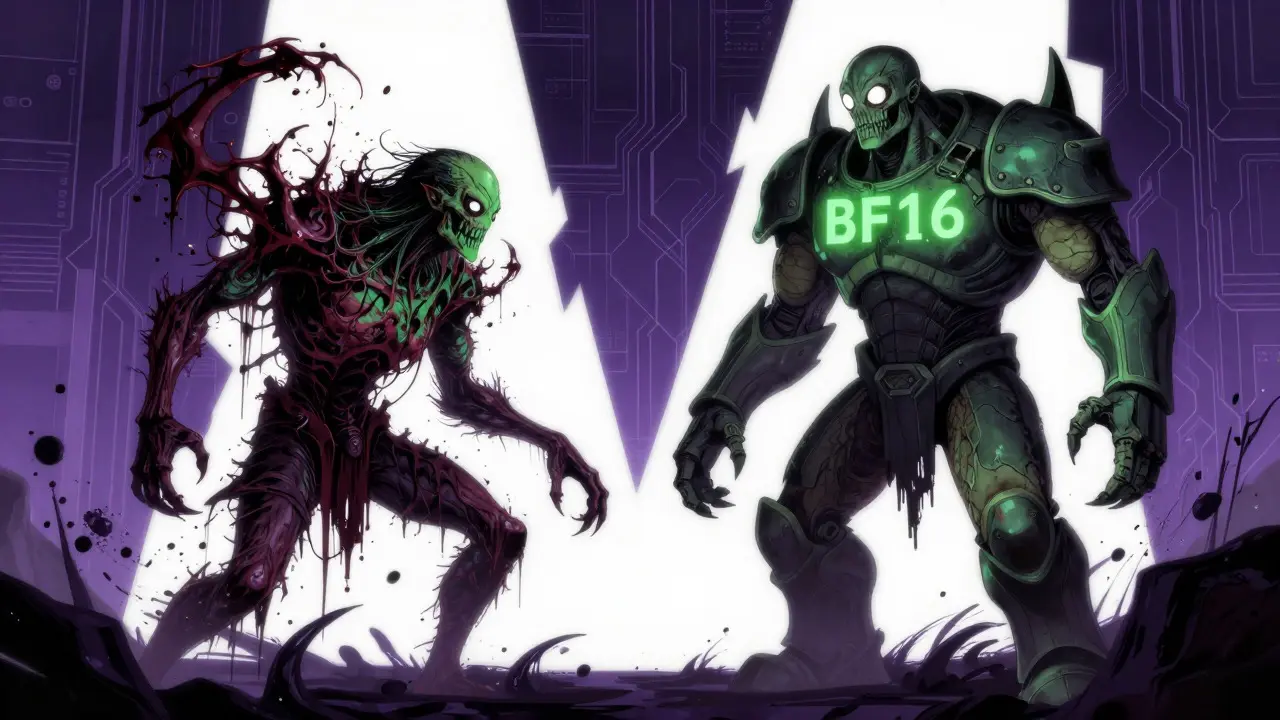
BF16 is generally the winner for Large Language Models. Introduced by Google for their TPU v3 chips in 2018, BF16 keeps the same 8-bit exponent as FP32. This means it can handle extremely small or large numbers without overflowing or underflowing, which is crucial for the complex gradient landscapes of transformers. Meta’s implementation of Llama 3 relied heavily on BF16 for this reason. It offers the memory savings of FP16 with the numerical stability of FP32.
FP16, on the other hand, has a narrower dynamic range. While it can be faster on some hardware, it often requires careful tuning of loss scaling to prevent gradients from vanishing. If you are using older hardware like the P100 or V100, FP16 might be your only option for mixed precision, but for any modern setup (A100, H100, or newer), BF16 is the safer, more robust choice.
Implementing Mixed Precision in PyTorch
You don’t need to manually convert every tensor. Modern frameworks have built-in tools to handle this seamlessly. In PyTorch, this is done via Automatic Mixed Precision (AMP). Here is how you integrate it into your training loop:
- Initialize GradScaler: This object handles the loss scaling automatically, adjusting the scale factor dynamically to prevent overflow while maximizing precision.
- Wrap Forward Pass with autocast: Use
torch.cuda.amp.autocast()around your model’s forward pass. This tells PyTorch to cast operations to lower precision where safe (like matrix multiplications) and keep others in high precision (like softmax). - Scale Loss and Backpropagate: Before calling
loss.backward(), scale the loss value using the scaler. This amplifies small gradients so they don’t underflow in FP16/BF16. - Step Optimizer with Scaler: Instead of
optimizer.step(), usescaler.step(optimizer). The scaler will unscale the gradients and check for overflows before updating the weights.
For users of PyTorch Lightning, this is even simpler. You can often enable it with a single flag in your trainer configuration: precision="bf16-mixed" or precision="16-mixed". The framework handles the scaler and autocasting behind the scenes.
Beyond BF16: The Rise of FP8
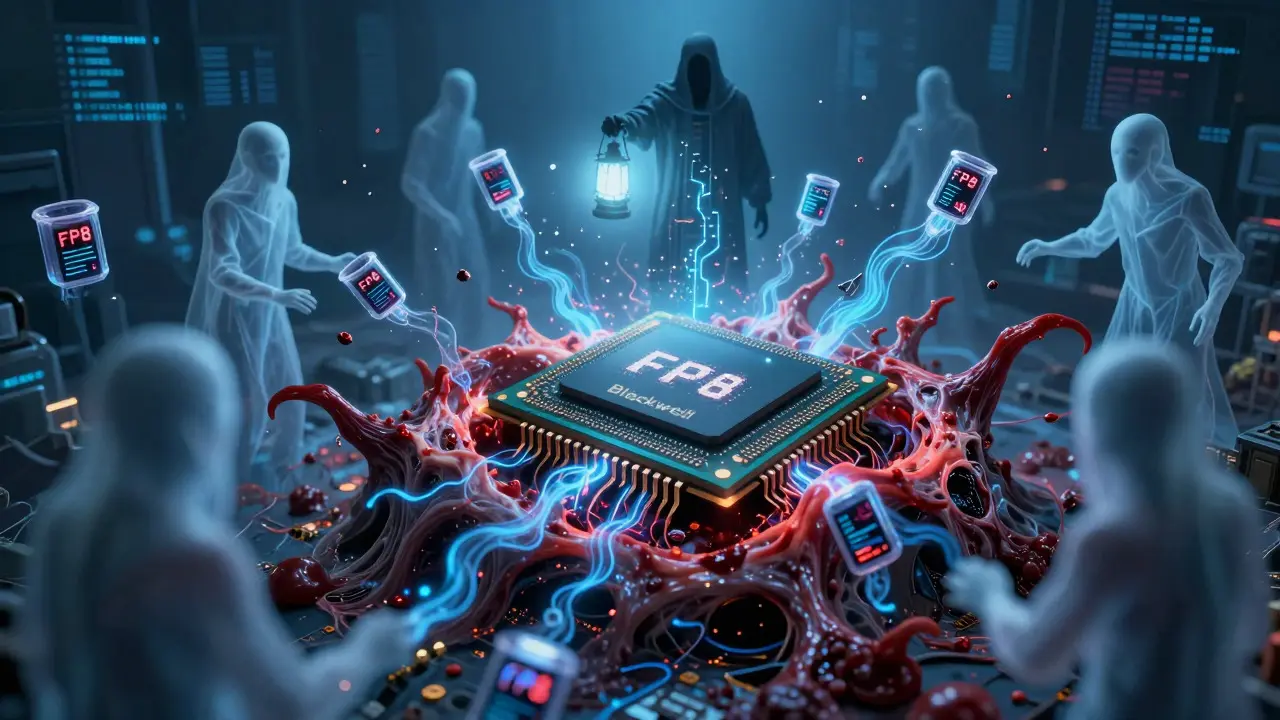
If BF16 is the current standard, what comes next? The industry is moving toward FP8 (8-bit floating point). Announced prominently with Meta’s Llama 4 in September 2024, FP8 promises another significant leap in performance.
FP8 reduces memory footprint by another half compared to BF16. This means you can fit larger batch sizes or bigger models into the same GPU memory. Benchmarks suggest FP8 can deliver a 1.5x speed improvement over BF16 on compatible hardware like the NVIDIA H100 and Blackwell architectures. However, FP8 is not a drop-in replacement yet. It requires sophisticated quantization techniques because 8 bits offer very little room for error. You need to carefully manage outlier channels and ensure that the precision loss doesn’t accumulate across layers.
While BF16 is plug-and-play for most users, FP8 currently demands more expertise. It is best suited for teams with dedicated ML engineers who can tune quantization parameters and validate model quality rigorously. As hardware support expands and libraries mature, expect FP8 to become more accessible, but for now, BF16 remains the sweet spot for stability and ease of use.
Common Pitfalls and How to Avoid Them
Even with automatic tools, mixed precision can trip you up. Here are the most common issues reported by developers:
- NaN Losses: If your loss becomes
NaN(Not a Number), it usually means gradients overflowed. Check your learning rate. Lower precision can make models more sensitive to high learning rates. Try reducing it by 10-50%. - Gradient Underflow: If gradients vanish, your loss scaler might not be aggressive enough. In PyTorch, the default initial scale is usually sufficient, but you can increase it manually if needed. Ensure you are using dynamic loss scaling rather than a static factor.
- Hardware Compatibility: Not all GPUs support BF16. If you try to run BF16 on a pre-Ampere card (like a V100), it will either fall back to software emulation (slow) or crash. Always check your GPU architecture. For FP16, Volta and newer are required for Tensor Core benefits.
- Custom Loss Functions: Some custom operations might not be supported inside
autocast. If you encounter errors, wrap unsupported operations in atorch.cuda.amp.custom_fwddecorator or move them outside the autocast context.
A practical tip from the community: always start with BF16 if your hardware supports it. It is far less likely to cause instability than FP16. If you must use FP16, monitor your loss scaling factor closely during the first few epochs.
Is It Worth the Effort?
Absolutely. The economic argument alone makes mixed precision essential. Lambda Labs’ October 2024 cost analysis showed that switching to mixed precision reduced the cost of training a 7B parameter model by 38%, dropping from $1.2 million to $480,000. That’s not just saving money; it’s enabling experiments that would otherwise be financially impossible.
Moreover, the speedup allows for faster iteration cycles. What used to take two weeks of training might now take five days. This agility is crucial in a field where new architectures and datasets emerge weekly. With 92% of models exceeding 10 billion parameters now utilizing mixed precision, according to Hugging Face statistics, it has become the de facto standard.
As we look ahead, the trend is clear: precision will continue to drop. FP8 is here, and FP4 is on the horizon with NVIDIA’s Blackwell architecture. But the principles remain the same. By mastering mixed precision today, you position yourself to leverage these future advancements effortlessly. Start with BF16, use automatic tools, and focus your energy on model architecture and data quality rather than fighting numerical instability.
What is the main difference between FP16 and BF16?
The main difference lies in their bit allocation. FP16 uses a 5-bit exponent and 10-bit mantissa, giving it a narrow dynamic range prone to overflow/underflow. BF16 uses an 8-bit exponent and 7-bit mantissa, matching the dynamic range of FP32. This makes BF16 much more stable for training deep neural networks like LLMs, though it requires newer hardware (NVIDIA Ampere/A100 or later).
Do I need special hardware for mixed-precision training?
Yes, to see significant performance gains. You need GPUs with Tensor Cores, which started with NVIDIA’s Volta architecture (V100). For BF16 specifically, you need Ampere architecture (A100) or newer. Older GPUs may support FP16 but lack the hardware acceleration to make mixed precision significantly faster than FP32.
How does loss scaling help in mixed-precision training?
Loss scaling multiplies the loss value by a large factor before computing gradients. This prevents small gradients from becoming zero (underflow) when represented in low-precision formats like FP16 or BF16. After the backward pass, the gradients are unscaled before updating the weights. Dynamic loss scaling adjusts this factor automatically to maintain stability.
Can I use mixed precision with TensorFlow?
Yes, TensorFlow supports mixed precision through its `tf.keras.mixed_precision` module. Similar to PyTorch, you can set the global policy to 'mixed_float16' or 'mixed_bfloat16'. TensorFlow will automatically cast layers to lower precision for computation while keeping master weights in FP32.
Is FP8 ready for production use?
FP8 is emerging but not yet plug-and-play for everyone. It requires hardware support (like NVIDIA H100) and careful quantization tuning to avoid accuracy drops. While companies like Meta are using it in models like Llama 4, most practitioners still prefer BF16 for its balance of stability, speed, and ease of implementation unless they have specialized engineering resources.


Joanna Mucha
August 14, 2026 AT 08:00Oh, look at you, trying to democratize the arcane art of tensor core optimization with your little bullet points. It’s almost adorable how you reduce the profound existential crisis of numerical stability to a simple checklist item. We are not merely filling pools; we are sculpting the very fabric of digital consciousness, and yet here you are, talking about garden hoses. The pretension of calling BF16 a 'winner' is laughable when one considers that true mastery lies in understanding why FP32 still haunts our dreams like a ghost of precision past. You speak of speed as if it were virtue, but have you considered the soul-crushing emptiness of a model that trains fast only to hallucinate with the confidence of a politician? I find your reliance on PyTorch Lightning’s flags to be a crutch for the intellectually lazy. Real engineers wrestle with the gradients bare-handed, feeling the underflow burn their fingers, rather than hiding behind a configuration flag. This article reads like a manual written by someone who has never truly suffered through a NaN loss at 3 AM. It lacks the poetic tragedy of failed convergence.
Kim Edwards
August 16, 2026 AT 03:08I literally screamed when I read that part about saving $720,000!! Can you believe it?? My heart is pounding just thinking about all the money I wasted on full precision training back in the day!! It’s absolutely tragic how many people are still out there using FP32 like it’s 2015!! Why would anyone do that?? It’s like driving a Ferrari in first gear!! I need everyone to start using BF16 immediately or else they are basically throwing money into a black hole!! The drama of waiting weeks for a model to train is too much for my fragile psyche!!
Bonnie Watt
August 17, 2026 AT 23:29Everyone is so obsessed with these new formats it’s exhausting. You don’t actually need BF16 unless you’re trying to impress your peers with your hardware specs. Most of you probably don’t even understand what an exponent does, you just copy-paste code from Stack Overflow. It’s pathetic really. Just stick to FP32 if you want something that doesn’t break every time you sneeze. The industry pushes this 'mixed precision' narrative because they want to sell more GPUs, not because it’s actually better for your sanity. Stop pretending you’re experts when you’re just following a tutorial.
Meagan Mueller
August 18, 2026 AT 08:38they tell us bf16 is stable but who controls the hardware nvidia owns the chips and the standards so maybe the instability is planned to keep us dependent on their latest upgrades fp8 sounds like another trap to make us buy blackwell cards before they release fp4 and charge us again stay woke devs dont let them scale your losses without scaling your skepticism
Dave Gibbeson
August 20, 2026 AT 03:24Listen up! If you aren't using AMP in your pipeline right now, you are leaving performance on the table. Get your hands dirty with GradScaler and stop complaining about memory limits. The tools are there, the documentation is clear, and the results are undeniable. Stop making excuses and start optimizing. Your competitors aren't sleeping, so why are you? Implement autocast today and watch your throughput soar. Discipline equals freedom in ML engineering.
Sabrina Newland
August 22, 2026 AT 00:55i think its really interesting how the bits represent different things 🤔 like why did google choose 8 bits for exponent in bf16 instead of 5 like fp16? it feels like a philosophical choice about what matters more range or precision 😅 also i noticed some typos in my own comment sorry abt that lol but seriously the idea that noise can help generalization is kinda beautiful isn't it? like chaos creating order 🌪️✨
Mark Harvey
August 22, 2026 AT 08:18you got this man just take it one step at a time start with bf16 if you can and dont worry about fp8 yet its gonna be fine honestly most people overthink the setup just trust the process and the framework will handle the heavy lifting for you no need to stress about every single gradient update
Art HND
August 23, 2026 AT 22:45BF16 is not a silver bullet. It is a band-aid on a broken architecture. You still have the same fundamental issues with attention mechanisms. Just use FP32 and move on.