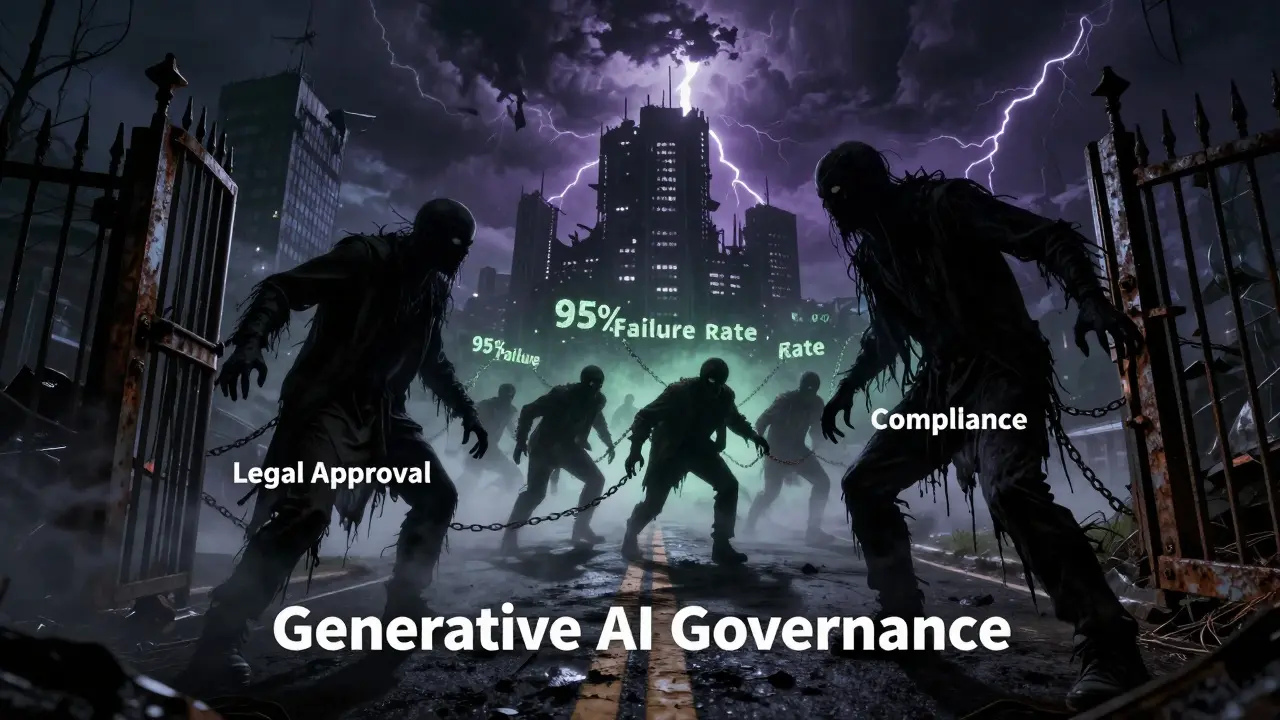
Most companies think of Generative AI governance as a speed bump. It’s the boring compliance stuff that slows down your engineers while they wait for legal approval. But here is the hard truth: if you treat governance like an obstacle, you will likely fail. According to MIT's State of AI in Business 2025 report, about 95% of generative AI pilots fail not because the technology was bad, but because the governance infrastructure was missing or weak.
The real game-changer is flipping the script. Instead of seeing governance as a cost center, view it as a return on investment (ROI) driver. When done right, it slashes security incidents, cuts audit preparation time from weeks to minutes, and actually speeds up deployment. This article breaks down how to measure that ROI, what tools you need, and why your next board meeting should be about governance efficiency, not just model accuracy.
Redefining Governance as Value Creation
For years, we’ve treated risk management as a shield-something you put up to stop things from going wrong. In the world of Generative AI, AI systems capable of creating text, code, images, and other content, this mindset is too slow. The pace of innovation demands that governance becomes part of the engine, not just the brakes.
Consider the data from Deloitte’s 2025 survey of nearly 1,900 executives. Companies are pouring money into AI, yet 80-95% report seeing zero or negligible returns. Why? Because without guardrails, projects stall, get rejected by legal, or worse, launch with hidden risks that cause costly rework later. Governance ROI, The measurable financial and operational benefits derived from implementing structured AI controls and policies changes this equation. It turns compliance into a competitive advantage by enabling faster, safer scaling.
When you implement strong governance, you aren’t just avoiding fines. You are building trust. Trust allows engineering teams to move faster because they know the safety nets are already in place. Research from Berkeley’s Center for Human-Compatible AI (CHAI) and related market studies shows that companies with robust AI governance frameworks see up to 27% higher revenue performance compared to those without. That is not a rounding error; that is the difference between leading the market and falling behind.
The Three Pillars of Technical Governance Architecture
You cannot achieve governance ROI with spreadsheets and monthly meetings. You need a technical architecture that automates control. There are three core components you must integrate:
- Policy-as-Code Automation: This translates human-readable rules into machine-enforceable code. Instead of hoping developers remember to check for PII (Personally Identifiable Information), the system automatically blocks outputs that violate your privacy policy. It removes subjective decision-making from high-risk deployments.
- Real-Time Monitoring and Guardrails: These systems track model behavior, data access patterns, and usage activities live. They flag deviations before they become public incidents. For example, if a customer service chatbot starts hallucinating medical advice, the guardrail intercepts it immediately.
- Evidence Automation: This is the secret weapon for audit readiness. Rather than scrambling to document decisions after the fact, evidence automation captures logs, approvals, and control validations continuously. It shifts audit readiness from a quarterly panic to a persistent state of being "always-on."
Tools like OneTrust, A platform specializing in automated governance, risk, and compliance solutions and Domino.ai, A data science platform offering integrated MLOps and governance capabilities provide these capabilities. They ensure that governance is embedded in the CI/CD pipeline, meaning every model version is tested against your standards before it ever reaches production.
Measuring Incident Reduction: The Financial Impact
How do you quantify the value of preventing a disaster? You look at the cost of failure. A single data breach involving generative AI can result in massive fines, reputational damage, and loss of customer trust. The total cost of a breach often exceeds the entire annual budget for AI governance.
Incident reduction ROI comes from two main sources:
- Early Risk Identification: Automated systems flag high-risk use cases early. If a team tries to use a large language model to process sensitive patient data without proper anonymization, the system stops it. This prevents the need for expensive remediation efforts later.
- Reduced Rework: Without governance, models often fail in production due to bias, hallucination, or security flaws. Fixing these issues post-launch is incredibly costly. Governance catches these errors during development, saving significant engineering hours.
FullStack Labs highlights that continuous monitoring and regular data cleaning directly contribute to improved AI model ROI. By keeping the data pipeline clean and the models monitored, you reduce the noise and errors that lead to incidents. This isn’t just about security; it’s about operational efficiency. Every hour saved on fixing a broken model is an hour spent innovating.

Audit Readiness: From Crisis Mode to Continuous Compliance
If you have ever prepared for a regulatory audit, you know the pain. Teams spend days digging through emails, Slack messages, and server logs to prove that controls were in place. With generative AI, regulators are getting stricter. The EU AI Act and emerging US regulations require detailed documentation of model training data, decision logic, and safety measures.
Audit Readiness, The state of being prepared to demonstrate compliance with regulatory requirements at any time transforms this process. Here is how:
| Feature | Traditional Approach | Automated Governance |
|---|---|---|
| Documentation Collection | Manual, ad-hoc, reactive | Automatic, continuous, real-time |
| Time to Prepare | Weeks or months | Minutes (on-demand) |
| Error Rate | High (human error) | Near-zero (system-generated) |
| Cost | High (labor-intensive) | Low (automated overhead) |
When governance is embedded in operations, you don’t "prepare" for audits. You are always ready. Evidence automation captures every log and approval instantly. If a regulator asks for proof that your model complies with fairness standards, you can generate that report in seconds. This capability alone can save tens of thousands of dollars in consulting fees and internal labor costs per year.
Overcoming Implementation Barriers
Knowing the benefits is one thing; doing it is another. Only 47% of organizations have adopted formal risk management frameworks for AI, according to RiskandInsurance. Why the gap? Several barriers stand in the way:
- Siloed Responsibilities: Often, IT handles security, Legal handles compliance, and Data Science handles models. This fragmentation leads to confusion and delays. Successful governance requires shared ownership.
- Lack of Executive Sponsorship: Without buy-in from the C-suite, governance initiatives lack funding and authority. Leaders must understand that governance enables growth, not restricts it.
- Complexity of Generative AI: Unlike traditional machine learning, which produces fixed predictions, generative AI creates open-ended content. This makes behavior harder to evaluate and requires new testing methods like red-teaming and hallucination checks.
To overcome these, start small. Spyrosoft’s case studies show that risk-stratifying use cases is crucial. Not all AI applications carry the same risk. Using AI to brainstorm project names requires minimal oversight. Using AI to generate code for medical devices requires strict, multi-layered controls. Tailor your governance intensity to the risk level. This proportional approach ensures you don’t bog down low-risk projects with unnecessary bureaucracy.

Best Practices for Maximizing Governance ROI
If you want to see real returns, follow these proven strategies:
- Integrate Early: Don’t add governance at the end. Embed it in your development pipeline from day one. Use tools that support policy-as-code so that compliance is checked automatically with every commit.
- Standardize Workflows: Create clear roles and responsibilities. Define who approves what. Standardized workflows reduce friction and make it easier to track accountability.
- Invest in Education: Your teams need to understand why governance matters. Train engineers on security basics and train legal teams on AI capabilities. Shared understanding builds collaboration rather than conflict.
- Iterate and Refine: Governance is not a one-time setup. Run controlled pilots to test your safeguards. Learn what works and adjust. As Domino.ai notes, mature teams treat governance as a collaborative function supported by reusable templates.
Remember, the goal is not perfection; it is progress. Start with the highest-risk areas and expand outward. Measure your metrics-incident rates, audit preparation time, approval cycle speed-and use that data to justify further investment.
Future Trajectory: Governance as Mandatory Infrastructure
As regulatory frameworks tighten globally, governance will cease to be optional. It will become as fundamental as having a firewall. Organizations that build their governance infrastructure now will have a significant head start. They will be able to adapt to new regulations quickly, whereas laggards will face expensive retrofits and potential shutdowns.
The future of AI operations (LLMOps) involves deeper integration of governance into every layer of the stack. We will see more automation, better detection of subtle biases, and seamless reporting. The companies that thrive will be those that view governance not as a constraint, but as the foundation of trustworthy, scalable AI.
What is the average ROI of implementing AI governance?
While specific numbers vary by industry, research indicates that companies with strong AI governance frameworks can see up to 27% higher revenue performance. Additionally, governance reduces total cost of ownership by minimizing breach costs, reducing rework, and cutting audit preparation time from weeks to minutes.
Why do most generative AI pilots fail?
According to MIT's State of AI in Business 2025 report, approximately 95% of generative AI pilots fail due to inadequate governance infrastructure, not technological limitations. Lack of clear policies, risk management, and integration with existing workflows causes projects to stall or produce unsafe results.
How does policy-as-code improve audit readiness?
Policy-as-code automates the enforcement of governance rules and continuously captures evidence of compliance. This means logs, approvals, and control validations are recorded in real-time. During an audit, you can instantly generate reports proving compliance, eliminating the need for manual, error-prone documentation collection.
What are the key components of a governance ROI framework?
The three key components are: 1) Policy-as-code automation for enforceable rules, 2) Real-time monitoring and guardrails to detect anomalies, and 3) Evidence automation for continuous audit readiness. Together, they reduce incidents, speed up approvals, and ensure regulatory compliance.
Is AI governance only for large enterprises?
No. While large enterprises face stricter regulations, smaller organizations also benefit from reduced risk and faster deployment. Proportional governance allows startups to apply lighter controls to low-risk uses and stricter ones to high-risk areas, ensuring safety without stifling innovation.



Lisa Puster
June 6, 2026 AT 00:54typical corporate fluff designed to sell more expensive compliance software. nobody cares about your 'roi' when the tech is fundamentally broken and hallucinating nonsense half the time. you are just trying to monetize fear while engineers do the actual work
Stephanie Frank
June 7, 2026 AT 02:36you sound like a buzzword generator that got stuck on loop. stop pretending that slapping a 'governance' label on your bureaucracy makes it innovative. it is just another way for middle management to hide their incompetence behind fancy acronyms. get a real job instead of writing clickbait for people who already know better
Marissa Haque
June 7, 2026 AT 05:46I have to say, this perspective is absolutely revolutionary!! I mean, really, who would have thought that following rules could actually save money?? It is so refreshing to see someone articulate the obvious with such clarity!!! The part about evidence automation is just mind-blowing!!! I am literally shaking with excitement about how this changes everything for our team!!! We need to implement this immediately because the potential benefits are just too huge to ignore!!! Thank you for sharing this invaluable insight!!!
Keith Barker
June 8, 2026 AT 23:14the concept of governance as value creation is merely a linguistic trick to make chains look like jewelry. we are still building cages for the digital mind but calling them safety nets. the illusion of control persists even as the system grows more opaque. perhaps we should question if the cage is necessary at all or if we are just afraid of what escapes.
Michael Richards
June 10, 2026 AT 21:43listen up because most of you are failing to grasp the fundamental shift here. if you are not automating your policy enforcement you are already obsolete. the market does not care about your excuses or your manual processes. winners automate compliance and losers drown in paperwork. stop making excuses and start integrating these tools into your pipeline right now or get left behind by companies that actually understand efficiency.
Andrea Alonzo
June 12, 2026 AT 11:15I completely understand why some people might feel resistant to these new frameworks because change can be incredibly daunting and often feels like an imposition on creative freedom, yet I believe that by approaching this transition with a mindset of collaboration and mutual respect we can create an environment where everyone feels supported in their journey toward safer AI deployment, which ultimately leads to a more sustainable and trustworthy technological landscape for all of us involved in this exciting field.
michael rome
June 12, 2026 AT 13:09It is important to recognize the human element in all of this. While the technical aspects are crucial, we must ensure that our teams feel supported rather than policed. Creating a culture of trust allows innovation to flourish within safe boundaries. We should focus on enabling our colleagues to succeed by providing clear guidelines and robust tools that simplify their workflow rather than adding friction. This approach fosters a positive environment where governance is seen as a helpful partner rather than an obstacle.
Robert Barakat
June 14, 2026 AT 07:39we build structures to contain chaos yet the chaos is inherent to the generative process itself. the attempt to codify ethics is a paradox since ethics are fluid and context dependent while code is rigid and absolute. we are trying to map the infinite onto the finite grid of logic gates. it is a noble failure perhaps but a failure nonetheless.