
Most companies start their Large Language Model is a type of artificial intelligence that processes and generates human-like text based on vast amounts of training data. Also known as LLM, it has become the cornerstone of modern enterprise automation, enabling tasks from customer support to complex document analysis. (LLM) journey with excitement. They build a flashy prototype in weeks. Then reality hits. The model hallucinates sensitive client data. The API costs skyrocket when traffic spikes. The legal team blocks deployment because no one defined who owns the output. This is the "pilot purgatory" trap. Moving from a cool demo to a reliable, secure, and cost-effective production system requires more than just code; it demands a rigorous enterprise strategy.
As of mid-2026, the landscape has shifted. It’s no longer about whether you should use AI, but how you govern it at scale. Gartner reports that 68% of Fortune 500 companies are running pilots, yet fewer than 15% have successfully scaled to full production without significant rework. The gap isn’t technology-it’s strategy. This guide breaks down exactly how to bridge that gap, moving from experimental chaos to operational excellence.
The Readiness Audit: Before You Write Code
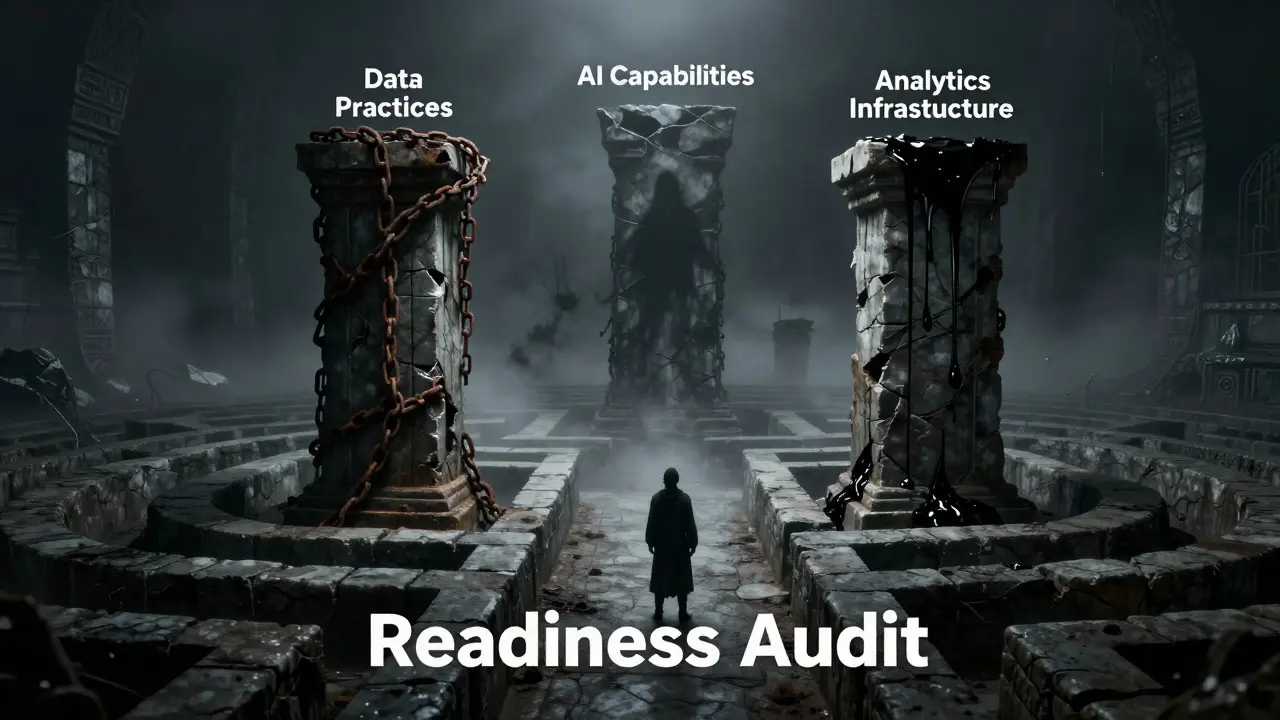
Before selecting a model or writing a single line of Python, you need to assess your organization's true readiness. EY’s 2023 analysis highlights three critical pillars: AI capabilities, data practices, and analytics infrastructure. If any of these are weak, your pilot will fail in production.
- Data Practices: Do you have clean, curated, and accessible data? LLMs are only as good as the context they receive. Organizations often spend 60-70% of their implementation time-averaging 97 hours per use case-just on data curation and bias mitigation. If your data is siloed in legacy systems with poor metadata, pause. Fix the data first.
- AI Capabilities: Do you have a mature data science team, or are you starting from scratch? Teams with existing ML operations can deploy in 3-6 months. Those building capabilities from scratch face a 9-12 month timeline. Be honest about this gap.
- Analytics Infrastructure: Can you monitor performance in real-time? You need pipelines that can process hundreds to thousands of documents daily and track metrics like latency and error rates. Without this, you’re flying blind.
A common mistake is assuming that general-purpose models work out of the box for niche industries. For healthcare or finance, you need domain-specific data comprising at least 30% of your training corpus to ensure relevance and accuracy.
Selecting Your Use Case: Start Small, Think Big
Not every problem needs an LLM. In fact, many don’t. EY warns that deploying LLMs without specific use cases leads to costly failures. Focus on high-impact, low-risk areas where the value proposition is clear.
| Use Case | Expected Outcome | Risk Level | Implementation Complexity |
|---|---|---|---|
| Customer Support Automation | Handle 40-60% of Tier 1 inquiries | Low | Medium |
| Content Creation & Drafting | Reduce draft time by 35-50% | Low | Low |
| Document Analysis & Summarization | Process 10x more documents than humans | Medium | High |
| Complex Investment Queries | 30-45% improvement in service efficiency | High | Very High |
Start with content creation or basic customer support. These areas allow you to test integration, measure user satisfaction, and refine prompts without risking regulatory violations. Avoid starting with high-stakes decisions like medical diagnosis or legal contract finalization until your governance framework is rock-solid.
Architecture Decisions: Cloud, On-Premises, or Hybrid?
Your deployment strategy dictates your security posture, cost structure, and performance. There is no one-size-fits-all answer. Compute HiveNet outlines four primary strategies, each with distinct trade-offs.
Cloud-Based Deployment offers the fastest path to market, typically taking 2-4 weeks. It handles scalability effortlessly, managing 1,000+ concurrent requests with latency under 500ms. However, data privacy concerns remain. For regulated industries like healthcare and finance, sending proprietary data to third-party APIs is often a non-starter.
On-Premises Deployment provides total data sovereignty. You control the hardware and the network. But it comes with a heavy price tag. Initial setup costs range from $250,000 to $2 million, requiring powerful infrastructure like NVIDIA A100 GPUs with minimum 80GB VRAM. This is ideal for organizations with strict compliance requirements but limited tolerance for cloud egress risks.
Edge Deployment is for ultra-low latency applications needing response times under 100ms. This requires aggressive model compression, reducing parameter counts by 60-80%. While efficient, this often sacrifices 5-15% accuracy. It’s best suited for localized, simple tasks rather than complex reasoning.
Hybrid Architectures are becoming the standard for large enterprises. They combine cloud scalability for non-sensitive tasks with on-premises processing for confidential data. This balance allows you to optimize cost while maintaining security.
Governance and Security: The Guardrails of Production
In a pilot, errors are learning opportunities. In production, they are liabilities. Governance isn’t a checkbox; it’s an ongoing discipline. Capella Solutions notes that 73% of organizations in regulated sectors prioritize on-premises or hybrid solutions specifically to maintain compliance control.
You must implement robust monitoring systems tracking 15+ key metrics. These include latency percentiles, error rates, token utilization, and cost per request. More importantly, you need circuit breakers. If a model’s confidence score falls below 0.85, the system should automatically route the query to a fallback mechanism or a human reviewer. This prevents hallucinations from reaching end-users.
Establish a dedicated AI governance team. They should review model performance bi-weekly and conduct comprehensive risk assessments quarterly. Define clear ownership: Who approves new prompts? Who audits output for bias? Who manages API keys? Without these answers, your strategy is incomplete.
Cost Optimization: Keeping the Lights On
LLM inference is expensive. Premium enterprise APIs can cost $20+ per thousand tokens, while open-source models might run for $0.50. Left unchecked, costs can spiral out of control during peak usage.
Implement dynamic batching to increase GPU utilization by 30-40%. This technique groups multiple requests together, maximizing hardware efficiency. Use model quantization techniques like INT8 or INT4 to reduce computational requirements by up to 75% while maintaining 95% of original accuracy. For cloud deployments, leverage spot or reserved instances to cut computing costs by 25-50% compared to on-demand pricing.
Monitor cost per thousand tokens religiously. Set alerts for unusual spikes. Often, a poorly optimized prompt or a recursive loop in the application logic can burn through credits in hours. Treat AI budget management with the same rigor as financial accounting.

The Phased Rollout Plan
Don’t boil the ocean. Capella Solutions recommends a phased approach with specific timeframes to manage risk and gather feedback.
- Pilot Phase (4-8 Weeks): Deploy in a controlled environment with a small group of power users. Focus on technical validation and initial user feedback.
- Limited Deployment (8-12 Weeks): Expand to a wider but constrained user base. Integrate with core business tools and begin measuring ROI against baseline metrics.
- Gradual Expansion (3-6 Months): Roll out across additional departments. Refine governance policies based on real-world incidents and edge cases.
- Full Deployment (6-12 Months): Organization-wide adoption. Continuous optimization and scaling. Establish automated MLOps pipelines to reduce future deployment times from months to days.
This structured progression ensures that you validate value before committing massive resources. It also gives your teams time to adapt to new workflows, reducing resistance and increasing adoption rates.
FAQ
How long does it take to move an LLM from pilot to production?
The timeline varies significantly based on your organization's AI maturity. Companies with established data science teams and clean data infrastructure can achieve production readiness in 3-6 months. Organizations building capabilities from scratch should expect a 9-12 month journey. This includes time for data curation, model fine-tuning, governance setup, and phased rollout.
What are the biggest risks of deploying LLMs in production?
The primary risks include data leakage, hallucinations leading to incorrect business decisions, and uncontrolled costs. Data leakage occurs when sensitive information is inadvertently sent to public APIs. Hallucinations can damage brand reputation if not caught by human reviewers. Cost overruns happen when monitoring is lacking, allowing inefficient queries to consume excessive compute resources.
Should we build custom models or use pre-trained ones?
For most enterprises, starting with pre-trained models like OpenAI’s GPT-4, Anthropic’s Claude 3, or Meta’s Llama 3 is the smarter choice. Building custom models requires $2-5 million in initial investment and 12-18 months of development. Pre-trained models offer immediate value and can be fine-tuned with your specific data to achieve 90-95% of the performance of a fully custom model at a fraction of the cost.
How do we ensure data privacy with cloud-based LLMs?
If using cloud APIs, ensure the provider offers enterprise-grade security certifications and guarantees that your data won't be used for training other models. For highly sensitive data, consider hybrid architectures where sensitive processing happens on-premises, or use private cloud instances. Implement strict access controls and audit logs to track all data interactions.
What metrics should we track in production?
Track technical metrics like latency (target under 500ms), throughput (tokens per second), and error rates. Monitor business metrics such as user satisfaction scores, task completion rates, and cost per request. Additionally, track quality metrics like hallucination frequency and confidence scores to trigger human intervention when necessary.



Chandan Singh
July 29, 2026 AT 17:38People always forget that the data curation part is where you actually spend your time. You can have the fanciest GPU cluster in the world but if your metadata is garbage the model will just hallucinate faster. We spent three months just cleaning our legacy SQL dumps before we even touched a transformer. It was painful but necessary.
Onyinyechi Nwosu
July 30, 2026 AT 15:10reading this makes me feel like my company is doing it wrong which is probably true lol. we just threw a chatbot at customer support and now they are apologizing for everything. good to know there is a structured way to do this
Brannen Hall
July 30, 2026 AT 18:26Most of this is just standard IT hygiene repackaged as AI strategy. You don't need an LLM to tell you that clean data matters or that you should monitor costs. The hype cycle has inflated simple database management into a 'strategic pillar' because people want to justify their budgets. Also on-prem is dead for most startups unless you are handling nuclear codes.
Brenna Gonedrman
July 30, 2026 AT 18:55OMG yes! I told my boss last week that we need better monitoring and he looked at me like I spoke alien. Like hello? If you don't track latency you are flying blind! It is so dramatic how many companies ignore the basics. We need to wake up and smell the coffee before we burn all our money on tokens!
Iva Grekova
July 31, 2026 AT 04:20I appreciate the breakdown here especially the part about starting small. It is easy to get carried away with what the tech can do but keeping boundaries clear helps everyone stay grounded. Thanks for sharing this perspective it feels very balanced and realistic rather than just hyping up the latest trend.
Courtney Wagstaff
August 1, 2026 AT 15:10The hybrid architecture bit really resonates with me. It is like having a cozy home base for your sensitive stuff while letting the wild party happen in the cloud for the public facing bits. Finding that sweet spot between security and speed is an art form honestly. Love the colorful analogy potential here!
tiffany King
August 1, 2026 AT 20:55This gives me so much hope for our team's upcoming project! Seeing a clear roadmap from pilot to production makes the whole process feel manageable instead of overwhelming. I am excited to see how we can implement these phased steps and maybe even help others avoid the pitfalls mentioned here. Great read!